
Border history
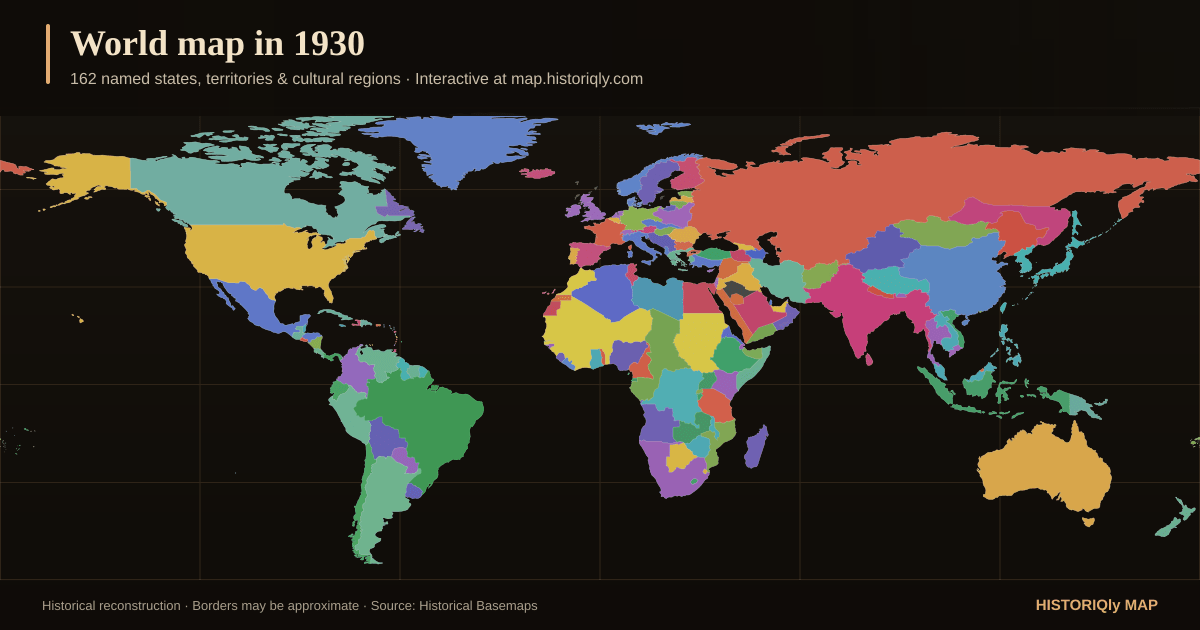
The interactive map lets you inspect named territories in 1930 and compare them to earlier or later snapshots on the timeline.
Modern historical map
Explore a reconstruction of the world around 1930. Compare borders during industrialisation, imperial competition, and the crises that defined the nineteenth and early twentieth centuries. Figures near this year include Abraham Joshua Heschel, Carl Jung, Emmanuel Levinas.
Snapshot at a glance
Counts come directly from this snapshot and the historical layers available in HistorIQly Map.
These names are encoded in the boundary dataset. Inclusion does not settle disputed borders, sovereignty, spelling, or historical interpretation.
What this snapshot shows
The interactive map lets you inspect named territories in 1930 and compare them to earlier or later snapshots on the timeline.
Meet figures alive in, or close to, 1930 and move from political geography to the people connected to the period.
The related chronicles below provide long-form reading tied closely to the modern period.
Conflicts connected to 1930
These editorial date ranges include 1930. Some records group intermittent campaigns or long-running conflict series, so inclusion does not mean continuous fighting in that exact year.
1930
Kuomintang (Chiang Kai-shek) vs Anti-Chiang Warlord Coalition (Yan Xishan, Feng Yuxiang)
The largest conflict of China's Warlord Era, involving nearly one million soldiers. Chiang Kai-shek's Nationalist government fought a massive coalition of warlords. The war caused 250,000 casualties and nearly bankrupted the Nationalist government.
Key battles and events: Battle along the Longhai Railway (1930); Zhang Xueliang's intervention (1930)
1927 – 1949
Nationalists (Kuomintang) vs Communists (CPC)
A decades-long struggle between Chiang Kai-shek's Nationalists and Mao Zedong's Communists — interrupted by WWII, then resumed until the Communists won in 1949, founding the People's Republic of China.
Key battles and events: Shanghai Massacre (1927); Long March (1934–1935)
1927 – 1933
Sandinista rebels (Augusto César Sandino) vs United States Marines, Nicaraguan National Guard
Guerrilla war waged by Augusto César Sandino against the U.S. Marine occupation of Nicaragua. Despite U.S. air superiority (including the first Marine Corps dive-bombing attack at Ocotal), Sandino's forces fought for six years until the Marines withdrew.
Key battles and events: Battle of Ocotal (1927); El Bramadero ambush (1928)
1919 – 1939
British India vs Waziri and Mahsud tribes
Decades of British campaigns in Waziristan's mountainous terrain proved that the region was nearly impossible to pacify — a lesson that would be relearned by NATO forces in the 21st century.
Key battles and events: Mahsud Campaign (1919-1920); Pink's War (1925)
1916 – 1934
Basmachi rebels (Central Asian resistance) vs Soviet Union
Central Asian resistance fighters waged a guerrilla war against Soviet Bolshevik rule across Turkestan, continuing to fight for nearly two decades after the Russian Revolution.
Key battles and events: Kokand uprising (1918); Enver Pasha's campaign (1921-1922)
1915 – 1934
United States Marines vs Haitian Caco guerrillas (Charlemagne Péralte)
Nearly two-decade American military occupation triggered by political instability. Faced sustained guerrilla resistance from the Caco movement led by Charlemagne Péralte. The occupation killed approximately 15,000 Haitians and displaced 50,000 peasants.
Key battles and events: Caco insurgency raids (1918-1920); Assassination of Péralte (1919)
1911 – 1932
Kingdom of Italy vs Senussi Order (Omar Mukhtar)
A brutal 20-year colonial war in Libya. Italy's pacification campaign under General Graziani included concentration camps, mass executions, and forced displacement of the entire Cyrenaican population. Resistance hero Omar Mukhtar was publicly hanged in 1931.
Key battles and events: Battle of El Agheila (1915); Kufra Oasis campaign (1931)
1898 – 1934
United States vs Various Caribbean and Central American forces
A series of US military interventions in Latin America and the Caribbean to protect American commercial interests and enforce the Roosevelt Corollary. US Marines occupied Haiti, Nicaragua, the Dominican Republic, and intervened in Mexico and Honduras.
Key battles and events: US occupation of Nicaragua (1912–1933); US occupation of Haiti (1915–1934)
Historical figures near 1930
Poland / United States
1907 – 1972
Jewish theologian, philosopher, civil rights activist, prophetic voice of the twentieth century
Switzerland
1875 – 1961
Analytical psychology, archetypes, collective unconscious, psychological types
France / Lithuania
1906 – 1995
Philosopher, phenomenologist, ethicist, Talmudic scholar
British India / England / Burma / Spain
1903 – 1950
Animal Farm, Nineteen Eighty-Four, anti-totalitarian essays, and the invention of Big Brother, doublethink, and Newspeak
United States
1863 – 1947
Assembly line mass production, Model T automobile, $5 workday, Ford Motor Company
India / South Africa
1869 – 1948
Nonviolent resistance, Indian independence, civil rights pioneer
Landmarks standing in 1930
Sites already standing (or still being used) in 1930, drawn from the map's landmark layers.
Built 1926 · North America
Patronal shrine of Cuba in the hills above Santiago (built 1926, declared a basilica in 1977), housing the venerated Virgen de la Caridad del Cobre statue discovered by sailors in 1612
Built 1920 · Africa
Major Catholic and Anglican pilgrimage site honouring the Uganda Martyrs of 1886
Built 1916 · South America
Neo-Gothic basilica built inside a canyon over the Guáitara River in southern Colombia
Built 1914 · Asia
Iconic mosque in Tarim, Yemen with the tallest mud-brick minaret in the world at 53 meters, a symbol of Hadrami Islamic architecture
Built 1914 · Africa
Monumental cathedral in Kinshasa, one of the largest churches in Central Africa
Built 1910 · Oceania
Capital of German New Guinea from 1910, built around Simpson Harbour as a major copra-trade port and the chief commercial hub of the New Guinea Islands.
Related chronicles
Serbia / United States · Scientist
He Won the Current War. He Died Broke at 86. The FBI Took His Papers the Same Day.
Genius, rivalry, and vindication — how a penniless Serbian immigrant defeated Edison and powered the modern world.
Read Nikola TeslaSpain / France · Artist
The Man Who Broke the Mirror
The life of the artist who shattered five centuries of Western painting and rebuilt it from the fragments — from Málaga to Mougins.
Read Pablo PicassoPoland / United States · Philosopher
The Prophet of Radical Amazement
The Hasidic rabbi’s son from Warsaw who became the conscience of American Judaism and marched arm in arm with Martin Luther King Jr.
Read Abraham Joshua HeschelFrance / Lithuania · Philosopher
The Philosopher of the Other
The Lithuanian Jewish philosopher who survived five years in a Nazi prisoner-of-war camp, lost his entire family to the Holocaust, and rebuilt ethics from the ground up — told in his own words.
Read Emmanuel LevinasBoundary source and context layers
Boundary geometry is adapted from Historical Basemaps, a GPL-3.0 project built for world- and continent-scale historical mapping. The source is a work in progress: pre-modern territories can overlap, borders are often disputed, and a snapshot should be read as a reconstruction around 1930, not as survey-level fact.
Conflicts, landmarks, trade routes, and biographies come from separate HistorIQly editorial datasets. They provide discovery context but do not yet expose a citation for every individual record; verify a specific claim with specialist sources before citing it.
Frequently asked questions
The 1930 source snapshot reconstructs political borders, territories, and named states for around 1930. You can inspect individual territories, view linked historical figures, and compare this snapshot with nearby years like 1914 and 1920.
HistorIQly records whose date ranges include 1930 include Central Plains War (China), Chinese Civil War, Sandino Rebellion (Nicaragua), Waziristan Campaigns, Basmachi Movement. Long-running entries may represent intermittent campaigns rather than continuous warfare.
Figures linked near 1930 include Abraham Joshua Heschel, Carl Jung, Emmanuel Levinas, George Orwell. Some were alive in this year; others are included because their lives fall within the surrounding historical period.
HistorIQly Map includes 49 historical snapshots spanning from 3000 BC through the modern era, covering the modern era and every other major period of world history.
Example labels encoded in the 1930 source snapshot include Canada, United States, Brazil, Denmark, British Raj, Argentina. These labels and reconstructed boundaries can be approximate or disputed; inspect the map methodology before using them for research.
Nearby years
Related map topics
Historical maps by year
Choose from 49 historical world maps by year. Explore borders, empires, wars, landmarks, trade routes, and people from 3000 BC to the modern era.
Modern history map
Compare modern history maps from revolutions and empires to world wars, decolonization, Cold War borders, and contemporary states.
World history atlas
Browse an interactive world history atlas with maps of empires, wars, trade routes, landmarks, and influential figures from ancient history through the modern era.