
Border history
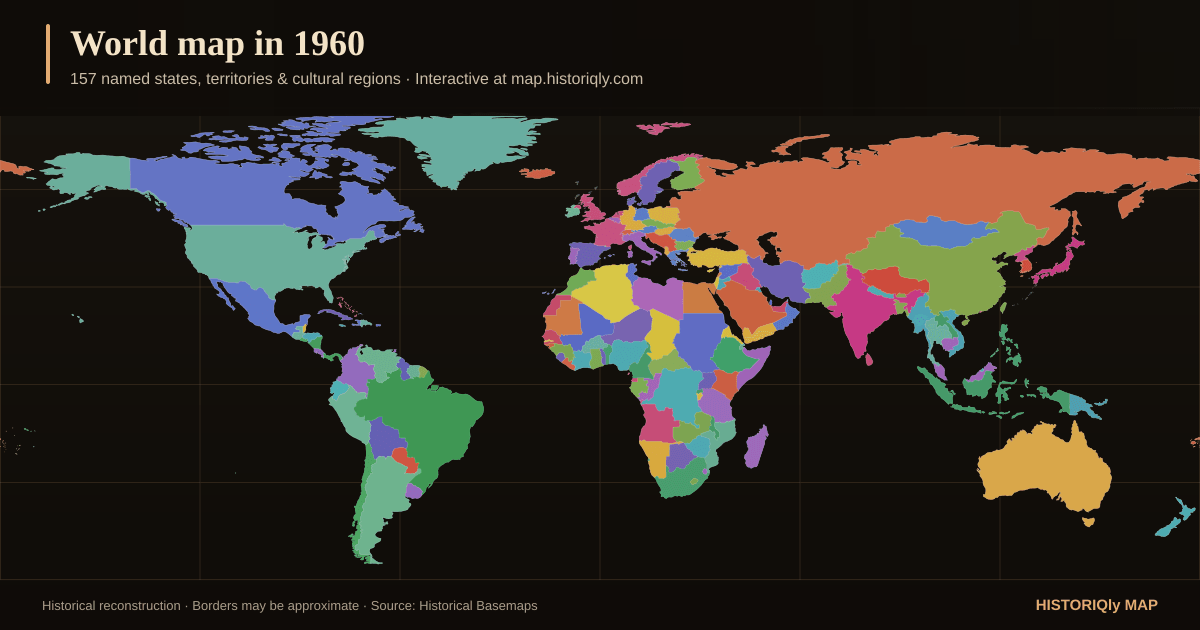
The interactive map lets you inspect named territories in 1960 and compare them to earlier or later snapshots on the timeline.
Contemporary historical map
Explore a reconstruction of the world around 1960. Navigate the post-war and contemporary world through decolonisation, new states, and modern political borders. Figures near this year include Deng Xiaoping, Eleanor Roosevelt, Elvis Presley.
Snapshot at a glance
Counts come directly from this snapshot and the historical layers available in HistorIQly Map.
These names are encoded in the boundary dataset. Inclusion does not settle disputed borders, sovereignty, spelling, or historical interpretation.
What this snapshot shows
The interactive map lets you inspect named territories in 1960 and compare them to earlier or later snapshots on the timeline.
Meet figures alive in, or close to, 1960 and move from political geography to the people connected to the period.
The related chronicles below provide long-form reading tied closely to the contemporary period.
Conflicts connected to 1960
These editorial date ranges include 1960. Some records group intermittent campaigns or long-running conflict series, so inclusion does not mean continuous fighting in that exact year.
1960 – 1965
Central Government (Lumumba, Mobutu) vs Katanga secessionists, various factions
Immediately after independence from Belgium, the Congo descended into chaos with army mutinies, the secession of mineral-rich Katanga, and Cold War proxy intervention. Prime Minister Patrice Lumumba was assassinated with CIA and Belgian involvement. Mobutu's eventual coup began decades of dictatorship.
Key battles and events: Katanga secession (1960); UN operations (1961-1963)
1960 – 1996
Guatemalan Government & Military vs Guatemalan National Revolutionary Unity (URNG)
A 36-year civil war that escalated into genocide against the indigenous Maya population in the early 1980s. The UN truth commission found the military responsible for 93% of the 200,000 deaths, including systematic massacres, forced disappearances, and scorched-earth campaigns.
Key battles and events: Ixil Triangle campaigns (1982-1983); Operation Sophia (1982)
1955 – 1972
Sudanese government vs Anyanya rebels
Long insurgency in southern Sudan driven by political exclusion and fears of northern domination, ending with the Addis Ababa Agreement and temporary southern autonomy.
Key battles and events: Torit Mutiny (1955); Anyanya offensives (1960s)
1955 – 1975
North Vietnam & Viet Cong vs South Vietnam & United States
The war that broke American confidence — two decades of jungle warfare, napalm, and guerrilla tactics that killed 3 million Vietnamese and 58,000 Americans.
Key battles and events: Tet Offensive (1968); Fall of Saigon (1975)
1954 – 1962
Algerian National Liberation Front (FLN) vs French Republic
A brutal eight-year guerrilla war that ended 132 years of French colonial rule in Algeria. The conflict killed 300,000–1.5 million Algerians, traumatised France, toppled the Fourth Republic, and inspired anti-colonial movements worldwide.
Key battles and events: Toussaint Rouge / All Saints' Day attacks (1954); Battle of Philippeville (1955)
1952 – 1960
British Colonial Government vs Kenya Land and Freedom Army (Mau Mau)
Kikuyu fighters rebelled against British colonial rule and land dispossession in Kenya. The British response included mass detention camps, torture, and forced relocations. Though militarily defeated, the uprising hastened Kenyan independence in 1963.
Key battles and events: Operation Anvil (1954); Battle of Mount Kenya forests (1953-1956)
1948 – 1960
British & Malayan forces vs Malayan Communist Party
A communist insurgency in British Malaya that became the textbook example of successful counterinsurgency. The British 'hearts and minds' strategy — combining military operations with political reform and resettlement — defeated the insurgents and is still studied by military planners worldwide.
Key battles and events: Sungai Siput ambush (1948); Briggs Plan resettlement (1950)
1947 – 1971
India vs Pakistan
Three major wars fought between India and Pakistan — the 1947 war over Kashmir's accession, the 1965 war triggered by Pakistani infiltration into Kashmir, and the 1971 war that led to the creation of Bangladesh.
Key battles and events: First Kashmir War (1947–1949); Battle of Asal Uttar (1965)
Historical figures near 1960
Sichuan, China
1904 – 1997
Reform and Opening Up, Special Economic Zones, lifting 800 million from poverty
New York, United States
1884 – 1962
Universal Declaration of Human Rights, transforming the role of First Lady, civil rights advocacy
United States
1935 – 1977
Pioneering rock and roll, cultural icon, best-selling solo music artist in history
United States
1899 – 1961
Nobel Prize-winning novelist, war correspondent, pioneer of modern American prose
United States
1917 – 1963
35th President of the United States, Cold War leader, champion of the space race
Liverpool / New York
1940 – 1980
Co-founder of The Beatles, solo artist, peace activist, songwriter
Landmarks standing in 1960
Sites already standing (or still being used) in 1960, drawn from the map's landmark layers.
Built 1958 · South America
Oscar Niemeyer's hyperboloid modernist cathedral of curved concrete columns
Built 1955 · South America
Largest Marian basilica in the world in São Paulo state, Brazil's national shrine drawing over 12 million pilgrims a year to the patroness of Brazil.
Built 1954 · South America
Underground Roman Catholic church carved within a salt mine near Bogotá, Colombia
Natural wonder · North America
Volcano that erupted from a Mexican cornfield in 1943, witnessed from birth
Built 1940 · Oceania
Carved Māori meeting house at the Waitangi Treaty Grounds in the Bay of Islands, built to represent all iwi of Aotearoa New Zealand.
Built 1935 · Oceania
Small Anglican memorial church on the shores of Lake Tekapo, one of New Zealand's most photographed buildings, framing the Southern Alps beyond its altar window.
Related chronicles
United States · Artist
The King of Rock and Roll
The true story of a poor boy from Tupelo who became the most famous entertainer on Earth — and the loneliest man in Graceland.
Read Elvis PresleyUnited States · Thinker
The Man Who Wrote Standing Up
The life of America’s most imitated writer — from the trenches of Italy to the cafés of Paris, from the bullrings of Spain to a shotgun in Idaho.
Read Ernest HemingwayUnited States · Leader
The Thousand Days
The story of the youngest elected president in American history — from the wreck of PT-109 to the brink of nuclear war, from the promise of the New Frontier to the shots in Dallas.
Read John F. KennedySichuan, China · Leader
The Architect of Modern China
Purged three times, rehabilitated three times — how a five-foot-tall pragmatist transformed China from one of the world’s poorest nations into its fastest-growing economy.
Read Deng XiaopingBoundary source and context layers
Boundary geometry is adapted from Historical Basemaps, a GPL-3.0 project built for world- and continent-scale historical mapping. The source is a work in progress: pre-modern territories can overlap, borders are often disputed, and a snapshot should be read as a reconstruction around 1960, not as survey-level fact.
Conflicts, landmarks, trade routes, and biographies come from separate HistorIQly editorial datasets. They provide discovery context but do not yet expose a citation for every individual record; verify a specific claim with specialist sources before citing it.
Frequently asked questions
The 1960 source snapshot reconstructs political borders, territories, and named states for around 1960. You can inspect individual territories, view linked historical figures, and compare this snapshot with nearby years like 1938 and 1945.
HistorIQly records whose date ranges include 1960 include Congo Crisis, Guatemalan Civil War, First Sudanese Civil War, Vietnam War, Algerian War of Independence. Long-running entries may represent intermittent campaigns rather than continuous warfare.
Figures linked near 1960 include Deng Xiaoping, Eleanor Roosevelt, Elvis Presley, Ernest Hemingway. Some were alive in this year; others are included because their lives fall within the surrounding historical period.
HistorIQly Map includes 49 historical snapshots spanning from 3000 BC through the modern era, covering the contemporary era and every other major period of world history.
Example labels encoded in the 1960 source snapshot include Canada, United States, China, Brazil, Greenland, India. These labels and reconstructed boundaries can be approximate or disputed; inspect the map methodology before using them for research.
Nearby years
Related map topics
Historical maps by year
Choose from 49 historical world maps by year. Explore borders, empires, wars, landmarks, trade routes, and people from 3000 BC to the modern era.
Modern history map
Compare modern history maps from revolutions and empires to world wars, decolonization, Cold War borders, and contemporary states.
World history atlas
Browse an interactive world history atlas with maps of empires, wars, trade routes, landmarks, and influential figures from ancient history through the modern era.