
Border history
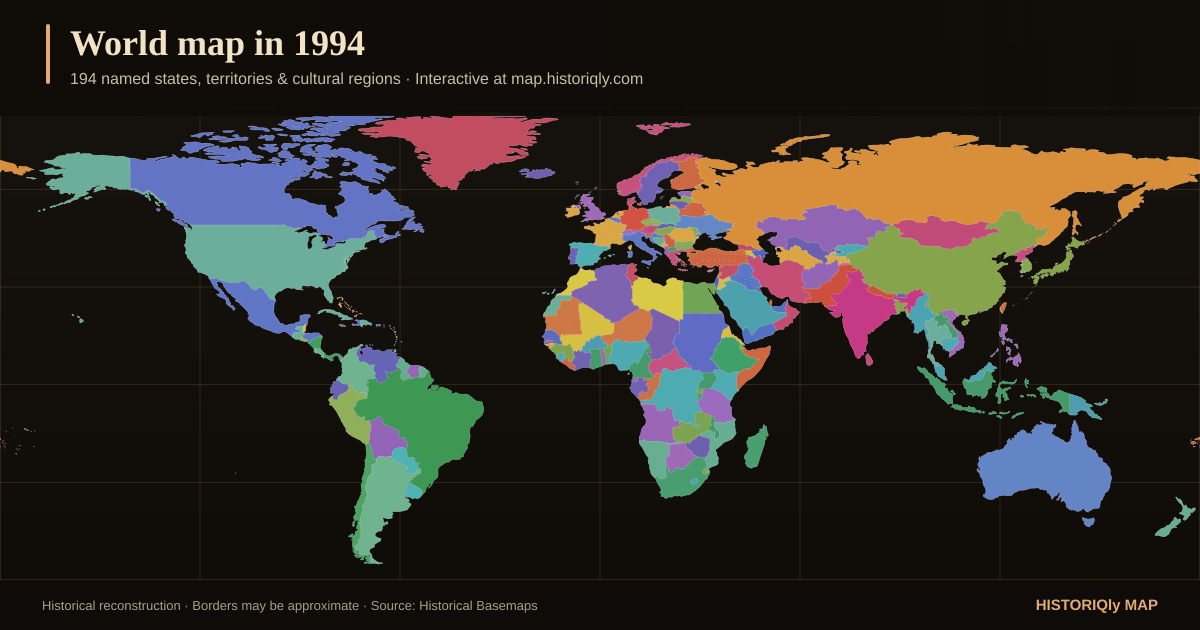
The interactive map lets you inspect named territories in 1994 and compare them to earlier or later snapshots on the timeline.
Contemporary historical map
Explore a reconstruction of the world around 1994. Navigate the post-war and contemporary world through decolonisation, new states, and modern political borders. Figures near this year include Deng Xiaoping, Kofi Annan, Margaret Thatcher.
Snapshot at a glance
Counts come directly from this snapshot and the historical layers available in HistorIQly Map.
These names are encoded in the boundary dataset. Inclusion does not settle disputed borders, sovereignty, spelling, or historical interpretation.
What this snapshot shows
The interactive map lets you inspect named territories in 1994 and compare them to earlier or later snapshots on the timeline.
Meet figures alive in, or close to, 1994 and move from political geography to the people connected to the period.
The related chronicles below provide long-form reading tied closely to the contemporary period.
Conflicts connected to 1994
These editorial date ranges include 1994. Some records group intermittent campaigns or long-running conflict series, so inclusion does not mean continuous fighting in that exact year.
1994 – 1996
Chechen Republic of Ichkeria vs Russian Federation
Russia invaded the breakaway Chechen Republic to reassert federal control. The brutal urban warfare in Grozny devastated the city and killed tens of thousands, ending in a humiliating Russian withdrawal.
Key battles and events: Battle of Khankala (December 1994); First Battle of Grozny (1994–1995)
1993 – 2005
Burundian Government (Tutsi-led military) vs Hutu rebel groups (CNDD-FDD, FNL)
An ethnic civil war between the Tutsi-dominated military and Hutu rebel groups, paralleling the Rwandan genocide next door. An estimated 300,000 people died before a power-sharing agreement ended the conflict.
Key battles and events: October 1993 massacres; Battle of Bujumbura (1994)
1992 – 2002
Algerian government vs Islamist insurgent groups
A brutal civil war that erupted after the cancellation of Algeria's elections, pitting the state against Islamist insurgents in a conflict marked by massacres and disappearances.
Key battles and events: Battle of Algiers (1997); Bentalha massacre (1997)
1992 – 1995
Republic of Bosnia and Herzegovina vs Bosnian Serb and Bosnian Croat forces
The bloodiest war of Yugoslavia's collapse, marked by the siege of Sarajevo, ethnic cleansing and the Srebrenica genocide before ending with the Dayton Accords.
Key battles and events: Siege of Sarajevo (1992-1996); Battle of Mostar (1992-1994)
1992 – 1997
Government forces (Kulobi-Khujandi alliance) vs United Tajik Opposition (Islamists, democrats, regionalists)
Post-Soviet civil war in Tajikistan between the ruling communist elite and an opposition coalition, killing up to 100,000 people and displacing over a million.
Key battles and events: Battle for Dushanbe (1992); Kofarnihon massacres (1992)
1992 – 1994
United Nations, United States vs Somali National Alliance (Aidid)
A humanitarian intervention in famine-ravaged Somalia escalated into urban combat. The Battle of Mogadishu ('Black Hawk Down') killed 18 US soldiers and led to American withdrawal.
Key battles and events: Battle of Mogadishu (1993); Operation Gothic Serpent (1993)
1991 – 1995
Croatia vs Yugoslav People's Army and Serb forces
War triggered by Yugoslavia's breakup in which Croatia fought the JNA and Serb separatist forces before major Croatian offensives restored most of the state's territory.
Key battles and events: Battle of Vukovar (1991); Siege of Dubrovnik (1991-1992)
1991 – 2002
Sierra Leone Government & ECOMOG vs Revolutionary United Front (RUF)
The RUF, backed by Charles Taylor's Liberia and funded by 'blood diamonds', waged a campaign of terror that included mass amputations of civilians' hands. British military intervention in 2000 and a UN peacekeeping force finally ended the war.
Key battles and events: RUF invasion from Liberia (1991); January 6 invasion of Freetown (1999)
Historical figures near 1994
Sichuan, China
1904 – 1997
Reform and Opening Up, Special Economic Zones, lifting 800 million from poverty
Ghana / New York
1938 – 2018
Secretary-General of the United Nations, Nobel Peace Prize laureate, global advocate for human rights and development
United Kingdom
1925 – 2013
First female British Prime Minister, Falklands War, economic transformation of Britain
India
1910 – 1997
Founder of the Missionaries of Charity, Nobel Peace Prize laureate, champion of the poorest of the poor
South Africa
1918 – 2013
Anti-apartheid revolutionary, political prisoner for 27 years, first Black president of South Africa, Nobel Peace Prize laureate
United States
1911 – 2004
40th President of the United States, Cold War leadership, Reaganomics, transforming the conservative movement
Landmarks standing in 1994
Sites already standing (or still being used) in 1994, drawn from the map's landmark layers.
Built 1986 · Asia
Islamabad's landmark mosque with a striking tent-shaped design by Turkish architect Vedat Dalokay, one of the largest mosques in the world
Built 1986 · Africa
Mosque with the world's tallest minaret, partially built over the Atlantic Ocean in Casablanca
Built 1985 · Africa
World's largest church by area, modelled on St. Peter's Basilica, in Yamoussoukro
Natural wonder · Asia
Burning natural gas crater in Turkmenistan's Karakum Desert, alight continuously since 1971
Built 1963 · Africa
Holy city and largest mosque in sub-Saharan Africa, centre of the Mouride brotherhood in Senegal
Built 1958 · South America
Oscar Niemeyer's hyperboloid modernist cathedral of curved concrete columns
Related chronicles
Sichuan, China · Leader
The Architect of Modern China
Purged three times, rehabilitated three times — how a five-foot-tall pragmatist transformed China from one of the world’s poorest nations into its fastest-growing economy.
Read Deng XiaopingGhana / New York · Leader
The Conscience of the World
The story of a quiet boy from Kumasi who became the moral voice of a fractured world — from the Gold Coast to the glass towers of the United Nations, from Rwanda’s killing fields to the Nobel stage in Oslo.
Read Kofi AnnanIndia · Philosopher
The Saint of the Gutters
The story of an Albanian schoolgirl who heard a call within a call, walked into the slums of Calcutta with five rupees in her pocket, and built a global mission to the dying, the abandoned, and the forgotten.
Read Mother TeresaSouth Africa · Revolutionary
The Long Walk to Freedom
The story of a Xhosa chief’s son who became the world’s most famous prisoner, endured twenty-seven years behind bars, and emerged to dismantle apartheid and lead a nation back from the brink of civil war.
Read Nelson MandelaBoundary source and context layers
Boundary geometry is adapted from Historical Basemaps, a GPL-3.0 project built for world- and continent-scale historical mapping. The source is a work in progress: pre-modern territories can overlap, borders are often disputed, and a snapshot should be read as a reconstruction around 1994, not as survey-level fact.
Conflicts, landmarks, trade routes, and biographies come from separate HistorIQly editorial datasets. They provide discovery context but do not yet expose a citation for every individual record; verify a specific claim with specialist sources before citing it.
Frequently asked questions
The 1994 source snapshot reconstructs political borders, territories, and named states for around 1994. You can inspect individual territories, view linked historical figures, and compare this snapshot with nearby years like 1945 and 1960.
HistorIQly records whose date ranges include 1994 include First Chechen War, Burundi Civil War, Algerian Civil War, Bosnian War, Tajik Civil War. Long-running entries may represent intermittent campaigns rather than continuous warfare.
Figures linked near 1994 include Deng Xiaoping, Kofi Annan, Margaret Thatcher, Mother Teresa. Some were alive in this year; others are included because their lives fall within the surrounding historical period.
HistorIQly Map includes 49 historical snapshots spanning from 3000 BC through the modern era, covering the contemporary era and every other major period of world history.
Example labels encoded in the 1994 source snapshot include Russia, Canada, United States, China, Brazil, Greenland. These labels and reconstructed boundaries can be approximate or disputed; inspect the map methodology before using them for research.
Nearby years
Related map topics
Historical maps by year
Choose from 49 historical world maps by year. Explore borders, empires, wars, landmarks, trade routes, and people from 3000 BC to the modern era.
Modern history map
Compare modern history maps from revolutions and empires to world wars, decolonization, Cold War borders, and contemporary states.
World history atlas
Browse an interactive world history atlas with maps of empires, wars, trade routes, landmarks, and influential figures from ancient history through the modern era.