
Border history
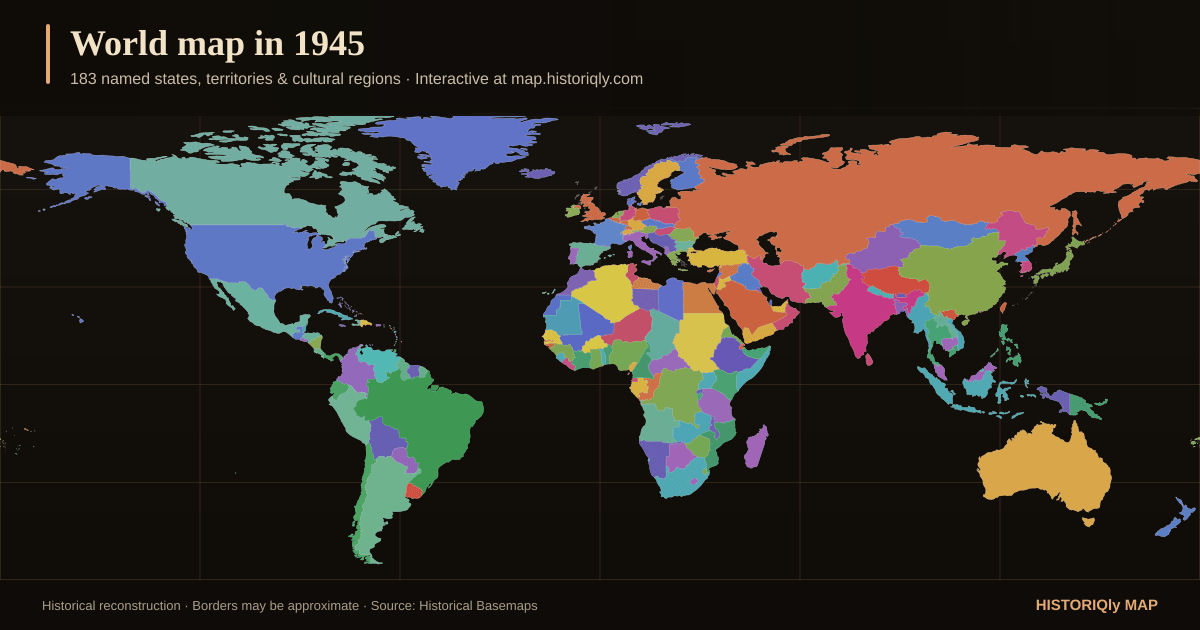
The interactive map lets you inspect named territories in 1945 and compare them to earlier or later snapshots on the timeline.
Modern historical map
Explore a reconstruction of the world around 1945. Compare borders during industrialisation, imperial competition, and the crises that defined the nineteenth and early twentieth centuries. Figures near this year include Abraham Joshua Heschel, Carl Jung, Emmanuel Levinas.
Snapshot at a glance
Counts come directly from this snapshot and the historical layers available in HistorIQly Map.
These names are encoded in the boundary dataset. Inclusion does not settle disputed borders, sovereignty, spelling, or historical interpretation.
What this snapshot shows
The interactive map lets you inspect named territories in 1945 and compare them to earlier or later snapshots on the timeline.
Meet figures alive in, or close to, 1945 and move from political geography to the people connected to the period.
The related chronicles below provide long-form reading tied closely to the modern period.
Conflicts connected to 1945
These editorial date ranges include 1945. Some records group intermittent campaigns or long-running conflict series, so inclusion does not mean continuous fighting in that exact year.
1939 – 1945
Allied Powers vs Axis Powers
The deadliest conflict in human history — 70 million dead across six continents in a war that ended with mushroom clouds and the birth of the nuclear age.
Key battles and events: Stalingrad (1942–1943); Midway (1942)
1945 – 1949
Indonesian Republic (Sukarno) vs Netherlands & Britain
After Japan's surrender, Indonesia declared independence, but the Netherlands attempted to reimpose colonial control. Four years of armed struggle and guerrilla warfare, combined with international pressure, forced the Dutch to recognise Indonesian sovereignty over the world's largest archipelago.
Key battles and events: Battle of Surabaya (1945); Dutch 'Police Actions' (1947, 1948)
1945
Soviet Union, Mongolia vs Japan, Manchukuo
Massive Soviet offensive against Japanese-held Manchuria in the final days of WWII. Over 1.5 million Soviet troops destroyed the 700,000-strong Kwantung Army in just 11 days. Considered alongside the atomic bombs as a decisive factor in Japan's surrender.
Key battles and events: Battle of Mutanchiang (1945); Capture of Harbin (1945)
1944 – 1945
Finland vs Nazi Germany
After Finland signed an armistice with the Soviet Union, it was required to expel German troops from Finnish Lapland. Germany's scorched-earth retreat devastated Finland's northernmost region, destroying 40% of all buildings and leaving 100,000 people homeless.
Key battles and events: Battle of Tornio (1944); Battle of Kemi (1944)
1941 – 1945
Yugoslav Partisans (Tito) vs Nazi Germany, Italy, Ustaše Croatia, Chetniks
Complex multi-sided conflict featuring the largest resistance movement in occupied Europe. Tito's communist Partisans grew to 800,000 fighters and liberated Yugoslavia largely without direct Allied ground support, while fighting Axis occupiers, fascist collaborators, and royalist Chetniks simultaneously.
Key battles and events: Battle of Sutjeska (1943); Battle of Neretva (1943)
1937 – 1945
Republic of China (Nationalists & Communists) vs Empire of Japan
Japan's full-scale invasion of China beginning at the Marco Polo Bridge, encompassing the Nanjing Massacre and eight years of brutal warfare. It merged into the Pacific theatre of World War II and cost over 20 million Chinese lives.
Key battles and events: Battle of Shanghai (1937); Battle of Nanjing (1937)
1927 – 1949
Nationalists (Kuomintang) vs Communists (CPC)
A decades-long struggle between Chiang Kai-shek's Nationalists and Mao Zedong's Communists — interrupted by WWII, then resumed until the Communists won in 1949, founding the People's Republic of China.
Key battles and events: Shanghai Massacre (1927); Long March (1934–1935)
Historical figures near 1945
Poland / United States
1907 – 1972
Jewish theologian, philosopher, civil rights activist, prophetic voice of the twentieth century
Switzerland
1875 – 1961
Analytical psychology, archetypes, collective unconscious, psychological types
France / Lithuania
1906 – 1995
Philosopher, phenomenologist, ethicist, Talmudic scholar
British India / England / Burma / Spain
1903 – 1950
Animal Farm, Nineteen Eighty-Four, anti-totalitarian essays, and the invention of Big Brother, doublethink, and Newspeak
United States
1863 – 1947
Assembly line mass production, Model T automobile, $5 workday, Ford Motor Company
India / South Africa
1869 – 1948
Nonviolent resistance, Indian independence, civil rights pioneer
Landmarks standing in 1945
Sites already standing (or still being used) in 1945, drawn from the map's landmark layers.
Natural wonder · North America
Volcano that erupted from a Mexican cornfield in 1943, witnessed from birth
Built 1940 · Oceania
Carved Māori meeting house at the Waitangi Treaty Grounds in the Bay of Islands, built to represent all iwi of Aotearoa New Zealand.
Built 1935 · Oceania
Small Anglican memorial church on the shores of Lake Tekapo, one of New Zealand's most photographed buildings, framing the Southern Alps beyond its altar window.
Built 1931 · South America
Art Deco statue of Jesus Christ overlooking Rio de Janeiro
Built 1926 · North America
Patronal shrine of Cuba in the hills above Santiago (built 1926, declared a basilica in 1977), housing the venerated Virgen de la Caridad del Cobre statue discovered by sailors in 1612
Built 1920 · Africa
Major Catholic and Anglican pilgrimage site honouring the Uganda Martyrs of 1886
Related chronicles
Spain / France · Artist
The Man Who Broke the Mirror
The life of the artist who shattered five centuries of Western painting and rebuilt it from the fragments — from Málaga to Mougins.
Read Pablo PicassoPoland / United States · Philosopher
The Prophet of Radical Amazement
The Hasidic rabbi’s son from Warsaw who became the conscience of American Judaism and marched arm in arm with Martin Luther King Jr.
Read Abraham Joshua HeschelFrance / Lithuania · Philosopher
The Philosopher of the Other
The Lithuanian Jewish philosopher who survived five years in a Nazi prisoner-of-war camp, lost his entire family to the Holocaust, and rebuilt ethics from the ground up — told in his own words.
Read Emmanuel LevinasSwitzerland · Thinker
The Architect of the Unconscious
The Swiss psychiatrist who mapped the deepest layers of the human mind — archetypes, the shadow, the collective unconscious — and spent a lifetime proving that the psyche has a life of its own.
Read Carl JungBoundary source and context layers
Boundary geometry is adapted from Historical Basemaps, a GPL-3.0 project built for world- and continent-scale historical mapping. The source is a work in progress: pre-modern territories can overlap, borders are often disputed, and a snapshot should be read as a reconstruction around 1945, not as survey-level fact.
Conflicts, landmarks, trade routes, and biographies come from separate HistorIQly editorial datasets. They provide discovery context but do not yet expose a citation for every individual record; verify a specific claim with specialist sources before citing it.
Frequently asked questions
The 1945 source snapshot reconstructs political borders, territories, and named states for around 1945. You can inspect individual territories, view linked historical figures, and compare this snapshot with nearby years like 1930 and 1938.
HistorIQly records whose date ranges include 1945 include World War II, Indonesian National Revolution, Soviet Invasion of Manchuria (Operation August Storm), Lapland War, Yugoslav People's Liberation War. Long-running entries may represent intermittent campaigns rather than continuous warfare.
Figures linked near 1945 include Abraham Joshua Heschel, Carl Jung, Emmanuel Levinas, George Orwell. Some were alive in this year; others are included because their lives fall within the surrounding historical period.
HistorIQly Map includes 49 historical snapshots spanning from 3000 BC through the modern era, covering the modern era and every other major period of world history.
Example labels encoded in the 1945 source snapshot include Canada, United States, Brazil, Denmark, China, India. These labels and reconstructed boundaries can be approximate or disputed; inspect the map methodology before using them for research.
Nearby years
Related map topics
Historical maps by year
Choose from 49 historical world maps by year. Explore borders, empires, wars, landmarks, trade routes, and people from 3000 BC to the modern era.
Modern history map
Compare modern history maps from revolutions and empires to world wars, decolonization, Cold War borders, and contemporary states.
World history atlas
Browse an interactive world history atlas with maps of empires, wars, trade routes, landmarks, and influential figures from ancient history through the modern era.