
Border history
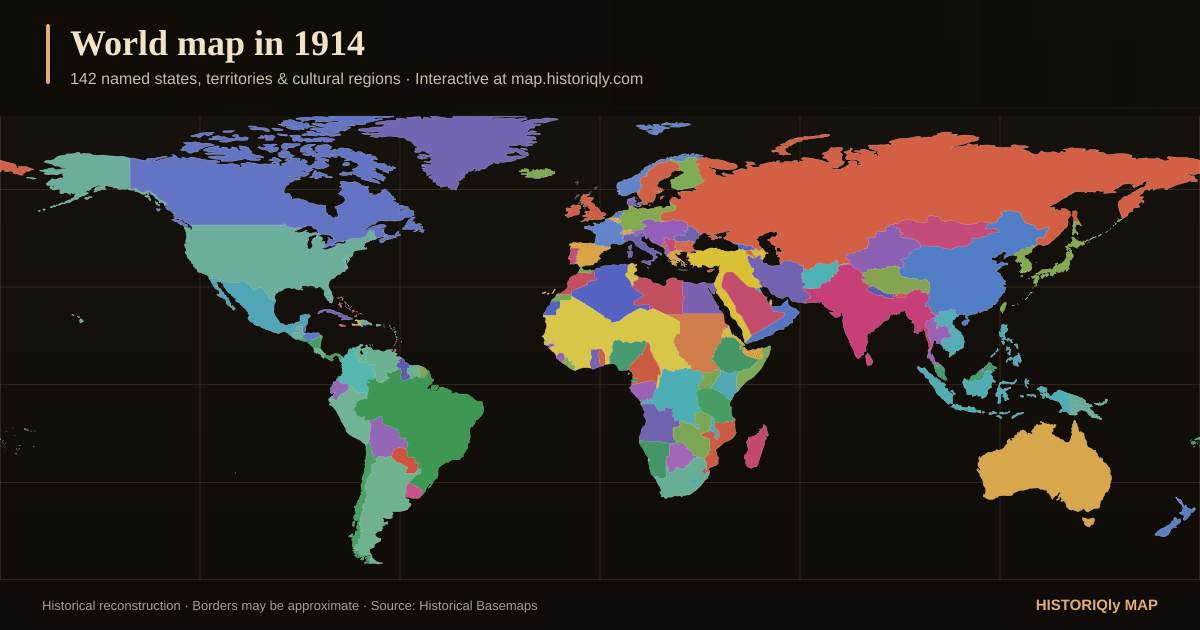
The interactive map lets you inspect named territories in 1914 and compare them to earlier or later snapshots on the timeline.
Modern historical map
Explore a reconstruction of the world around 1914. Compare borders during industrialisation, imperial competition, and the crises that defined the nineteenth and early twentieth centuries. Figures near this year include Abraham Joshua Heschel, Carl Jung, Emmanuel Levinas.
Snapshot at a glance
Counts come directly from this snapshot and the historical layers available in HistorIQly Map.
These names are encoded in the boundary dataset. Inclusion does not settle disputed borders, sovereignty, spelling, or historical interpretation.
What this snapshot shows
The interactive map lets you inspect named territories in 1914 and compare them to earlier or later snapshots on the timeline.
Meet figures alive in, or close to, 1914 and move from political geography to the people connected to the period.
The related chronicles below provide long-form reading tied closely to the modern period.
Conflicts connected to 1914
These editorial date ranges include 1914. Some records group intermittent campaigns or long-running conflict series, so inclusion does not mean continuous fighting in that exact year.
1914 – 1918
Allied Powers vs Central Powers
A global war with devastating military and civilian losses that contributed to the collapse of the German, Russian, Austro-Hungarian and Ottoman empires.
Key battles and events: Marne (1914); Gallipoli (1915)
1914 – 1918
German Empire (Paul von Lettow-Vorbeck) vs British Empire, Belgium, Portugal
Remarkable four-year guerrilla campaign in German East Africa. Lettow-Vorbeck, with never more than 14,000 troops (mostly African askaris), tied down 300,000 Allied troops throughout WWI. He never surrendered and only laid down arms upon news of the Armistice.
Key battles and events: Battle of Tanga (1914); Battle of Mahiwa (1917)
1911 – 1932
Kingdom of Italy vs Senussi Order (Omar Mukhtar)
A brutal 20-year colonial war in Libya. Italy's pacification campaign under General Graziani included concentration camps, mass executions, and forced displacement of the entire Cyrenaican population. Resistance hero Omar Mukhtar was publicly hanged in 1931.
Key battles and events: Battle of El Agheila (1915); Kufra Oasis campaign (1931)
1910 – 1920
Revolutionary factions (Villa, Zapata, Carranza, Obregón) vs Federal Government (Díaz, Huerta)
A decade-long multi-sided civil war that overthrew dictator Porfirio Díaz and transformed Mexico. The revolution pitted peasant armies under Zapata and Villa against various elite factions, killing over 1 million people and producing the world's first social revolutionary constitution (1917).
Key battles and events: Battle of Ciudad Juárez (1911); Battle of Celaya (1915)
1899 – 1920
Dervish State (Mohammed Abdullah Hassan) vs British Empire, Italy, Ethiopia
A 21-year insurgency led by Mohammed Abdullah Hassan and his Dervish state against British, Italian, and Ethiopian forces in the Horn of Africa. Ended only when the British deployed aircraft — one of the first uses of air power in colonial warfare.
Key battles and events: Battle of Jigjiga (1900); Battle of Dul Madoba (1913)
1898 – 1934
United States vs Various Caribbean and Central American forces
A series of US military interventions in Latin America and the Caribbean to protect American commercial interests and enforce the Roosevelt Corollary. US Marines occupied Haiti, Nicaragua, the Dominican Republic, and intervened in Mexico and Honduras.
Key battles and events: US occupation of Nicaragua (1912–1933); US occupation of Haiti (1915–1934)
1873 – 1914
Dutch East Indies vs Aceh Sultanate
One of the longest colonial wars in history. The fiercely independent Acehnese sultanate resisted Dutch conquest for over 40 years through guerrilla warfare and Islamic holy war, costing tens of thousands of lives on both sides.
Key battles and events: First Dutch Expedition (1873); Second Dutch Expedition (1873–1874)
Historical figures near 1914
Poland / United States
1907 – 1972
Jewish theologian, philosopher, civil rights activist, prophetic voice of the twentieth century
Switzerland
1875 – 1961
Analytical psychology, archetypes, collective unconscious, psychological types
France / Lithuania
1906 – 1995
Philosopher, phenomenologist, ethicist, Talmudic scholar
Prague / Austria-Hungary
1883 – 1924
The Metamorphosis, The Trial, The Castle, pioneer of existentialist and absurdist fiction
Germany
1886 – 1929
The Star of Redemption, dialogical philosophy, Buber-Rosenzweig Bible translation, the Lehrhaus
British India / England / Burma / Spain
1903 – 1950
Animal Farm, Nineteen Eighty-Four, anti-totalitarian essays, and the invention of Big Brother, doublethink, and Newspeak
Landmarks standing in 1914
Sites already standing (or still being used) in 1914, drawn from the map's landmark layers.
Built 1914 · Asia
Iconic mosque in Tarim, Yemen with the tallest mud-brick minaret in the world at 53 meters, a symbol of Hadrami Islamic architecture
Built 1914 · Africa
Monumental cathedral in Kinshasa, one of the largest churches in Central Africa
Built 1910 · Oceania
Capital of German New Guinea from 1910, built around Simpson Harbour as a major copra-trade port and the chief commercial hub of the New Guinea Islands.
Built 1908 · Asia
Maronite Christian pilgrimage shrine overlooking Jounieh Bay, with a 15-ton bronze statue of the Virgin Mary atop a hill in Harissa
Built 1907 · North America
Gothic Revival cathedral in Washington, D.C., site of presidential funerals and national services
Built 1891 · Oceania
Gothic Revival Anglican cathedral designed by William Butterfield at the heart of Melbourne, featuring distinctive spires completed in 1932.
Related chronicles
Serbia / United States · Scientist
He Won the Current War. He Died Broke at 86. The FBI Took His Papers the Same Day.
Genius, rivalry, and vindication — how a penniless Serbian immigrant defeated Edison and powered the modern world.
Read Nikola TeslaSpain / France · Artist
The Man Who Broke the Mirror
The life of the artist who shattered five centuries of Western painting and rebuilt it from the fragments — from Málaga to Mougins.
Read Pablo PicassoPoland / United States · Philosopher
The Prophet of Radical Amazement
The Hasidic rabbi’s son from Warsaw who became the conscience of American Judaism and marched arm in arm with Martin Luther King Jr.
Read Abraham Joshua HeschelPrague / Austria-Hungary · Thinker
The Man Who Became a Metaphor
Alienation, bureaucracy, and genius — how a Prague insurance clerk wrote the most unsettling literature of the twentieth century, then asked his best friend to burn it all.
Read Franz KafkaBoundary source and context layers
Boundary geometry is adapted from Historical Basemaps, a GPL-3.0 project built for world- and continent-scale historical mapping. The source is a work in progress: pre-modern territories can overlap, borders are often disputed, and a snapshot should be read as a reconstruction around 1914, not as survey-level fact.
Conflicts, landmarks, trade routes, and biographies come from separate HistorIQly editorial datasets. They provide discovery context but do not yet expose a citation for every individual record; verify a specific claim with specialist sources before citing it.
Frequently asked questions
The 1914 source snapshot reconstructs political borders, territories, and named states for around 1914. You can inspect individual territories, view linked historical figures, and compare this snapshot with nearby years like 1880 and 1900.
HistorIQly records whose date ranges include 1914 include World War I, East African Campaign (WWI), Italo-Senussi War, Mexican Revolution, Somaliland Campaign (Dervish War). Long-running entries may represent intermittent campaigns rather than continuous warfare.
Figures linked near 1914 include Abraham Joshua Heschel, Carl Jung, Emmanuel Levinas, Franz Kafka. Some were alive in this year; others are included because their lives fall within the surrounding historical period.
HistorIQly Map includes 49 historical snapshots spanning from 3000 BC through the modern era, covering the modern era and every other major period of world history.
Example labels encoded in the 1914 source snapshot include Russian Empire, Canada, United States, Brazil, Manchu Empire, Denmark. These labels and reconstructed boundaries can be approximate or disputed; inspect the map methodology before using them for research.
Nearby years
Related map topics
Historical maps by year
Choose from 49 historical world maps by year. Explore borders, empires, wars, landmarks, trade routes, and people from 3000 BC to the modern era.
Modern history map
Compare modern history maps from revolutions and empires to world wars, decolonization, Cold War borders, and contemporary states.
World history atlas
Browse an interactive world history atlas with maps of empires, wars, trade routes, landmarks, and influential figures from ancient history through the modern era.