
Border history
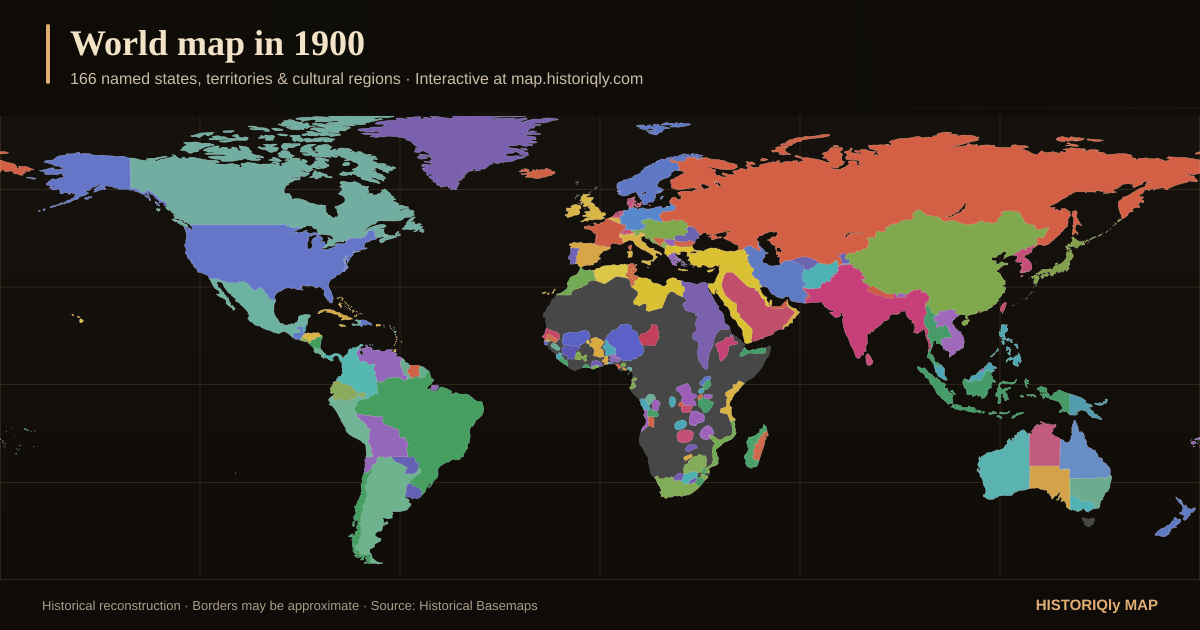
The interactive map lets you inspect named territories in 1900 and compare them to earlier or later snapshots on the timeline.
Modern historical map
Explore a reconstruction of the world around 1900. Compare borders during industrialisation, imperial competition, and the crises that defined the nineteenth and early twentieth centuries. Figures near this year include Carl Jung, Franz Kafka, Franz Rosenzweig.
Snapshot at a glance
Counts come directly from this snapshot and the historical layers available in HistorIQly Map.
These names are encoded in the boundary dataset. Inclusion does not settle disputed borders, sovereignty, spelling, or historical interpretation.
What this snapshot shows
The interactive map lets you inspect named territories in 1900 and compare them to earlier or later snapshots on the timeline.
Meet figures alive in, or close to, 1900 and move from political geography to the people connected to the period.
The related chronicles below provide long-form reading tied closely to the modern period.
Conflicts connected to 1900
These editorial date ranges include 1900. Some records group intermittent campaigns or long-running conflict series, so inclusion does not mean continuous fighting in that exact year.
1900 – 1901
Eight-Nation Alliance (Japan, Russia, Britain, France, US, Germany, Italy, Austria) vs Qing China, Boxer rebels
An international military coalition invaded China to relieve the besieged foreign legations in Beijing, imposing crushing indemnities that further humiliated the Qing dynasty.
Key battles and events: Siege of the Legations (1900); Battle of Tientsin (1900)
1899 – 1901
Eight-Nation Alliance vs Qing Dynasty & Boxer militia
An anti-foreign uprising by the 'Righteous Harmony Fists' militia, backed by the Qing court, besieged the Beijing legation quarter for 55 days before an eight-nation coalition relieved the siege and imposed crushing reparations.
Key battles and events: Battle of Langfang (1900); Battle of Tianjin (1900)
1899 – 1902
United States vs First Philippine Republic (Aguinaldo)
After the U.S. acquired the Philippines from Spain, Filipino independence forces fought a guerrilla war against American occupation. The brutal conflict killed an estimated 200,000-1,000,000 Filipino civilians and marked the U.S.'s entry into imperial colonialism.
Key battles and events: Battle of Manila (1899); Battle of Tirad Pass (1899)
1899 – 1902
British Empire vs Boer republics (Transvaal & Orange Free State)
Britain fought the Boer republics for control of South Africa. The British used scorched earth tactics and concentration camps, killing tens of thousands of Boer civilians before achieving victory.
Key battles and events: Siege of Ladysmith (1899–1900); Siege of Mafeking (1899–1900)
1899 – 1920
Dervish State (Mohammed Abdullah Hassan) vs British Empire, Italy, Ethiopia
A 21-year insurgency led by Mohammed Abdullah Hassan and his Dervish state against British, Italian, and Ethiopian forces in the Horn of Africa. Ended only when the British deployed aircraft — one of the first uses of air power in colonial warfare.
Key battles and events: Battle of Jigjiga (1900); Battle of Dul Madoba (1913)
1899 – 1902
Colombian Liberal Party vs Colombian Conservative Party (Government)
A devastating civil war between Colombian Liberal and Conservative parties that killed approximately 100,000 people and wrecked the economy. The war's chaos directly enabled the U.S.-backed secession of Panama in 1903.
Key battles and events: Battle of Palonegro (1900); Battle of Peralonso (1899)
1899 – 1913
French Republic vs Wadai Empire, Sultanate of Bagirmi, Rabih's army
France conquered the Lake Chad region, defeating the warlord Rabih az-Zubayr and the Wadai Empire, completing the French sphere of influence across the Sahel.
Key battles and events: Battle of Kousséri (1900); Fall of Abéché (1909)
1898 – 1934
United States vs Various Caribbean and Central American forces
A series of US military interventions in Latin America and the Caribbean to protect American commercial interests and enforce the Roosevelt Corollary. US Marines occupied Haiti, Nicaragua, the Dominican Republic, and intervened in Mexico and Honduras.
Key battles and events: US occupation of Nicaragua (1912–1933); US occupation of Haiti (1915–1934)
Historical figures near 1900
Switzerland
1875 – 1961
Analytical psychology, archetypes, collective unconscious, psychological types
Prague / Austria-Hungary
1883 – 1924
The Metamorphosis, The Trial, The Castle, pioneer of existentialist and absurdist fiction
Germany
1886 – 1929
The Star of Redemption, dialogical philosophy, Buber-Rosenzweig Bible translation, the Lehrhaus
Prussia / Switzerland / Italy
1844 – 1900
Thus Spoke Zarathustra, Beyond Good and Evil, the Übermensch, eternal recurrence, and the declaration that God is dead
United States
1863 – 1947
Assembly line mass production, Model T automobile, $5 workday, Ford Motor Company
India / South Africa
1869 – 1948
Nonviolent resistance, Indian independence, civil rights pioneer
Landmarks standing in 1900
Sites already standing (or still being used) in 1900, drawn from the map's landmark layers.
Built 1891 · Oceania
Gothic Revival Anglican cathedral designed by William Butterfield at the heart of Melbourne, featuring distinctive spires completed in 1932.
Built 1888 · Asia
The Pink Mosque of Shiraz, famous for its stained glass windows that cast kaleidoscopic rainbows across the prayer hall at sunrise
Built 1883 · Oceania
Established in 1883 on Western Australia's Kimberley coast, Broome became one of the world's leading pearling ports, supplying most of the global mother-of-pearl by 1910.
Built 1883 · Europe
Ornate Russian Orthodox church in St. Petersburg built on the site of Alexander II's assassination
Built 1882 · Europe
Gaudí's unfinished masterpiece basilica in Barcelona
Built 1879 · Africa
Anglican cathedral built on the site of the former slave market in Stone Town, Tanzania
Related chronicles
Serbia / United States · Scientist
He Won the Current War. He Died Broke at 86. The FBI Took His Papers the Same Day.
Genius, rivalry, and vindication — how a penniless Serbian immigrant defeated Edison and powered the modern world.
Read Nikola TeslaSpain / France · Artist
The Man Who Broke the Mirror
The life of the artist who shattered five centuries of Western painting and rebuilt it from the fragments — from Málaga to Mougins.
Read Pablo PicassoPrague / Austria-Hungary · Thinker
The Man Who Became a Metaphor
Alienation, bureaucracy, and genius — how a Prague insurance clerk wrote the most unsettling literature of the twentieth century, then asked his best friend to burn it all.
Read Franz KafkaGermany · Philosopher
The Star That Would Not Be Extinguished
Conversion, revelation, and paralysis — how a German-Jewish philosopher wrote his masterwork on military postcards, almost became a Christian, then spent his final years communicating one letter at a time.
Read Franz RosenzweigBoundary source and context layers
Boundary geometry is adapted from Historical Basemaps, a GPL-3.0 project built for world- and continent-scale historical mapping. The source is a work in progress: pre-modern territories can overlap, borders are often disputed, and a snapshot should be read as a reconstruction around 1900, not as survey-level fact.
Conflicts, landmarks, trade routes, and biographies come from separate HistorIQly editorial datasets. They provide discovery context but do not yet expose a citation for every individual record; verify a specific claim with specialist sources before citing it.
Frequently asked questions
The 1900 source snapshot reconstructs political borders, territories, and named states for around 1900. You can inspect individual territories, view linked historical figures, and compare this snapshot with nearby years like 1815 and 1880.
HistorIQly records whose date ranges include 1900 include Boxer Protocol and Eight-Nation Alliance, Boxer Rebellion, Philippine-American War, Second Boer War, Somaliland Campaign (Dervish War). Long-running entries may represent intermittent campaigns rather than continuous warfare.
Figures linked near 1900 include Carl Jung, Franz Kafka, Franz Rosenzweig, Friedrich Nietzsche. Some were alive in this year; others are included because their lives fall within the surrounding historical period.
HistorIQly Map includes 49 historical snapshots spanning from 3000 BC through the modern era, covering the modern era and every other major period of world history.
Example labels encoded in the 1900 source snapshot include Russian Empire, Canada, Manchu Empire, United States of America, Kingdom of Brazil, Greenland. These labels and reconstructed boundaries can be approximate or disputed; inspect the map methodology before using them for research.
Nearby years
Related map topics
Historical maps by year
Choose from 49 historical world maps by year. Explore borders, empires, wars, landmarks, trade routes, and people from 3000 BC to the modern era.
Modern history map
Compare modern history maps from revolutions and empires to world wars, decolonization, Cold War borders, and contemporary states.
World history atlas
Browse an interactive world history atlas with maps of empires, wars, trade routes, landmarks, and influential figures from ancient history through the modern era.