
Border history
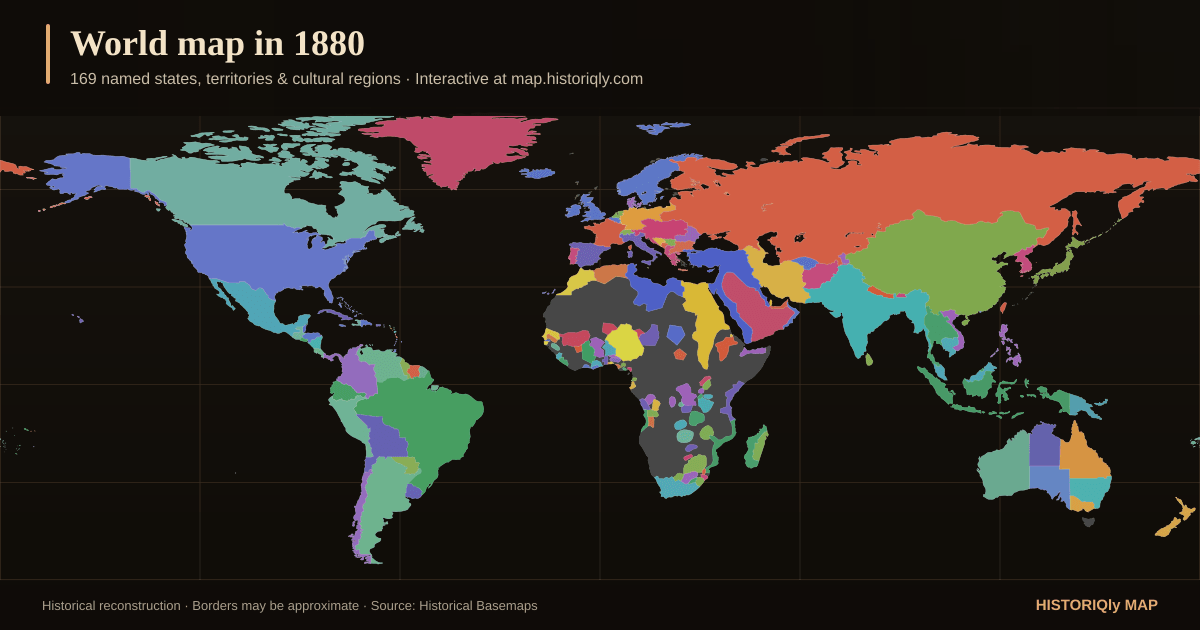
The interactive map lets you inspect named territories in 1880 and compare them to earlier or later snapshots on the timeline.
Modern historical map
Explore a reconstruction of the world around 1880. Compare borders during industrialisation, imperial competition, and the crises that defined the nineteenth and early twentieth centuries. Figures near this year include Carl Jung, Charles Darwin, Friedrich Nietzsche.
Snapshot at a glance
Counts come directly from this snapshot and the historical layers available in HistorIQly Map.
These names are encoded in the boundary dataset. Inclusion does not settle disputed borders, sovereignty, spelling, or historical interpretation.
What this snapshot shows
The interactive map lets you inspect named territories in 1880 and compare them to earlier or later snapshots on the timeline.
Meet figures alive in, or close to, 1880 and move from political geography to the people connected to the period.
The related chronicles below provide long-form reading tied closely to the modern period.
Conflicts connected to 1880
These editorial date ranges include 1880. Some records group intermittent campaigns or long-running conflict series, so inclusion does not mean continuous fighting in that exact year.
1880 – 1881
South African Republic (Boers) vs British Empire
The Transvaal Boers revolted against British annexation. Expert Boer marksmen using modern rifles inflicted a humiliating defeat on the British at Majuba Hill. Britain granted the Transvaal self-governance — a rare imperial retreat.
Key battles and events: Battle of Laing's Nek (1881); Battle of Majuba Hill (1881)
1879 – 1884
Chile vs Peru & Bolivia
Chile fought Peru and Bolivia for control of the nitrate-rich Atacama Desert, capturing Lima and annexing Bolivia's entire coastline — making Bolivia a landlocked nation to this day.
Key battles and events: Battle of Iquique (1879); Battle of Tacna (1880)
1878 – 1885
Argentine Republic vs Mapuche & Tehuelche peoples
Argentina's military campaign to seize Patagonia and the Pampas from indigenous peoples. General Julio Argentino Roca's expedition killed or displaced thousands of Mapuche and Tehuelche, opening vast lands for settlement.
Key battles and events: Battle of Choele Choel (1879); Roca's Southern Expedition (1879)
1878 – 1880
British Empire vs Afghan Empire (Sher Ali Khan, Ayub Khan)
Britain invaded Afghanistan again to counter Russian influence in the 'Great Game'. After initial victories and the installation of a friendly emir, the British suffered a devastating defeat at Maiwand before winning at Kandahar. Britain gained control of Afghan foreign policy but not its territory.
Key battles and events: Battle of Ali Masjid (1878); Battle of Maiwand (1880)
1873 – 1914
Dutch East Indies vs Aceh Sultanate
One of the longest colonial wars in history. The fiercely independent Acehnese sultanate resisted Dutch conquest for over 40 years through guerrilla warfare and Islamic holy war, costing tens of thousands of lives on both sides.
Key battles and events: First Dutch Expedition (1873); Second Dutch Expedition (1873–1874)
1849 – 1886
United States & Mexico vs Apache tribes (Cochise, Geronimo)
Decades of guerrilla warfare between Apache bands and the U.S. Army across the American Southwest. Geronimo's final surrender in 1886 ended the last major Native American armed resistance in the United States.
Key battles and events: Battle of Apache Pass (1862); Battle of Big Dry Wash (1882)
1849 – 1898
British India vs Pashtun tribes, Waziri tribes
Decades of campaigns on the North-West Frontier pitted British Indian forces against fiercely independent Pashtun tribes, creating the volatile border region that remains contested to this day.
Key battles and events: Ambela Campaign (1863); Siege of Chitral (1895)
1839 – 1895
Russian Empire vs Kokand, Bukhara, Khiva Khanates, Turkmen tribes
Russia systematically conquered the Central Asian khanates in a 'Great Game' expansion that brought the ancient Silk Road cities under Tsarist control and alarmed the British Empire.
Key battles and events: Fall of Tashkent (1865); Battle of Samarkand (1868)
Historical figures near 1880
Switzerland
1875 – 1961
Analytical psychology, archetypes, collective unconscious, psychological types
England
1809 – 1882
Theory of evolution by natural selection, HMS Beagle voyage, On the Origin of Species
Prussia / Switzerland / Italy
1844 – 1900
Thus Spoke Zarathustra, Beyond Good and Evil, the Übermensch, eternal recurrence, and the declaration that God is dead
United States
1863 – 1947
Assembly line mass production, Model T automobile, $5 workday, Ford Motor Company
Germany / England
1818 – 1883
The Communist Manifesto, Das Kapital, historical materialism, class struggle theory
India / South Africa
1869 – 1948
Nonviolent resistance, Indian independence, civil rights pioneer
Landmarks standing in 1880
Sites already standing (or still being used) in 1880, drawn from the map's landmark layers.
Built 1879 · Africa
Anglican cathedral built on the site of the former slave market in Stone Town, Tanzania
Built 1872 · Africa
Roman Catholic basilica overlooking the Bay of Algiers, a symbol of Christian-Muslim coexistence
Built 1869 · Oceania
Founded in 1869 as Palmerston on northern Australia's Timor Sea coast, Darwin grew into a gold, pearling and trepang port linking Australia to Southeast Asian markets.
Built 1868 · Oceania
Gothic Revival cathedral in Sydney, the seat of the Catholic Archbishop of Australia
Built 1866 · Oceania
Gothic Revival timber cathedral in Wellington, a masterpiece of colonial New Zealand architecture
Built 1858 · Europe
World's most visited Catholic pilgrimage site after the Vatican, where Bernadette Soubirous reported apparitions of the Virgin Mary
Related chronicles
Serbia / United States · Scientist
He Won the Current War. He Died Broke at 86. The FBI Took His Papers the Same Day.
Genius, rivalry, and vindication — how a penniless Serbian immigrant defeated Edison and powered the modern world.
Read Nikola TeslaPrussia / Germany · Leader
The Iron Chancellor
The story of the Prussian Junker who united Germany through three wars, built the most intricate alliance system Europe had ever seen, and invented the welfare state.
Read Otto von BismarckSwitzerland · Thinker
The Architect of the Unconscious
The Swiss psychiatrist who mapped the deepest layers of the human mind — archetypes, the shadow, the collective unconscious — and spent a lifetime proving that the psyche has a life of its own.
Read Carl JungPoland / France · Scientist
Rejected From University Because She Was a Woman. Won Two Nobel Prizes. Her Notebooks Are Still Radioactive.
Two Nobel Prizes, a forbidden love, and a body so radioactive it had to be buried in a lead coffin — the extraordinary life of the woman who changed science forever.
Read Marie CurieBoundary source and context layers
Boundary geometry is adapted from Historical Basemaps, a GPL-3.0 project built for world- and continent-scale historical mapping. The source is a work in progress: pre-modern territories can overlap, borders are often disputed, and a snapshot should be read as a reconstruction around 1880, not as survey-level fact.
Conflicts, landmarks, trade routes, and biographies come from separate HistorIQly editorial datasets. They provide discovery context but do not yet expose a citation for every individual record; verify a specific claim with specialist sources before citing it.
Frequently asked questions
The 1880 source snapshot reconstructs political borders, territories, and named states for around 1880. You can inspect individual territories, view linked historical figures, and compare this snapshot with nearby years like 1800 and 1815.
HistorIQly records whose date ranges include 1880 include First Boer War, War of the Pacific, Conquest of the Desert, Second Anglo-Afghan War, Dutch–Aceh War. Long-running entries may represent intermittent campaigns rather than continuous warfare.
Figures linked near 1880 include Carl Jung, Charles Darwin, Friedrich Nietzsche, Henry Ford. Some were alive in this year; others are included because their lives fall within the surrounding historical period.
HistorIQly Map includes 49 historical snapshots spanning from 3000 BC through the modern era, covering the modern era and every other major period of world history.
Example labels encoded in the 1880 source snapshot include Russian Empire, Canada, Manchu Empire, United States of America, Kingdom of Brazil, British Raj. These labels and reconstructed boundaries can be approximate or disputed; inspect the map methodology before using them for research.
Nearby years
Related map topics
Historical maps by year
Choose from 49 historical world maps by year. Explore borders, empires, wars, landmarks, trade routes, and people from 3000 BC to the modern era.
Modern history map
Compare modern history maps from revolutions and empires to world wars, decolonization, Cold War borders, and contemporary states.
World history atlas
Browse an interactive world history atlas with maps of empires, wars, trade routes, landmarks, and influential figures from ancient history through the modern era.