
Border history
The interactive map lets you inspect named territories in 1815 and compare them to earlier or later snapshots on the timeline.
Enlightenment historical map
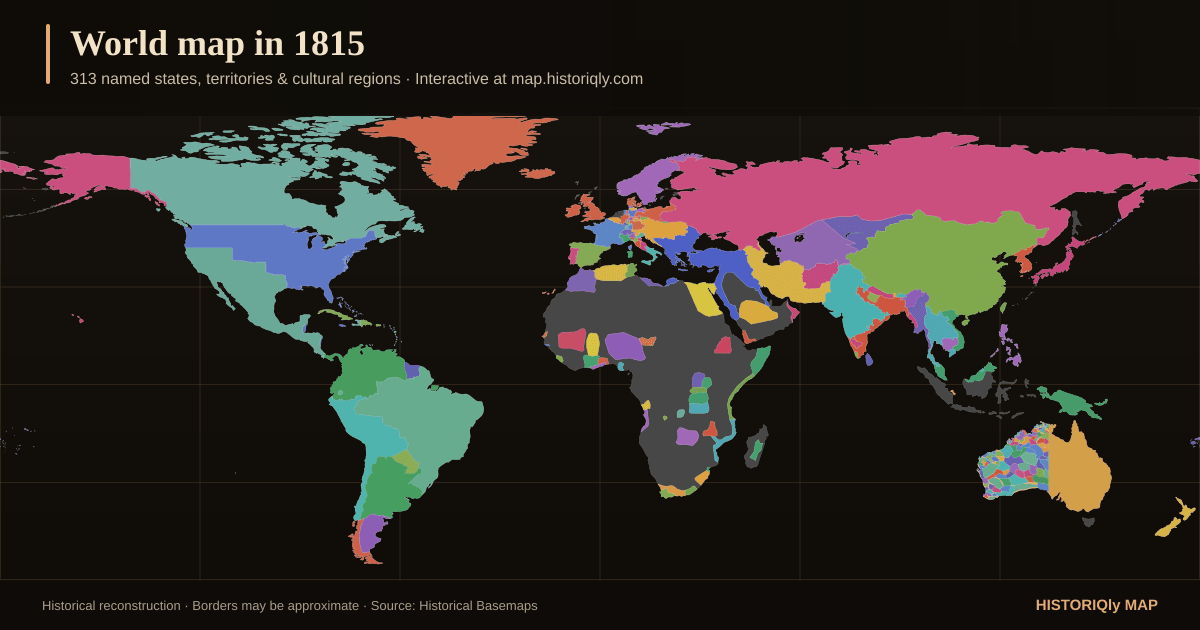
Explore a reconstruction of the world around 1815. Trace the age of revolution, colonial rivalry, and the political reshaping of the early modern world. Figures near this year include James Madison, Jane Austen, John Adams.
Snapshot at a glance
Counts come directly from this snapshot and the historical layers available in HistorIQly Map.
These names are encoded in the boundary dataset. Inclusion does not settle disputed borders, sovereignty, spelling, or historical interpretation.
What this snapshot shows
The interactive map lets you inspect named territories in 1815 and compare them to earlier or later snapshots on the timeline.
Meet figures alive in, or close to, 1815 and move from political geography to the people connected to the period.
The related chronicles below provide long-form reading tied closely to the enlightenment period.
Conflicts connected to 1815
These editorial date ranges include 1815. Some records group intermittent campaigns or long-running conflict series, so inclusion does not mean continuous fighting in that exact year.
1803 – 1815
French Empire vs Various European coalitions
Napoleon's wars reshaped every border in Europe — from Austerlitz to the burning of Moscow to the final stand at Waterloo, no conflict before the 20th century had such a sweeping impact.
Key battles and events: Austerlitz (1805); Trafalgar (1805)
1815 – 1840
Zulu Kingdom (Shaka) vs Ndwandwe, Mthethwa, displaced peoples across southern Africa
The Mfecane was a massive upheaval triggered by Zulu expansion under Shaka that displaced millions across southern and eastern Africa, reshaping the entire region's political map.
Key battles and events: Battle of Gqokli Hill (1818); Battle of Mhlatuze River (1819)
1814 – 1880
Unitarians (Buenos Aires centralists) vs Federals (provincial caudillos)
Decades of conflict between Buenos Aires centralists (Unitarians) and provincial federalists tore Argentina apart. Caudillo Juan Manuel de Rosas dominated as dictator from 1835–1852 before his overthrow at Caseros. The wars ended only when Buenos Aires was federalized in 1880.
Key battles and events: Battle of Cepeda (1820); Battle of Caseros (1852)
1812 – 1815
United States vs British Empire & Canadian colonies
The young United States declared war on Britain over maritime grievances and expansionist ambitions. The war saw the burning of Washington D.C., the defence of Baltimore inspiring 'The Star-Spangled Banner', and Andrew Jackson's victory at New Orleans.
Key battles and events: Burning of Washington (1814); Battle of Baltimore (1814)
1810 – 1818
United Provinces of the Río de la Plata vs Spanish Empire (Royalists)
Following the May Revolution of 1810, Argentine patriots fought Spanish royalists across the Río de la Plata, the Andes, and Upper Peru. José de San Martín's crossing of the Andes to liberate Chile was one of the greatest military feats in history.
Key battles and events: Battle of Tucumán (1812); Battle of Salta (1813)
1810 – 1826
Chilean patriots, Argentine liberators (San Martín, O'Higgins) vs Royalist Spain
Bernardo O'Higgins and José de San Martín led the liberation of Chile with the famous crossing of the Andes, establishing Chile as an independent republic.
Key battles and events: Battle of Chacabuco (1817); Battle of Maipú (1818)
1810 – 1819
Colombian patriots (Simón Bolívar) vs Royalist Spain
Bolívar's daring crossing of the Andes and his victory at Boyacá liberated New Granada, leading to the creation of Gran Colombia — the short-lived republic that unified much of northern South America.
Key battles and events: Battle of Boyacá (1819); Siege of Cartagena (1815)
1810 – 1821
Mexican Insurgents (Hidalgo, Morelos, Iturbide) vs Spanish Colonial Government
Father Miguel Hidalgo's 'Grito de Dolores' in 1810 launched Mexico's independence movement. After a decade of guerrilla warfare, Agustín de Iturbide united royalist and rebel forces to achieve independence and briefly made himself emperor of Mexico.
Key battles and events: Battle of Guanajuato (1810); Battle of Calderón Bridge (1811)
Historical figures near 1815
United States
1751 – 1836
Principal architect of the Constitution, author of the Bill of Rights, co-author of The Federalist Papers, 4th President of the United States
England
1775 – 1817
Author of Pride and Prejudice, pioneer of the English novel of manners, master of irony and free indirect discourse
America
1735 – 1826
2nd President, Declaration of Independence, Massachusetts Constitution, peace with France
America
1743 – 1826
3rd President, principal author of the Declaration of Independence, Louisiana Purchase, founder of the University of Virginia
Caribbean / United States
1755 – 1804
Founding Father, first Secretary of the Treasury, Federalist Papers, creation of the U.S. financial system
Königsberg, Prussia
1724 – 1804
Critique of Pure Reason, categorical imperative, transcendental idealism, Copernican revolution in philosophy
Landmarks standing in 1815
Sites already standing (or still being used) in 1815, drawn from the map's landmark layers.
Built 1794 · Oceania
Pacific crossroads for the 19th-century whaling industry and sandalwood trade, strategic refueling station linking Asia and the Americas
Built 1788 · Oceania
Former British penal settlement on Norfolk Island, part of the Australian Convict Sites World Heritage listing, later resettled by Pitcairn Islanders.
Built 1788 · Oceania
First European settlement in Australia that grew into the primary trade hub of the South Pacific, connecting Oceania to global commerce
Built 1782 · Asia
Temple of the Emerald Buddha within Bangkok's Grand Palace, Thailand's most sacred site
Built 1776 · North America
Spanish Franciscan mission in California known as the 'Jewel of the Missions,' famed for its Great Stone Church ruins and returning swallows.
Built 1766 · South America
Brazilian Rococo masterpiece by the sculptor Aleijadinho in the colonial gold-rush town of Ouro Preto, Minas Gerais.
Related chronicles
America · Leader
The Atlas of Independence
The life of America’s most underappreciated founder — the farmer’s son who defended British soldiers in court, argued a continent into independence, and kept a young republic out of war.
Read John AdamsUnited States · Leader
The Father of the Constitution
The quiet Virginian who designed the blueprint for American democracy — architect of the Constitution, author of the Bill of Rights, and the president who proved the republic could survive a war.
Read James MadisonEngland · Thinker
The Lady Behind the Pen
The life of the anonymous lady who rewrote the rules of English fiction from a cottage in Hampshire — told in her own voice in a first-person ePub.
Read Jane AustenAmerica · Leader
The Pen of the Revolution
The man who wrote the words that launched a nation — author of the Declaration of Independence, architect of the Louisiana Purchase, founder of the University of Virginia, and the president who doubled the size of a republic while wrestling with slavery’s shadow.
Read Thomas JeffersonBoundary source and context layers
Boundary geometry is adapted from Historical Basemaps, a GPL-3.0 project built for world- and continent-scale historical mapping. The source is a work in progress: pre-modern territories can overlap, borders are often disputed, and a snapshot should be read as a reconstruction around 1815, not as survey-level fact.
The source marks 1 of 436 geometries in this snapshot as approximate.
Conflicts, landmarks, trade routes, and biographies come from separate HistorIQly editorial datasets. They provide discovery context but do not yet expose a citation for every individual record; verify a specific claim with specialist sources before citing it.
Frequently asked questions
The 1815 source snapshot reconstructs political borders, territories, and named states for around 1815. You can inspect individual territories, view linked historical figures, and compare this snapshot with nearby years like 1783 and 1800.
HistorIQly records whose date ranges include 1815 include Napoleonic Wars, Mfecane (The Crushing), Argentine Civil Wars, War of 1812, Argentine War of Independence. Long-running entries may represent intermittent campaigns rather than continuous warfare.
Figures linked near 1815 include James Madison, Jane Austen, John Adams, Thomas Jefferson. Some were alive in this year; others are included because their lives fall within the surrounding historical period.
HistorIQly Map includes 49 historical snapshots spanning from 3000 BC through the modern era, covering the enlightenment era and every other major period of world history.
Example labels encoded in the 1815 source snapshot include Russian Empire, Canada, Manchu Empire, Viceroyalty of Brazil, Denmark, United States. These labels and reconstructed boundaries can be approximate or disputed; inspect the map methodology before using them for research.
Nearby years
Related map topics
Historical maps by year
Choose from 49 historical world maps by year. Explore borders, empires, wars, landmarks, trade routes, and people from 3000 BC to the modern era.
Modern history map
Compare modern history maps from revolutions and empires to world wars, decolonization, Cold War borders, and contemporary states.
World history atlas
Browse an interactive world history atlas with maps of empires, wars, trade routes, landmarks, and influential figures from ancient history through the modern era.