
Border history
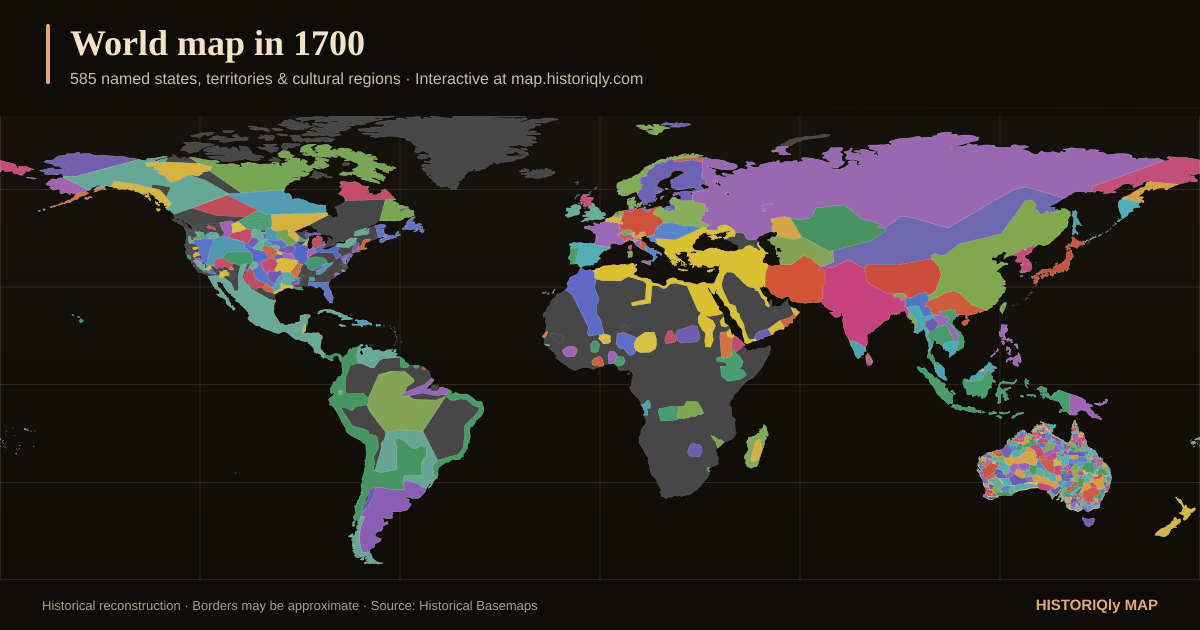
The interactive map lets you inspect named territories in 1700 and compare them to earlier or later snapshots on the timeline.
Enlightenment historical map
Explore a reconstruction of the world around 1700. Trace the age of revolution, colonial rivalry, and the political reshaping of the early modern world. Figures near this year include Baal Shem Tov, Isaac Newton, Johann Sebastian Bach.
Snapshot at a glance
Counts come directly from this snapshot and the historical layers available in HistorIQly Map.
These names are encoded in the boundary dataset. Inclusion does not settle disputed borders, sovereignty, spelling, or historical interpretation.
What this snapshot shows
The interactive map lets you inspect named territories in 1700 and compare them to earlier or later snapshots on the timeline.
Meet figures alive in, or close to, 1700 and move from political geography to the people connected to the period.
The related chronicles below provide long-form reading tied closely to the enlightenment period.
Conflicts connected to 1700
These editorial date ranges include 1700. Some records group intermittent campaigns or long-running conflict series, so inclusion does not mean continuous fighting in that exact year.
1700 – 1721
Sweden vs Russia vs Denmark-Norway vs Saxony-Poland
Peter the Great's war to transform Russia into a European power — Sweden's Charles XII won stunning victories before losing everything at Poltava.
Key battles and events: Narva (1700); Poltava (1709)
1689 – 1746
Jacobite supporters of the Stuart dynasty vs British Government (Hanoverians)
A series of uprisings to restore the exiled Stuart kings to the British throne. The final rising in 1745 under Bonnie Prince Charlie came close to success before the devastating defeat at Culloden ended Stuart hopes forever.
Key battles and events: Battle of Killiecrankie (1689); Battle of the Boyne (1690)
1687 – 1757
Qing Dynasty vs Dzungar Khanate
Seven decades of warfare between the Qing Empire and the last great nomadic power in Central Asia. The Qing's final victory in 1757 resulted in the near-complete destruction of the Dzungar people — one of the 18th century's worst atrocities — and brought Xinjiang and Mongolia under Chinese control.
Key battles and events: Battle of Jao Modo (1696); Battle of Oroi-Jalatu (1756)
1684 – 1834
Rozvi Empire vs Portuguese, Mutapa, Ndebele
The Rozvi Empire expelled the Portuguese from the Zimbabwe Plateau and dominated southern Africa until being destroyed by Ndebele invaders during the Mfecane.
Key battles and events: Expulsion of Portuguese from Mashonaland (1690s); Ndebele destruction of Rozvi (1834)
1680 – 1707
Mughal Empire (Aurangzeb) vs Maratha Empire (Shivaji, Sambhaji)
Mughal emperor Aurangzeb spent the last 25 years of his reign in an exhausting campaign to subjugate the Maratha Confederacy in the Deccan. Though he captured forts and executed Maratha leaders, the guerrilla resistance ultimately drained Mughal resources and hastened the empire's decline.
Key battles and events: Siege of Purandar (1665); Siege of Jinji (1689-1698)
1674 – 1761
Maratha Empire (Shivaji, Peshwas) vs Mughal Empire, Afghan Durrani Empire
Shivaji founded the Maratha Empire through guerrilla warfare against the Mughals. His successors expanded across India, effectively replacing Mughal power, until the catastrophic Third Battle of Panipat against the Afghans shattered Maratha supremacy.
Key battles and events: Battle of Pratapgad (1659); Battle of Bhopal (1738)
1609 – 1701
Haudenosaunee (Iroquois Confederacy) vs Huron-Wendat, Erie, Susquehannock, Algonquin, French
Haudenosaunee, other Indigenous nations, and European allies fought over trade and power; the Great Peace of Montreal followed in 1701.
Key battles and events: Destruction of Huronia (1649); Destruction of Erie nation (1656)
1595 – 1707
Mughal Empire vs Deccan Sultanates (Ahmadnagar, Bijapur, Golconda)
Century-long Mughal campaigns to conquer the Deccan sultanates of southern India, culminating in Aurangzeb's exhausting obsession that drained the empire's strength.
Key battles and events: Siege of Ahmadnagar (1600); Fall of Bijapur (1686)
Historical figures near 1700
Poland-Lithuania (modern Ukraine)
c. 1698 – 1760
Founding of Hasidism, mystical devotion, joyful prayer, elevation of the common Jew
England
1643 – 1727
Laws of motion, universal gravitation, calculus, optics, Principia Mathematica
Germany
1685 – 1750
Baroque composer, organist, master of counterpoint, creator of the Brandenburg Concertos, the Well-Tempered Clavier, and the St. Matthew Passion
England
1632 – 1704
Empiricist philosophy, natural rights theory, founding modern liberalism
France
1638 – 1715
Absolute monarch, builder of Versailles, longest reign in European history
Russia
1672 – 1725
Tsar of Russia, founder of St. Petersburg, moderniser, military reformer, Great Northern War victor
Landmarks standing in 1700
Sites already standing (or still being used) in 1700, drawn from the map's landmark layers.
Built 1692 · North America
White Dove of the Desert, a Spanish colonial mission near Tucson, Arizona
Built 1692 · Asia
Sacred Buddhist monastery clinging to a cliff face 3,120 m above the Paro Valley in Bhutan
Built 1690 · Asia
Founded as a British East India Company trading post, grew into the commercial capital of British India and gateway to Bengal's wealth
Built 1675 · Europe
Grand Sephardic synagogue built by Portuguese Jews who fled the Inquisition, still lit by candles and in active use
Built 1673 · Asia
Mughal-era mosque in Lahore, Pakistan, one of the largest and most beautiful in the world
Built 1670 · North America
Major colonial port in British North America, center of the rice and indigo trade and one of the busiest slave trading ports in the Americas
Related chronicles
Poland-Lithuania (modern Ukraine) · Philosopher
The Master of the Good Name
The orphaned clay digger who became the most transformative Jewish mystic since the Kabbalists — founding Hasidism through joy, story, and the radical claim that every soul can reach God.
Read Baal Shem TovEngland · Scientist
The Last Magician
The life of the man who unlocked the laws of the universe — from a fatherless childhood in Lincolnshire to the presidency of the Royal Society. A first-person ePub told in Newton’s own voice.
Read Isaac NewtonGermany · Artist
The Fifth Evangelist
The life of the greatest composer in Western history — organist, cantor, and genius of counterpoint who wrote over a thousand works, fathered twenty children, and died in near-obscurity before the world understood what it had lost.
Read Johann Sebastian BachEngland · Philosopher
The Father of Liberalism
The philosopher who gave the world natural rights, the social contract, and the intellectual blueprint for modern democracy — told in his own words in a first-person ePub.
Read John LockeBoundary source and context layers
Boundary geometry is adapted from Historical Basemaps, a GPL-3.0 project built for world- and continent-scale historical mapping. The source is a work in progress: pre-modern territories can overlap, borders are often disputed, and a snapshot should be read as a reconstruction around 1700, not as survey-level fact.
The source marks 8 of 782 geometries in this snapshot as approximate.
Conflicts, landmarks, trade routes, and biographies come from separate HistorIQly editorial datasets. They provide discovery context but do not yet expose a citation for every individual record; verify a specific claim with specialist sources before citing it.
Frequently asked questions
The 1700 source snapshot reconstructs political borders, territories, and named states for around 1700. You can inspect individual territories, view linked historical figures, and compare this snapshot with nearby years like 1600 and 1650.
HistorIQly records whose date ranges include 1700 include Great Northern War, Jacobite Risings, Dzungar–Qing Wars, Rozvi Empire Wars, Mughal–Maratha Wars. Long-running entries may represent intermittent campaigns rather than continuous warfare.
Figures linked near 1700 include Baal Shem Tov, Isaac Newton, Johann Sebastian Bach, John Locke. Some were alive in this year; others are included because their lives fall within the surrounding historical period.
HistorIQly Map includes 49 historical snapshots spanning from 3000 BC through the modern era, covering the enlightenment era and every other major period of world history.
Example labels encoded in the 1700 source snapshot include Tsardom of Muscovy, central Asian khanates, Manchu Empire, Ottoman Empire, Mughal Empire, Vice-Royalty of Peru. These labels and reconstructed boundaries can be approximate or disputed; inspect the map methodology before using them for research.
Nearby years
Related map topics
Historical maps by year
Choose from 49 historical world maps by year. Explore borders, empires, wars, landmarks, trade routes, and people from 3000 BC to the modern era.
Modern history map
Compare modern history maps from revolutions and empires to world wars, decolonization, Cold War borders, and contemporary states.
World history atlas
Browse an interactive world history atlas with maps of empires, wars, trade routes, landmarks, and influential figures from ancient history through the modern era.