
Border history
The interactive map lets you inspect named territories in 1600 and compare them to earlier or later snapshots on the timeline.
Renaissance historical map
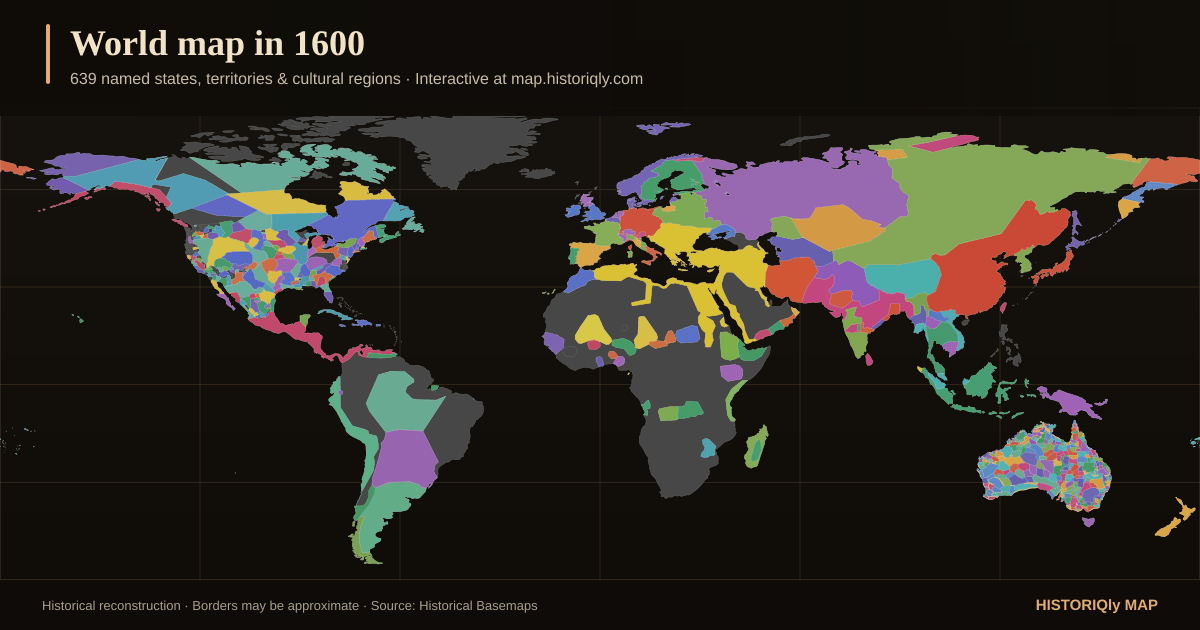
Explore a reconstruction of the world around 1600. See the late medieval and early modern transition as maritime powers, gunpowder states, and new empires emerge. Figures near this year include Elizabeth I, Galileo Galilei, William Shakespeare.
Snapshot at a glance
Counts come directly from this snapshot and the historical layers available in HistorIQly Map.
These names are encoded in the boundary dataset. Inclusion does not settle disputed borders, sovereignty, spelling, or historical interpretation.
What this snapshot shows
The interactive map lets you inspect named territories in 1600 and compare them to earlier or later snapshots on the timeline.
Meet figures alive in, or close to, 1600 and move from political geography to the people connected to the period.
The related chronicles below provide long-form reading tied closely to the renaissance period.
Conflicts connected to 1600
These editorial date ranges include 1600. Some records group intermittent campaigns or long-running conflict series, so inclusion does not mean continuous fighting in that exact year.
1600 – 1615
Eastern Army (Tokugawa Ieyasu) vs Western Army (Ishida Mitsunari)
The decisive battle of Sekigahara unified Japan under Tokugawa rule, ending the Sengoku period. The subsequent siege of Osaka Castle eliminated the last Toyotomi resistance and ushered in 250 years of peace.
Key battles and events: Battle of Sekigahara (1600); Winter Siege of Osaka (1614)
1598 – 1663
Dutch Republic, VOC and WIC vs Portuguese Empire and Iberian Union
A global colonial war fought from Brazil and Angola to Ceylon, India and Southeast Asia, as Dutch companies tried to seize Portuguese commercial and maritime dominance.
Key battles and events: Battle of Bantam (1601); Second Battle of Guararapes (1649)
1595 – 1707
Mughal Empire vs Deccan Sultanates (Ahmadnagar, Bijapur, Golconda)
Century-long Mughal campaigns to conquer the Deccan sultanates of southern India, culminating in Aurangzeb's exhausting obsession that drained the empire's strength.
Key battles and events: Siege of Ahmadnagar (1600); Fall of Bijapur (1686)
1593 – 1606
Habsburg Monarchy and allies vs Ottoman Empire and vassals
A grinding Habsburg-Ottoman struggle across Hungary and the Balkans whose huge cost exhausted both empires and ended in the Peace of Zsitvatorok.
Key battles and events: Battle of Sisak (1593); Siege of Eger (1596)
1593 – 1603
Gaelic Irish chieftains (Hugh O'Neill) vs Kingdom of England
The last great Gaelic Irish resistance to English rule, led by Hugh O'Neill, Earl of Tyrone. After initial Irish victories and Spanish intervention at Kinsale, English forces prevailed, completing the Tudor conquest of Ireland.
Key battles and events: Battle of the Yellow Ford (1598); Battle of Kinsale (1601)
1585 – 1604
England (Elizabeth I) vs Spain (Philip II)
England's support for Dutch rebels and Protestant causes provoked Spain to launch the famous Spanish Armada in 1588. The Armada's catastrophic defeat by English fire ships and Atlantic storms marked the beginning of England's rise as a naval power and Spain's slow decline.
Key battles and events: Defeat of the Spanish Armada (1588); English Armada (1589)
1568 – 1648
Dutch Republic (United Provinces) vs Spanish Empire (Habsburg Spain)
The Dutch provinces revolted against Spanish Habsburg rule over taxation, religious persecution, and political autonomy. After 80 years of fighting, the Peace of Munster recognised Dutch independence.
Key battles and events: Battle of Heiligerlee (1568); Siege of Leiden (1573–1574)
1557 – 1707
Mughal Empire vs Rajput kingdoms (Mewar, Marwar)
A series of wars between the Mughal emperors and the Hindu Rajput kingdoms. While Akbar won many Rajputs as allies, Mewar resisted for generations until Aurangzeb's campaigns finally subdued them.
Key battles and events: Siege of Chittorgarh (1568); Battle of Haldighati (1576)
Historical figures near 1600
England
1533 – 1603
Defeated the Spanish Armada, established the Elizabethan Religious Settlement, presided over England's golden age of literature and exploration
Italy
1564 – 1642
Father of modern observational astronomy, physics, and the scientific method
England
1564 – 1616
Playwright, poet, actor, shareholder in the Globe Theatre, author of Hamlet, Macbeth, King Lear, and the Sonnets
France
1519 – 1589
Queen Mother of France, regent during the Wars of Religion, political survivor, patron of the arts
Geneva
1509 – 1564
Protestant reformer, theologian, author of the Institutes of the Christian Religion, builder of Geneva's reformed church
Florence & Rome
1475 – 1564
Sculptor, painter, architect, poet — creator of the David, the Sistine Chapel ceiling, and the dome of St. Peter's
Landmarks standing in 1600
Sites already standing (or still being used) in 1600, drawn from the map's landmark layers.
Built 1600 · Asia
Historic Hindu temple complex in Madurai, Tamil Nadu
Built 1597 · North America
Caribbean terminus of the Spanish treasure fleet system, where Peruvian silver carried across the Isthmus of Panama was loaded for Seville.
Built 1593 · South America
Neoclassical cathedral on Plaza de Mayo, seat of the Archbishop of Buenos Aires
Built 1587 · South America
Lavish Baroque church in Salvador covered in gold leaf, a jewel of colonial Brazil
Built 1587 · Asia
Oldest stone church in the Philippines, the only building in Manila to survive every war and earthquake
Built 1586 · South America
Oldest surviving church in Santiago, Chile, built after the 1583 earthquake
Related chronicles
England · Leader
The Virgin Queen
The princess who survived the Tower, outwitted Europe’s mightiest kings, and ruled for forty-four years without ever sharing her throne — told in her own voice.
Read Elizabeth IItaly · Scientist
The Man Who Moved the Earth
The astronomer who turned a spyglass toward the heavens, saw what no one had seen before, and paid for the truth with his freedom — told in his own words.
Read Galileo GalileiEngland · Artist
The Upstart Crow Who Named the World
The glover’s son from Stratford who became the greatest writer in the English language — from the lost years to the Globe Theatre, told in his own voice in a first-person ePub.
Read William ShakespeareFrance · Leader
The Black Queen
The Florentine orphan who became the most powerful woman in Europe — queen, regent, and the force behind three kings of France through thirty years of civil war.
Read Catherine de' MediciBoundary source and context layers
Boundary geometry is adapted from Historical Basemaps, a GPL-3.0 project built for world- and continent-scale historical mapping. The source is a work in progress: pre-modern territories can overlap, borders are often disputed, and a snapshot should be read as a reconstruction around 1600, not as survey-level fact.
The source marks 864 of 866 geometries in this snapshot as approximate.
Conflicts, landmarks, trade routes, and biographies come from separate HistorIQly editorial datasets. They provide discovery context but do not yet expose a citation for every individual record; verify a specific claim with specialist sources before citing it.
Frequently asked questions
The 1600 source snapshot reconstructs political borders, territories, and named states for around 1600. You can inspect individual territories, view linked historical figures, and compare this snapshot with nearby years like 1500 and 1530.
HistorIQly records whose date ranges include 1600 include Sekigahara Campaign, Dutch-Portuguese War, Mughal–Deccan Wars, Long Turkish War, Nine Years' War in Ireland. Long-running entries may represent intermittent campaigns rather than continuous warfare.
Figures linked near 1600 include Elizabeth I, Galileo Galilei, William Shakespeare, Catherine de' Medici. Some were alive in this year; others are included because their lives fall within the surrounding historical period.
HistorIQly Map includes 49 historical snapshots spanning from 3000 BC through the modern era, covering the renaissance era and every other major period of world history.
Example labels encoded in the 1600 source snapshot include central Asian khanates, Tsardom of Muscovy, Ming Chinese Empire, Ottoman Empire, Quazaq Khanate, Tibet. These labels and reconstructed boundaries can be approximate or disputed; inspect the map methodology before using them for research.
Nearby years
Related map topics
Historical maps by year
Choose from 49 historical world maps by year. Explore borders, empires, wars, landmarks, trade routes, and people from 3000 BC to the modern era.
Historical borders
Compare historical borders on an interactive map. Explore territories, empires, wars, and political change from 3000 BC through a modern comparison view.
World history atlas
Browse an interactive world history atlas with maps of empires, wars, trade routes, landmarks, and influential figures from ancient history through the modern era.