
Border history
The interactive map lets you inspect named territories in 1492 and compare them to earlier or later snapshots on the timeline.
Renaissance historical map
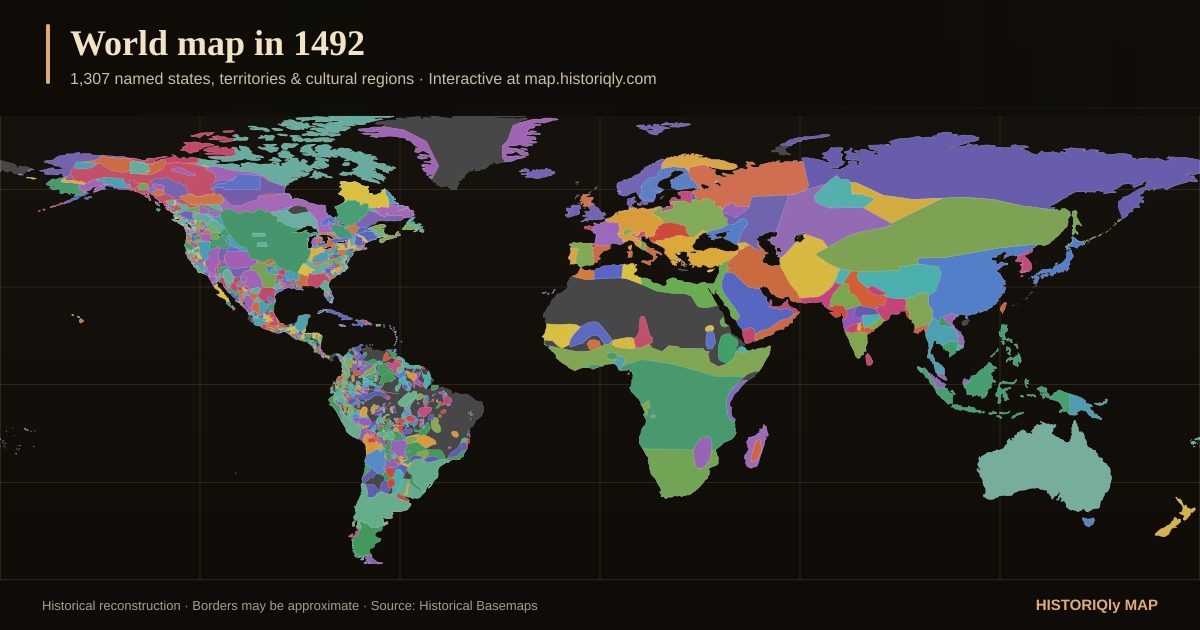
Explore a reconstruction of the world around 1492. See the late medieval and early modern transition as maritime powers, gunpowder states, and new empires emerge. Figures near this year include Christopher Columbus, Henry VIII, Leonardo da Vinci.
Snapshot at a glance
Counts come directly from this snapshot and the historical layers available in HistorIQly Map.
These names are encoded in the boundary dataset. Inclusion does not settle disputed borders, sovereignty, spelling, or historical interpretation.
What this snapshot shows
The interactive map lets you inspect named territories in 1492 and compare them to earlier or later snapshots on the timeline.
Meet figures alive in, or close to, 1492 and move from political geography to the people connected to the period.
The related chronicles below provide long-form reading tied closely to the renaissance period.
Conflicts connected to 1492
These editorial date ranges include 1492. Some records group intermittent campaigns or long-running conflict series, so inclusion does not mean continuous fighting in that exact year.
1468 – 1769
Crimean Khanate, Ottoman Empire vs Poland-Lithuania, Muscovy/Russia, Cossack Hetmanate
Three centuries of devastating slave raids by the Crimean Tatars into Eastern Europe, capturing an estimated 2–3 million people for Ottoman slave markets.
Key battles and events: Sack of Moscow (1571); Battle of Molodi (1572)
1467 – 1615
Rival daimyō clans (Oda, Toyotomi, Tokugawa, Takeda, Uesugi, etc.) vs Various feudal lords & Ashikaga Shogunate
Nearly 150 years of civil war as feudal warlords fought for supremacy across Japan. Three great unifiers — Oda Nobunaga, Toyotomi Hideyoshi, and Tokugawa Ieyasu — progressively reunified the country, culminating in the Tokugawa Shogunate that would rule for 250 years.
Key battles and events: Ōnin War / Fall of Kyoto (1467–1477); Battle of Okehazama (1560)
1464 – 1591
Songhai Empire (Sunni Ali, Askia Muhammad) vs Mali Empire remnants, Mossi states
Sunni Ali Ber transformed Songhai into West Africa's largest empire, conquering Timbuktu and Djenné. Under the Askia dynasty, Songhai became a center of Islamic learning until Moroccan musketeers destroyed it at Tondibi in 1591.
Key battles and events: Capture of Timbuktu (1468); Capture of Djenné (1473)
1445 – 1556
Tsardom of Russia (Ivan IV) vs Khanate of Kazan, Khanate of Astrakhan
Ivan the Terrible's conquest of the Tatar khanates of Kazan (1552) and Astrakhan (1556) was a transformative moment in Russian history, opening the Volga trade route and beginning Russia's expansion into a multi-ethnic empire.
Key battles and events: Siege of Kazan (1552); Fall of Astrakhan (1556)
1438 – 1533
Inca Empire (Pachacuti, Huayna Capac) vs Chimú, Chanka & other Andean peoples
Beginning with Pachacuti's defeat of the Chanka, the Incas expanded from a small kingdom near Cusco into the largest empire in pre-Columbian America, stretching 4,000 km along the Andes. They built an extraordinary road system without the wheel or writing.
Key battles and events: Battle of Yahuarpampa / Chanka War (1438); Conquest of the Chimú (1470)
1428 – 1521
Aztec Triple Alliance (Tenochtitlan, Texcoco, Tlacopan) vs Various Mesoamerican city-states
The Aztec Triple Alliance rapidly expanded from the Valley of Mexico to dominate most of central Mesoamerica. Through a combination of military conquest and the ritualized 'Flower Wars', the Aztecs built an empire of 5-6 million people with Tenochtitlan as one of the world's largest cities.
Key battles and events: Tepanec War (1428); Conquest of Tlatelolco (1473)
1390 – 1709
Kingdom of Kongo vs Portuguese, Imbangala, Jaga, rival vassals
The Kingdom of Kongo fought Portuguese expansion, slave-raiding Imbangala, and internal succession wars that culminated in its catastrophic defeat at the Battle of Mbwila.
Key battles and events: Battle of Mbwila (1665); Battle of Ambuila (1665)
1353 – 1707
Kingdom of Lan Xang vs Siam, Burma, Đại Việt, Champa
The Lao kingdom of Lan Xang fought for survival against its powerful neighbours for 350 years, at its peak controlling territory from the Mekong to the Vietnamese highlands.
Key battles and events: Fa Ngum's unification (1353); Burmese invasion (1574)
Historical figures near 1492
Spain / Atlantic / Caribbean
c. 1451 – 1506
Four voyages across the Atlantic, opening sustained European contact with the Americas
England
1491 – 1547
Break with Rome, English Reformation, six marriages, founding the Church of England
Florence, Milan, France
1452 – 1519
Painter of the Mona Lisa and The Last Supper, inventor, anatomist, engineer, and the supreme polymath of the Renaissance
Germany
1483 – 1546
Protestant Reformation, 95 Theses, Bible translation, theology of grace
Florence & Rome
1475 – 1564
Sculptor, painter, architect, poet — creator of the David, the Sistine Chapel ceiling, and the dome of St. Peter's
Florence
1469 – 1527
Political philosopher, diplomat, author of The Prince, founder of modern political science
Landmarks standing in 1492
Sites already standing (or still being used) in 1492, drawn from the map's landmark layers.
Built 1481 · Asia
Sacred blue-tiled shrine in Afghanistan believed by many to hold the tomb of Ali ibn Abi Talib, a major pilgrimage destination
Built 1459 · Asia
UNESCO-listed medieval mosque in Bagerhat, Bangladesh, the largest in the Sultanate period with 77 low domes and thick brick walls
Built 1450 · South America
Inca citadel set high in the Andes Mountains
Natural wonder · Oceania
Symmetrical shield volcano in New Zealand's Hauraki Gulf that erupted around 600 years ago, hosting the world's largest pohutukawa forest on its cooled lava fields.
Built 1438 · South America
Inca Temple of the Sun in Cusco, once the richest temple in the empire, its walls lined with gold
Built 1438 · South America
Massive Inca fortress above Cusco with interlocking stone walls made of boulders weighing over 100 tonnes each
Related chronicles
England · Leader
The King Who Broke with Rome
The Tudor king who shattered a thousand years of papal authority, married six wives, dissolved the monasteries, and forged the Church of England — transforming his kingdom and reshaping the course of Western civilisation forever.
Read Henry VIIISpain / Atlantic / Caribbean · Explorer
The Admiral of the Ocean Sea
The Genoese weaver’s son who convinced a queen, crossed an ocean, and changed the world forever — told in his own words in a first-person ePub.
Read Christopher ColumbusFlorence, Milan, France · Artist
He Filled 13,000 Pages With the Future. Then the World Lost Them for 300 Years.
The life of the ultimate Renaissance man — illegitimate son, apprentice, painter, engineer, anatomist, and visionary. A first-person ePub told in Leonardo's own voice.
Read Leonardo da VinciFlorence · Thinker
The Man Who Taught Princes to Rule
The Florentine diplomat who watched republics fall, served tyrants and statesmen alike, was tortured for conspiracy, and in exile wrote the most dangerous book in Western political thought — told in his own voice.
Read Niccolò MachiavelliBoundary source and context layers
Boundary geometry is adapted from Historical Basemaps, a GPL-3.0 project built for world- and continent-scale historical mapping. The source is a work in progress: pre-modern territories can overlap, borders are often disputed, and a snapshot should be read as a reconstruction around 1492, not as survey-level fact.
The source marks 1,945 of 1,946 geometries in this snapshot as approximate.
Conflicts, landmarks, trade routes, and biographies come from separate HistorIQly editorial datasets. They provide discovery context but do not yet expose a citation for every individual record; verify a specific claim with specialist sources before citing it.
Frequently asked questions
The 1492 source snapshot reconstructs political borders, territories, and named states for around 1492. You can inspect individual territories, view linked historical figures, and compare this snapshot with nearby years like 1300 and 1400.
HistorIQly records whose date ranges include 1492 include Crimean Khanate Slave Raids, Sengoku Period (Japanese Warring States), Wars of the Songhai Empire, Russo–Kazan Wars, Inca Empire Expansion. Long-running entries may represent intermittent campaigns rather than continuous warfare.
Figures linked near 1492 include Christopher Columbus, Henry VIII, Leonardo da Vinci, Martin Luther. Some were alive in this year; others are included because their lives fall within the surrounding historical period.
HistorIQly Map includes 49 historical snapshots spanning from 3000 BC through the modern era, covering the renaissance era and every other major period of world history.
Example labels encoded in the 1492 source snapshot include Chagatai Khanate, Ming Empire, Grand Duchy of Moscow, Timurid Emirates, Tibet, Emirate of the White Sheep Turks. These labels and reconstructed boundaries can be approximate or disputed; inspect the map methodology before using them for research.
Nearby years
Related map topics
Historical maps by year
Choose from 49 historical world maps by year. Explore borders, empires, wars, landmarks, trade routes, and people from 3000 BC to the modern era.
Historical borders
Compare historical borders on an interactive map. Explore territories, empires, wars, and political change from 3000 BC through a modern comparison view.
World history atlas
Browse an interactive world history atlas with maps of empires, wars, trade routes, landmarks, and influential figures from ancient history through the modern era.