
Border history
The interactive map lets you inspect named territories in 1200 and compare them to earlier or later snapshots on the timeline.
Medieval historical map
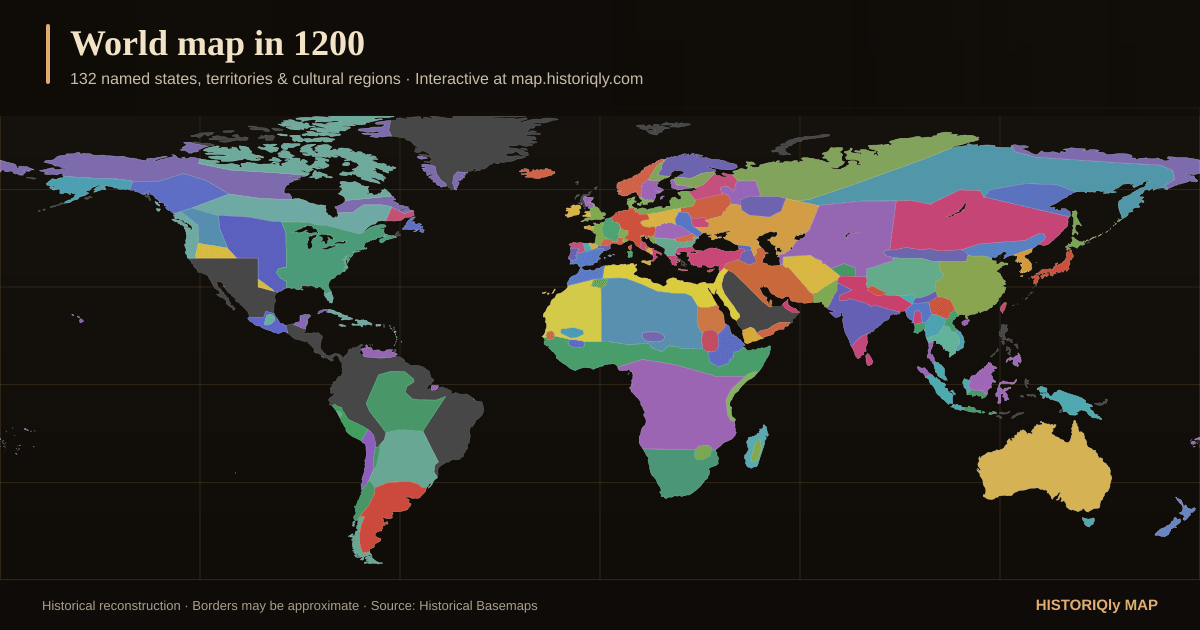
Explore a reconstruction of the world around 1200. Explore caliphates, dynasties, kingdoms, and trade networks across Afro-Eurasia. Figures near this year include Genghis Khan, Zhu Xi, Ibn Rushd.
Snapshot at a glance
Counts come directly from this snapshot and the historical layers available in HistorIQly Map.
These names are encoded in the boundary dataset. Inclusion does not settle disputed borders, sovereignty, spelling, or historical interpretation.
What this snapshot shows
The interactive map lets you inspect named territories in 1200 and compare them to earlier or later snapshots on the timeline.
Meet figures alive in, or close to, 1200 and move from political geography to the people connected to the period.
The related chronicles below provide long-form reading tied closely to the medieval period.
Conflicts connected to 1200
These editorial date ranges include 1200. Some records group intermittent campaigns or long-running conflict series, so inclusion does not mean continuous fighting in that exact year.
1096 – 1291
Christian Crusader states vs Muslim dynasties
Two centuries of religious warfare for control of the Holy Land — nine major crusades that transformed trade, culture, and the balance of power between Christendom and Islam.
Key battles and events: Siege of Jerusalem (1099); Hattin (1187)
1200 – 1600
Tongan chiefly lineages vs Rival regional chiefly networks
Tongan maritime power grew through regional exchange and political rivalry. This approximate period overview does not establish continuous conquest or uniformly controlled borders.
Key battles and events: State formation and overseas contacts (c. 1200–1300); Expansion of maritime influence (later second millennium AD)
1193 – 1290
Teutonic Knights, Livonian Order, Denmark, Sweden vs Pagan Baltic & Finnic peoples
Catholic military orders waged a century of crusades to conquer and Christianise the pagan peoples of the Baltic region. The Teutonic Knights established a powerful monastic state in Prussia and Livonia that shaped the region's politics for centuries.
Key battles and events: Siege of Riga (1201); Battle on the Ice / Lake Peipus (1242)
1177 – 1220
Khmer Empire (Jayavarman VII) vs Kingdom of Champa
Champa's devastating 1177 naval attack sacked the Khmer capital of Angkor. Jayavarman VII rallied the Khmer, defeated Champa in a great naval battle on Tonle Sap, and rebuilt Angkor on an even grander scale — including the famous Bayon temple.
Key battles and events: Cham sack of Angkor (1177); Naval battle on Tonle Sap (1181)
1150 – 1200
Toltec state (Tula/Tollan, Huemac) vs Chichimec groups (Xolotl) vs Nonoalca factions
The Toltec capital Tula collapsed in the mid-12th century amid Tolteca–Nonoalca factionalism and Chichimec pressure from the north, opening central Mexico to successive Nahua migrations that culminated in the Aztec rise.
Key battles and events: Fall and burning of Tula (c. 1150 CE); Chichimec migration under Xolotl (c. 1200 CE)
1141 – 1218
Khwarezmian Empire (Atsiz, Tekish, Ala ad-Din Muhammad II) vs Great Seljuk Sultanate (Ahmad Sanjar, Toghrul III) vs Ghurid Sultanate vs Kara-Khitan / Kara-Khanid successors
Starting as Seljuk vassals, the Khwarezmshahs asserted independence under Atsiz, defeated the last Great Seljuk sultan Toghrul III in 1194, broke the Ghurids in 1215, and under Muhammad II absorbed the Kara-Khanids to become the dominant Muslim power on the eve of the Mongol onslaught.
Key battles and events: Battle of Rey (1194); Conquest of Samarkand (1210)
1124 – 1218
Kara-Khitan / Western Liao (Yelü Dashi) vs Seljuk Empire (Ahmad Sanjar) vs Kara-Khanid Khanate vs Mongol Empire (Jebe)
After the fall of the Liao to the Jurchen Jin, Yelü Dashi led the remnant Khitans westward, founding the Western Liao and crushing the Seljuks at Qatwan in 1141 to dominate Transoxiana until the Mongols destroyed the realm in 1218.
Key battles and events: Conquest of Balasagun (1134); Battle of Qatwan (9 September 1141)
1121 – 1269
Almohad Caliphate vs Almoravids, Christian kingdoms
The Almohad movement swept out of the Atlas Mountains to conquer North Africa and Al-Andalus, creating the last great Berber empire. They fought both the declining Almoravids and the advancing Christian kingdoms of the Reconquista.
Key battles and events: Fall of Marrakesh (1147); Battle of Alarcos (1195)
Historical figures near 1200
Mongolia / Central Asia
c. 1162 – 1227
Unifier of Mongolia, founder of the largest contiguous empire in history
Fujian and Jiangxi, Southern Song dynasty China
1130 – 1200
Neo-Confucian synthesis, the Four Books, White Deer Grotto Academy, the doctrine of li and qi
Al-Andalus / Almohad Empire
1126 – 1198
Aristotle commentaries, Incoherence of the Incoherence, reconciliation of reason and revelation in Islamic thought
West Africa
c. 1217 – c. 1255
Founder of the Mali Empire, victor at the Battle of Kirina, father of the Manden Charter
Rhineland
1098 – 1179
Mystic, composer, physician, theologian, and Doctor of the Church — the most extraordinary woman of the Middle Ages
Kingdom of Sicily / Paris / Rome
c. 1225 – 1274
Scholastic philosopher, theologian, author of the Summa Theologiae, synthesiser of Aristotle and Christianity
Landmarks standing in 1200
Sites already standing (or still being used) in 1200, drawn from the map's landmark layers.
Built 1200 · North America
Sacred stone circle of 28 radiating spokes high in Wyoming's Bighorn Mountains, used by Plains peoples for ceremonies aligned to the solstice sun.
Built 1200 · Europe
Medieval commercial hub of the Hanseatic League in Flanders
Built 1200 · South America
Capital of the Inca Empire and hub of the Qhapaq Ñan road system, redistributing textiles, coca, maize, and metals across the Andes.
Built 1200 · South America
Remote island famous for its monumental moai statues
Built 1200 · Europe
Co-founder of the Hanseatic League and Germany's largest port, connecting North Sea trade with Central European river networks
Built 1200 · Oceania
Terraced stone pyramid tombs of the Tu'i Tonga kings at the ancient Tongan capital of Mu'a, built from coral limestone megaliths
Related chronicles
Mongolia / Central Asia · Conqueror
A Slave at 15. Khan at 40. Buried Where No One Will Ever Find Him.
The orphaned herdsman who rose from the Mongolian steppe to build the largest contiguous empire in human history — and the brutal genius behind it.
Read Genghis KhanFujian and Jiangxi, Southern Song dynasty China · Philosopher
The Philosopher Who Became a Sage
The Song dynasty philosopher who synthesised a thousand years of Confucian thought into the system that would govern East Asian intellectual life for seven centuries — condemned as a heretic in 1196, enshrined as a sage in 1241.
Read Zhu XiAl-Andalus / Almohad Empire · Philosopher
The Commentator
The Córdoban jurist and physician who wrote more commentaries on Aristotle than any scholar in history — and whose work was so indispensable to medieval Europe that they called him simply The Commentator, as though no other existed.
Read Ibn RushdWest Africa · Conqueror
The Lion Who Founded an Empire
The child who could not walk became the man who built an empire. Sundiata Keita — born into prophecy, hardened by exile, victorious at Kirina — founded the Mali Empire and gave his people one of history's earliest human rights charters.
Read Sundiata KeitaBoundary source and context layers
Boundary geometry is adapted from Historical Basemaps, a GPL-3.0 project built for world- and continent-scale historical mapping. The source is a work in progress: pre-modern territories can overlap, borders are often disputed, and a snapshot should be read as a reconstruction around 1200, not as survey-level fact.
The source marks 286 of 286 geometries in this snapshot as approximate.
Conflicts, landmarks, trade routes, and biographies come from separate HistorIQly editorial datasets. They provide discovery context but do not yet expose a citation for every individual record; verify a specific claim with specialist sources before citing it.
Frequently asked questions
The 1200 source snapshot reconstructs political borders, territories, and named states for around 1200. You can inspect individual territories, view linked historical figures, and compare this snapshot with nearby years like 1000 and 1100.
HistorIQly records whose date ranges include 1200 include The Crusades, Tongan Maritime Power and Rivalries, Northern Crusades / Baltic Crusades, Khmer–Cham Wars, Chichimec Invasions and Fall of Tula. Long-running entries may represent intermittent campaigns rather than continuous warfare.
Figures linked near 1200 include Genghis Khan, Zhu Xi, Ibn Rushd, Sundiata. Some were alive in this year; others are included because their lives fall within the surrounding historical period.
HistorIQly Map includes 49 historical snapshots spanning from 3000 BC through the modern era, covering the medieval era and every other major period of world history.
Example labels encoded in the 1200 source snapshot include Mongol Empire, Cuman Khanates, Song Empire, Tibet, Buwayhid Emirates, Fatimid Caliphate. These labels and reconstructed boundaries can be approximate or disputed; inspect the map methodology before using them for research.
Nearby years
Related map topics
Historical maps by year
Choose from 49 historical world maps by year. Explore borders, empires, wars, landmarks, trade routes, and people from 3000 BC to the modern era.
Medieval history map
Explore medieval world maps with kingdoms, caliphates, dynasties, trade routes, landmarks, wars, and border changes across Afro-Eurasia.
World history atlas
Browse an interactive world history atlas with maps of empires, wars, trade routes, landmarks, and influential figures from ancient history through the modern era.