
Border history
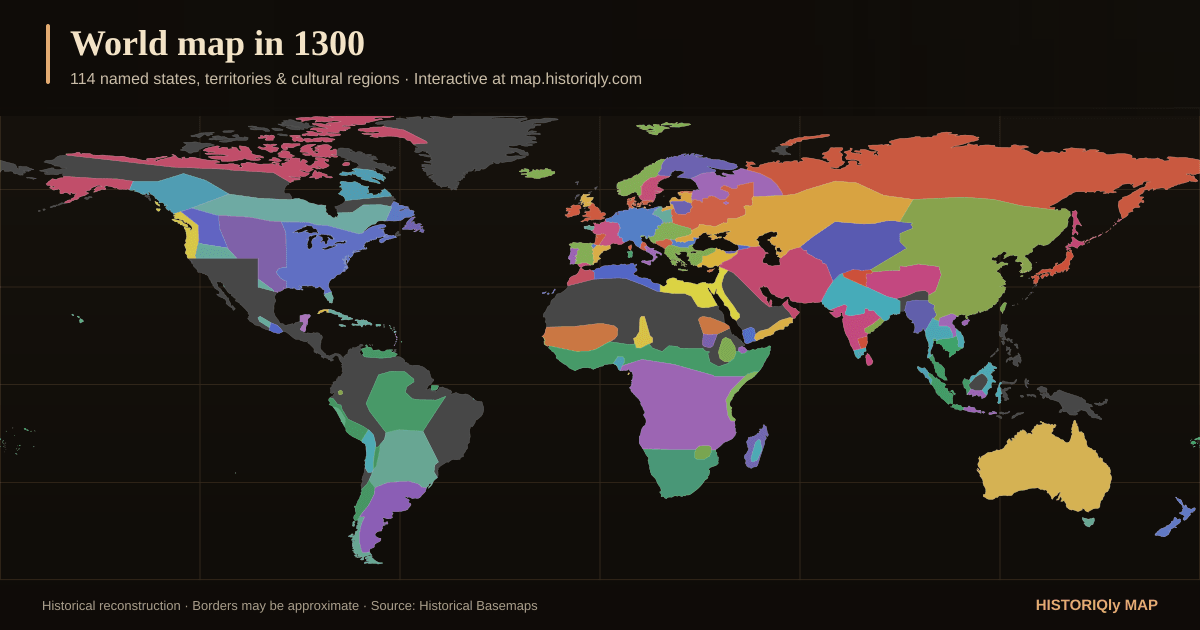
The interactive map lets you inspect named territories in 1300 and compare them to earlier or later snapshots on the timeline.
Medieval historical map
Explore a reconstruction of the world around 1300. Explore caliphates, dynasties, kingdoms, and trade networks across Afro-Eurasia. Figures near this year include Dante Alighieri, Mansa Musa, Ibn Battuta.
Snapshot at a glance
Counts come directly from this snapshot and the historical layers available in HistorIQly Map.
These names are encoded in the boundary dataset. Inclusion does not settle disputed borders, sovereignty, spelling, or historical interpretation.
What this snapshot shows
The interactive map lets you inspect named territories in 1300 and compare them to earlier or later snapshots on the timeline.
Meet figures alive in, or close to, 1300 and move from political geography to the people connected to the period.
The related chronicles below provide long-form reading tied closely to the medieval period.
Conflicts connected to 1300
These editorial date ranges include 1300. Some records group intermittent campaigns or long-running conflict series, so inclusion does not mean continuous fighting in that exact year.
1206 – 1368
Mongol Empire vs Various kingdoms and empires
The largest contiguous land empire in history — Genghis Khan and his successors conquered from Korea to Hungary, killing tens of millions and connecting East and West through the Pax Mongolica.
Key battles and events: Siege of Beijing (1215); Siege of Baghdad (1258)
1296 – 1560
Kingdom of England vs Kingdom of Scotland
Centuries of border warfare between England and Scotland, from Edward I's invasions through the Wars of Independence to ongoing border raids. The 'Auld Alliance' with France made Scotland a persistent strategic threat to England's northern flank.
Key battles and events: Battle of Stirling Bridge (1297); Battle of Bannockburn (1314)
1296 – 1357
Kingdom of Scotland (Wallace, Bruce) vs Kingdom of England (Edward I, II, III)
Scotland fought to maintain independence against English conquest. William Wallace's guerrilla campaign and Robert the Bruce's decisive victory at Bannockburn (1314) secured Scottish sovereignty, inspiring the Declaration of Arbroath — one of history's first statements of national self-determination.
Key battles and events: Battle of Stirling Bridge (1297); Battle of Falkirk (1298)
1293 – 1527
Majapahit Empire vs Srivijaya remnants, rival Javanese kingdoms
The Majapahit Empire unified most of the Indonesian archipelago under Gajah Mada's oath of Palapa. At its height it controlled Java, Sumatra, Borneo, and parts of the Malay Peninsula — the largest pre-colonial Southeast Asian empire.
Key battles and events: Mongol invasion of Java repulsed (1293); Gajah Mada's campaigns (1331–1364)
1282 – 1302
Kingdom of Aragon, Sicilian rebels vs Angevin Kingdom of Naples, Papacy
A popular uprising against French Angevin rule in Sicily sparked a twenty-year war that split the Kingdom of Sicily and reshaped the balance of power in the Mediterranean.
Key battles and events: Sicilian Vespers massacre (1282); Battle of the Gulf of Naples (1284)
1235 – 1340
Mali Empire (Sundiata Keita, Mansa Musa) vs Sosso Kingdom, neighbouring states
Sundiata Keita defeated the Sosso king Sumanguru at the Battle of Kirina, founding the Mali Empire — the richest state in medieval Africa. Under Mansa Musa, Mali controlled the trans-Saharan gold trade; Musa's 1324 pilgrimage to Mecca was so lavish it crashed gold prices across the Mediterranean.
Key battles and events: Battle of Kirina (1235); Conquest of Timbuktu (c. 1285)
1235 – 1599
Mali Empire (Sundiata, Mansa Musa) vs Sosso Kingdom, rival Sahelian states
Sundiata Keita defeated the Sosso at Kirina and founded the Mali Empire, which became the wealthiest state in the medieval world under Mansa Musa. At its peak it controlled the trans-Saharan gold and salt trade across West Africa.
Key battles and events: Battle of Kirina (1235); Sundiata's unification campaigns
1206 – 1398
Delhi Sultanate (various dynasties) vs Hindu kingdoms, Mongol invaders
The Delhi Sultanate expanded Muslim rule across most of the Indian subcontinent through successive dynasties. It also successfully repelled multiple Mongol invasions that would have devastated India as they did Persia and Central Asia.
Key battles and events: Battle of Tarain (1192); Battle of Amroha (1305)
Historical figures near 1300
Florence
c. 1265 – 1321
Author of the Divine Comedy, founder of the Italian literary language, poet of exile
Mali / West Africa
c. 1280 – c. 1337
Ruler of the Mali Empire, his 1324 hajj pilgrimage flooded Egypt and Arabia with gold and crashed prices across the Mediterranean world for a decade
Morocco / Global
1304 – c. 1368
Greatest medieval traveller, author of the Rihla, visited 44 modern countries across three decades
Kingdom of Sicily / Paris / Rome
c. 1225 – 1274
Scholastic philosopher, theologian, author of the Summa Theologiae, synthesiser of Aristotle and Christianity
North Africa / Mamluk Egypt
1332 – 1406
The Muqaddimah, the cyclical theory of history, the concept of asabiyyah, founding sociology and historiography as disciplines
West Africa
c. 1217 – c. 1255
Founder of the Mali Empire, victor at the Battle of Kirina, father of the Manden Charter
Landmarks standing in 1300
Sites already standing (or still being used) in 1300, drawn from the map's landmark layers.
Built 1300 · Oceania
Largest ceremonial platform on Rapa Nui, bearing a row of fifteen restored moai facing inland to honor ancestral chiefs.
Built 1296 · Europe
Gothic-Renaissance cathedral crowned by Brunelleschi's revolutionary dome
Built 1280 · Oceania
New Zealand's most significant early Polynesian settlement site, with burials containing moa eggs, adzes, and whale tooth pendants
Built 1250 · Asia
Chariot-shaped 13th-century Hindu temple dedicated to Surya in Odisha
Built 1250 · Oceania
Basalt-walled royal compound on Kosrae, Micronesia, a rival to Nan Madol with massive walls enclosing sacred royal residences
Built 1250 · Africa
Late Iron Age stone-walled settlement in Kruger National Park, linked to the Great Zimbabwe trade network in South Africa
Related chronicles
Florence · Thinker
The Poet Who Mapped the Afterlife
The Florentine poet who wrote the greatest work of medieval literature — a journey through Hell, Purgatory, and Paradise that mapped the entire moral universe of the Western world, and did it in exile, condemned to death by the city he loved.
Read Dante AlighieriMali / West Africa · Leader
The King Who Broke the World's Gold Market
The ruler of the Mali Empire whose 1324 pilgrimage to Mecca flooded Cairo with gold and crashed the Egyptian economy for a decade — and who built Timbuktu into the greatest centre of Islamic learning in sub-Saharan Africa.
Read Mansa MusaMorocco / Global · Explorer
The Man Who Walked the World
The extraordinary life of the Moroccan scholar who spent 29 years wandering from Tangier to China, covering 75,000 miles across 44 modern countries — and whose Rihla remains the greatest travel narrative of the medieval world.
Read Ibn BattutaKingdom of Sicily / Paris / Rome · Philosopher
The Angelic Doctor
The Dominican friar who reconciled ancient reason with Christian faith — kidnapped by his own family, silenced by a vision, and the author of the most systematic work of philosophy in the medieval world.
Read Thomas AquinasBoundary source and context layers
Boundary geometry is adapted from Historical Basemaps, a GPL-3.0 project built for world- and continent-scale historical mapping. The source is a work in progress: pre-modern territories can overlap, borders are often disputed, and a snapshot should be read as a reconstruction around 1300, not as survey-level fact.
The source marks 237 of 237 geometries in this snapshot as approximate.
Conflicts, landmarks, trade routes, and biographies come from separate HistorIQly editorial datasets. They provide discovery context but do not yet expose a citation for every individual record; verify a specific claim with specialist sources before citing it.
Frequently asked questions
The 1300 source snapshot reconstructs political borders, territories, and named states for around 1300. You can inspect individual territories, view linked historical figures, and compare this snapshot with nearby years like 1200 and 1279.
HistorIQly records whose date ranges include 1300 include Mongol Conquests, Anglo–Scottish Wars, Wars of Scottish Independence, Wars of Majapahit, War of the Sicilian Vespers. Long-running entries may represent intermittent campaigns rather than continuous warfare.
Figures linked near 1300 include Dante Alighieri, Mansa Musa, Ibn Battuta, Thomas Aquinas. Some were alive in this year; others are included because their lives fall within the surrounding historical period.
HistorIQly Map includes 49 historical snapshots spanning from 3000 BC through the modern era, covering the medieval era and every other major period of world history.
Example labels encoded in the 1300 source snapshot include Great Khanate, Khanate of the Golden Horde, Ilkhanate, Chagatai Khanate, Ryazan, Sultanate of Delhi. These labels and reconstructed boundaries can be approximate or disputed; inspect the map methodology before using them for research.
Nearby years
Related map topics
Historical maps by year
Choose from 49 historical world maps by year. Explore borders, empires, wars, landmarks, trade routes, and people from 3000 BC to the modern era.
Medieval history map
Explore medieval world maps with kingdoms, caliphates, dynasties, trade routes, landmarks, wars, and border changes across Afro-Eurasia.
World history atlas
Browse an interactive world history atlas with maps of empires, wars, trade routes, landmarks, and influential figures from ancient history through the modern era.