
Border history
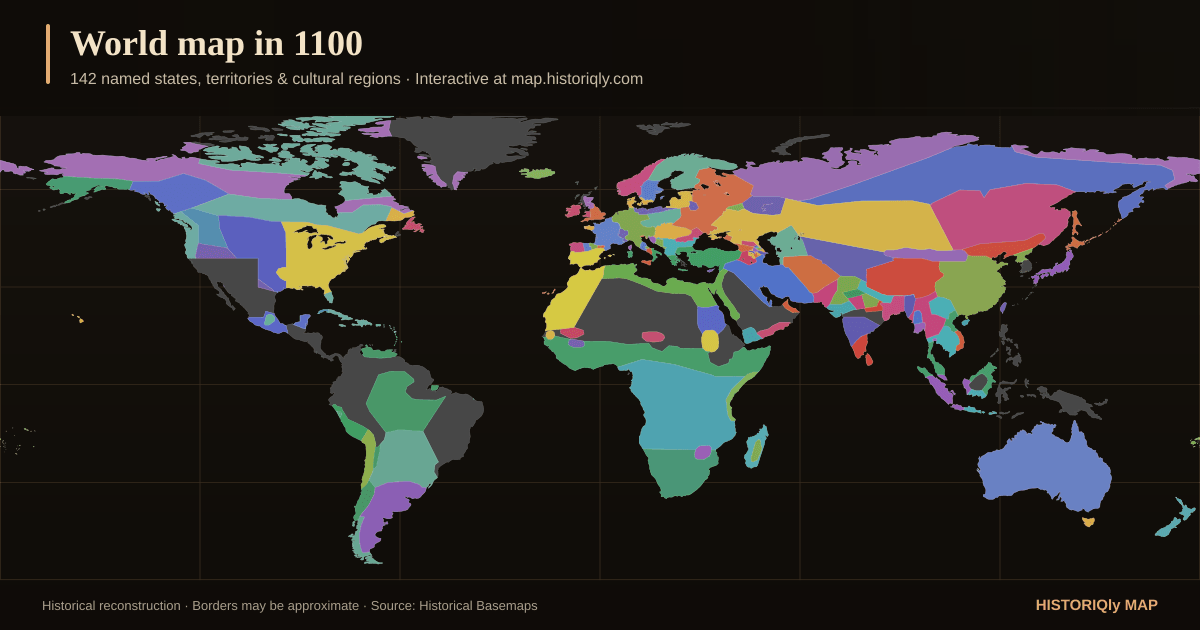
The interactive map lets you inspect named territories in 1100 and compare them to earlier or later snapshots on the timeline.
Medieval historical map
Explore a reconstruction of the world around 1100. Explore caliphates, dynasties, kingdoms, and trade networks across Afro-Eurasia. Figures near this year include Al-Ghazali, Hildegard of Bingen, William the Conqueror.
Snapshot at a glance
Counts come directly from this snapshot and the historical layers available in HistorIQly Map.
These names are encoded in the boundary dataset. Inclusion does not settle disputed borders, sovereignty, spelling, or historical interpretation.
What this snapshot shows
The interactive map lets you inspect named territories in 1100 and compare them to earlier or later snapshots on the timeline.
Meet figures alive in, or close to, 1100 and move from political geography to the people connected to the period.
The related chronicles below provide long-form reading tied closely to the medieval period.
Conflicts connected to 1100
These editorial date ranges include 1100. Some records group intermittent campaigns or long-running conflict series, so inclusion does not mean continuous fighting in that exact year.
1096 – 1291
Christian Crusader states vs Muslim dynasties
Two centuries of religious warfare for control of the Holy Land — nine major crusades that transformed trade, culture, and the balance of power between Christendom and Islam.
Key battles and events: Siege of Jerusalem (1099); Hattin (1187)
629 AD – 1180
Byzantine Empire vs Umayyad Caliphate, Abbasid Caliphate
Centuries of warfare between Byzantium and successive Arab caliphates. The Arabs besieged Constantinople twice (674–678, 717–718) but failed both times, with Greek fire proving decisive. The frontier stabilized along the Taurus Mountains for centuries.
Key battles and events: Battle of Yarmouk (636); First Arab Siege of Constantinople (674–678)
1100 – 1629
Great Zimbabwe / Mutapa Empire vs Rival Shona kingdoms, Portuguese colonists
Rise and fall of the Great Zimbabwe civilization and its successor the Mutapa Empire, which controlled gold trade in southeastern Africa before Portuguese interference.
Key battles and events: Establishment of Great Zimbabwe (c. 1100); Portuguese Battle of Dambarare (1629)
1055 – 1223
Cuman–Kipchak confederation vs Kievan Rus principalities (Svyatoslav II, Vladimir Monomakh, Mstislav the Bold)
For over 150 years the Cuman–Kipchaks raided and occasionally allied with the Rus principalities on the Pontic–Caspian steppe, inflicting major defeats at Alta (1068) but suffering Vladimir Monomakh's counter-offensives, before combined Cuman–Rus forces were annihilated by the Mongols at the Kalka in 1223.
Key battles and events: Battle of the Alta River (1068); Battle of the Stugna River (1093)
1044 – 1287
Pagan Kingdom of Burma vs Mon kingdoms, Arakanese, Mongol Yuan dynasty
Burma's first unified kingdom conquered the Mon and Arakanese peoples, building thousands of temples at Bagan before the Mongol invasion shattered the empire.
Key battles and events: Conquest of Thaton (1057); Battle of Ngasaunggyan (1277)
1038 – 1227
Song Dynasty vs Western Xia (Tangut Empire)
The Tangut Western Xia state fought the Song Dynasty for nearly two centuries over control of the Silk Road corridor in northwest China before being annihilated by the Mongols.
Key battles and events: Battle of Haoshuichuan (1038); Battle of Sanchuankou (1040)
982 AD – 1471
Đại Việt (Vietnam) vs Kingdom of Champa
Centuries of warfare between Vietnamese and Cham kingdoms as Đại Việt expanded southward, culminating in the destruction of the Cham capital and the effective end of Champa as a major power.
Key battles and events: Lê Hoàn's invasion of Champa (982); Cham sack of Thăng Long (1371)
907 AD – 1125
Khitan Liao Dynasty vs Song China, Balhae, Jurchen Jin
The Khitan built a powerful dual-administration empire controlling northern China and the steppe, forcing the Song dynasty to pay annual tribute before being overthrown by the Jurchen.
Key battles and events: Conquest of Balhae (926); Treaty of Shanyuan (1005)
Historical figures near 1100
Khorasan / Seljuk Empire
1058 – 1111
Critique of Aristotelian philosophy, synthesis of Sufism with orthodox Islam, Revival of the Religious Sciences
Rhineland
1098 – 1179
Mystic, composer, physician, theologian, and Doctor of the Church — the most extraordinary woman of the Middle Ages
Normandy & England
c. 1028 – 1087
Conquering England at the Battle of Hastings, ordering the Domesday Book, and transforming English society, language, and law
Al-Andalus / Almohad Empire
1126 – 1198
Aristotle commentaries, Incoherence of the Incoherence, reconciliation of reason and revelation in Islamic thought
Fujian and Jiangxi, Southern Song dynasty China
1130 – 1200
Neo-Confucian synthesis, the Four Books, White Deer Grotto Academy, the doctrine of li and qi
Mongolia / Central Asia
c. 1162 – 1227
Unifier of Mongolia, founder of the largest contiguous empire in history
Landmarks standing in 1100
Sites already standing (or still being used) in 1100, drawn from the map's landmark layers.
Built 1100 · Africa
Mysterious Swahili stone town on the Kenyan coast, abandoned in the 17th century with a palace, mosque, and houses lost in coastal forest
Built 1100 · Africa
Medieval stone ruins, capital of the Kingdom of Zimbabwe
Built 1100 · Europe
Romanesque church in Zurich where Huldrych Zwingli launched the Swiss Reformation in 1519
Built 1100 · Asia
Island kingdom controlling Persian Gulf trade routes
Built 1100 · Africa
Major intellectual and trade center on trans-Saharan routes
Built 1051 · Europe
Caves Monastery of Kyiv, the most important Orthodox Christian monastery in Ukraine and a foundational site of Eastern Slavic Christianity
Related chronicles
Khorasan / Seljuk Empire · Philosopher
The Proof of Islam
The scholar who silenced the philosophers, survived a spiritual collapse, and wrote the most influential Islamic text after the Quran — told in his own words.
Read Al-GhazaliRhineland · Thinker
The Sibyl of the Rhine
The Benedictine abbess who received visions from the age of three, composed the largest surviving body of medieval music, wrote encyclopedias of medicine and natural science, preached across Germany in her sixties, and corresponded with popes, emperors, and saints — told in her own words.
Read Hildegard of BingenNormandy & England · Conqueror
The Bastard Who Took a Kingdom
The illegitimate son of a Norman duke who survived childhood assassination attempts, crossed the Channel with six hundred ships, and won England in a single day of battle — then changed its language, law, and landscape forever.
Read William the ConquerorAl-Andalus / Almohad Empire · Philosopher
The Commentator
The Córdoban jurist and physician who wrote more commentaries on Aristotle than any scholar in history — and whose work was so indispensable to medieval Europe that they called him simply The Commentator, as though no other existed.
Read Ibn RushdBoundary source and context layers
Boundary geometry is adapted from Historical Basemaps, a GPL-3.0 project built for world- and continent-scale historical mapping. The source is a work in progress: pre-modern territories can overlap, borders are often disputed, and a snapshot should be read as a reconstruction around 1100, not as survey-level fact.
The source marks 235 of 235 geometries in this snapshot as approximate.
Conflicts, landmarks, trade routes, and biographies come from separate HistorIQly editorial datasets. They provide discovery context but do not yet expose a citation for every individual record; verify a specific claim with specialist sources before citing it.
Frequently asked questions
The 1100 source snapshot reconstructs political borders, territories, and named states for around 1100. You can inspect individual territories, view linked historical figures, and compare this snapshot with nearby years like 900 AD and 1000.
HistorIQly records whose date ranges include 1100 include The Crusades, Byzantine–Arab Wars, Great Zimbabwe & Mutapa Wars, Kipchak–Cuman Wars with Kievan Rus, Pagan Empire Wars. Long-running entries may represent intermittent campaigns rather than continuous warfare.
Figures linked near 1100 include Al-Ghazali, Hildegard of Bingen, William the Conqueror, Ibn Rushd. Some were alive in this year; others are included because their lives fall within the surrounding historical period.
HistorIQly Map includes 49 historical snapshots spanning from 3000 BC through the modern era, covering the medieval era and every other major period of world history.
Example labels encoded in the 1100 source snapshot include Cuman-Kipchak confederation, Song Empire, Tibet, Almoravid dynasty, Seljuk Empire, Fatimid Caliphate. These labels and reconstructed boundaries can be approximate or disputed; inspect the map methodology before using them for research.
Nearby years
Related map topics
Historical maps by year
Choose from 49 historical world maps by year. Explore borders, empires, wars, landmarks, trade routes, and people from 3000 BC to the modern era.
Medieval history map
Explore medieval world maps with kingdoms, caliphates, dynasties, trade routes, landmarks, wars, and border changes across Afro-Eurasia.
World history atlas
Browse an interactive world history atlas with maps of empires, wars, trade routes, landmarks, and influential figures from ancient history through the modern era.