
Border history
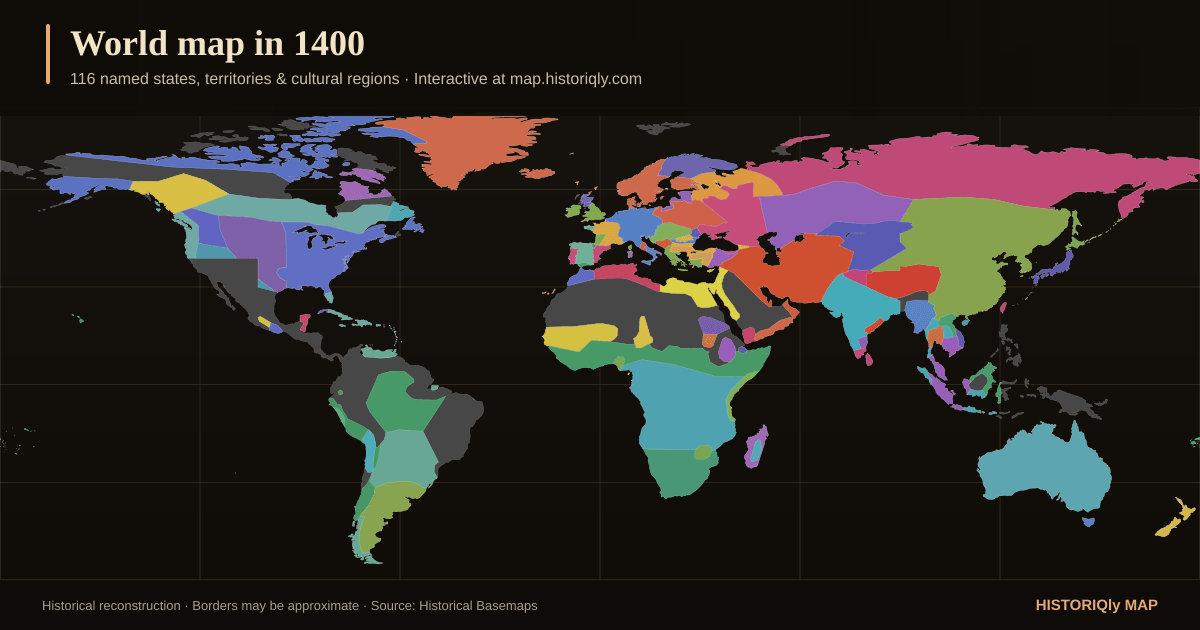
The interactive map lets you inspect named territories in 1400 and compare them to earlier or later snapshots on the timeline.
Renaissance historical map
Explore a reconstruction of the world around 1400. See the late medieval and early modern transition as maritime powers, gunpowder states, and new empires emerge. Figures near this year include Christine de Pizan, Ibn Khaldun, Zheng He.
Snapshot at a glance
Counts come directly from this snapshot and the historical layers available in HistorIQly Map.
These names are encoded in the boundary dataset. Inclusion does not settle disputed borders, sovereignty, spelling, or historical interpretation.
What this snapshot shows
The interactive map lets you inspect named territories in 1400 and compare them to earlier or later snapshots on the timeline.
Meet figures alive in, or close to, 1400 and move from political geography to the people connected to the period.
The related chronicles below provide long-form reading tied closely to the renaissance period.
Conflicts connected to 1400
These editorial date ranges include 1400. Some records group intermittent campaigns or long-running conflict series, so inclusion does not mean continuous fighting in that exact year.
1390 – 1709
Kingdom of Kongo vs Portuguese, Imbangala, Jaga, rival vassals
The Kingdom of Kongo fought Portuguese expansion, slave-raiding Imbangala, and internal succession wars that culminated in its catastrophic defeat at the Battle of Mbwila.
Key battles and events: Battle of Mbwila (1665); Battle of Ambuila (1665)
1380 – 1480
Grand Duchy of Moscow vs Golden Horde
Moscow's century-long struggle to throw off Mongol suzerainty. Dmitry Donskoy's victory at Kulikovo in 1380 was the first major defeat of the Horde, and Ivan III's 'Great Stand on the Ugra River' in 1480 ended Mongol overlordship forever.
Key battles and events: Battle of Kulikovo (1380); Tokhtamysh's sack of Moscow (1382)
1371 – 1459
Ottoman Empire vs Serbian Empire, Bulgarian Empire, Byzantine remnants
The Ottomans systematically conquered the Balkans over nearly a century, culminating in the fall of Serbia — reshaping southeastern Europe for the next five centuries.
Key battles and events: Battle of Maritsa (1371); Battle of Kosovo (1389)
1370 – 1405
Timurid Empire vs Golden Horde, Delhi Sultanate, Mamluks & Ottoman Empire
Timur carved out a vast empire from Central Asia, defeating the Golden Horde, sacking Delhi, destroying Damascus and Baghdad, and crushing the Ottomans at Ankara — leaving an estimated 17 million dead.
Key battles and events: Sack of Delhi (1398); Sack of Damascus (1401)
1354 – 1453
Ottoman Empire vs Byzantine Empire, Serbia, Bulgaria & Crusader coalitions
The Ottomans crossed into Europe at Gallipoli in 1354 and systematically conquered the Balkans, crushing Serbian and Crusader resistance before capturing Constantinople in 1453, ending the Byzantine Empire.
Key battles and events: Battle of Kosovo (1389); Battle of Nicopolis (1396)
1353 – 1707
Kingdom of Lan Xang vs Siam, Burma, Đại Việt, Champa
The Lao kingdom of Lan Xang fought for survival against its powerful neighbours for 350 years, at its peak controlling territory from the Mekong to the Vietnamese highlands.
Key battles and events: Fa Ngum's unification (1353); Burmese invasion (1574)
1351 – 1767
Ayutthaya Kingdom (Siam) vs Khmer Empire, Sukhothai, Lan Na, Burma
The Ayutthaya Kingdom fought expansionist wars for over four centuries, conquering Angkor and dominating mainland Southeast Asia until its catastrophic destruction by Burma in 1767.
Key battles and events: Sack of Angkor (1431); Fall of Ayutthaya (1569)
1337 – 1453
Kingdom of England vs Kingdom of France
The 116-year dynastic struggle between England and France that saw longbowmen shatter knightly armies, a peasant girl save a kingdom, and the birth of national identity in both countries.
Key battles and events: Crécy (1346); Poitiers (1356)
Historical figures near 1400
France
c. 1364 – c. 1430
First professional female writer in European history; author of The Book of the City of Ladies
North Africa / Mamluk Egypt
1332 – 1406
The Muqaddimah, the cyclical theory of history, the concept of asabiyyah, founding sociology and historiography as disciplines
China / Indian Ocean
c. 1371 – 1433
Commander of the Ming treasure fleets; led seven voyages from China to Southeast Asia, India, Arabia, and East Africa
France
c. 1412 – 1431
The teenage peasant girl who heard the voices of saints, led France to victory, and was burned at the stake at nineteen
Cusco, Tawantinsuyu (Inca Empire)
c. 1418 CE – 1471 CE
9th Sapa Inca, founder of the Inca Empire, builder of Machu Picchu, architect of Tawantinsuyu
Morocco / Global
1304 – c. 1368
Greatest medieval traveller, author of the Rihla, visited 44 modern countries across three decades
Landmarks standing in 1400
Sites already standing (or still being used) in 1400, drawn from the map's landmark layers.
Built 1400 · Europe
Europe's most important commercial hub in the 16th century, center of the diamond trade and gateway to the Spanish Netherlands
Built 1400 · South America
Ecuador's most important Inca site, a fortress-temple complex built atop an earlier Cañari settlement in the Andes
Built 1400 · Asia
Strategic strait controlling the spice trade between East and West
Built 1400 · Oceania
Restored open-air Polynesian temple on Tahiti with tiered stone altar (ahu) and standing slabs, the best-preserved marae in the Society Islands
Built 1400 · Oceania
Ceremonial stone village on the rim of Rano Kau crater on Easter Island, center of the birdman cult with elaborate petroglyphs of Make-make
Built 1400 · Oceania
Sacred Hawaiian place of refuge where law-breakers could be absolved by priests
Related chronicles
France · Thinker
The Woman Who Invented the Author
Widowed at twenty-five with three children to support, Christine de Pizan invented a profession that did not yet exist and became the first person in European history to earn a living entirely from writing.
Read Christine de PizanNorth Africa / Mamluk Egypt · Thinker
The Man Who Discovered History
The Tunisian scholar who lost everything to plague, survived decades of court intrigue, retreated to a mountain fortress, and wrote the founding text of sociology — then sat across a campfire from the most dangerous conqueror on earth.
Read Ibn KhaldunChina / Indian Ocean · Explorer
The Admiral Who Reached the Ends of the Earth
The Muslim eunuch admiral who commanded 317 ships and 27,800 men across the Indian Ocean to Southeast Asia, India, Arabia, and East Africa — two generations before Columbus set sail — and whose voyages were then deliberately erased.
Read Zheng HeFrance · Revolutionary
The Maid of Orléans
The peasant girl from Lorraine who heard the voices of saints at thirteen, led France to victory at Orléans and crowned a king at Reims — and was burned at the stake at nineteen by the people her victories had saved.
Read Joan of ArcBoundary source and context layers
Boundary geometry is adapted from Historical Basemaps, a GPL-3.0 project built for world- and continent-scale historical mapping. The source is a work in progress: pre-modern territories can overlap, borders are often disputed, and a snapshot should be read as a reconstruction around 1400, not as survey-level fact.
The source marks 233 of 233 geometries in this snapshot as approximate.
Conflicts, landmarks, trade routes, and biographies come from separate HistorIQly editorial datasets. They provide discovery context but do not yet expose a citation for every individual record; verify a specific claim with specialist sources before citing it.
Frequently asked questions
The 1400 source snapshot reconstructs political borders, territories, and named states for around 1400. You can inspect individual territories, view linked historical figures, and compare this snapshot with nearby years like 1279 and 1300.
HistorIQly records whose date ranges include 1400 include Wars of the Kingdom of Kongo, Muscovite–Mongol Wars, Ottoman Conquest of the Balkans, Conquests of Timur (Tamerlane), Ottoman Wars in Europe. Long-running entries may represent intermittent campaigns rather than continuous warfare.
Figures linked near 1400 include Christine de Pizan, Ibn Khaldun, Zheng He, Joan of Arc. Some were alive in this year; others are included because their lives fall within the surrounding historical period.
HistorIQly Map includes 49 historical snapshots spanning from 3000 BC through the modern era, covering the renaissance era and every other major period of world history.
Example labels encoded in the 1400 source snapshot include Great Khanate, White Horde, Timurid Empire, Sultanate of Delhi, Chagatai Khanate, Blue Horde. These labels and reconstructed boundaries can be approximate or disputed; inspect the map methodology before using them for research.
Nearby years
Related map topics
Historical maps by year
Choose from 49 historical world maps by year. Explore borders, empires, wars, landmarks, trade routes, and people from 3000 BC to the modern era.
Historical borders
Compare historical borders on an interactive map. Explore territories, empires, wars, and political change from 3000 BC through a modern comparison view.
World history atlas
Browse an interactive world history atlas with maps of empires, wars, trade routes, landmarks, and influential figures from ancient history through the modern era.