
Border history
The interactive map lets you inspect named territories in 1530 and compare them to earlier or later snapshots on the timeline.
Renaissance historical map
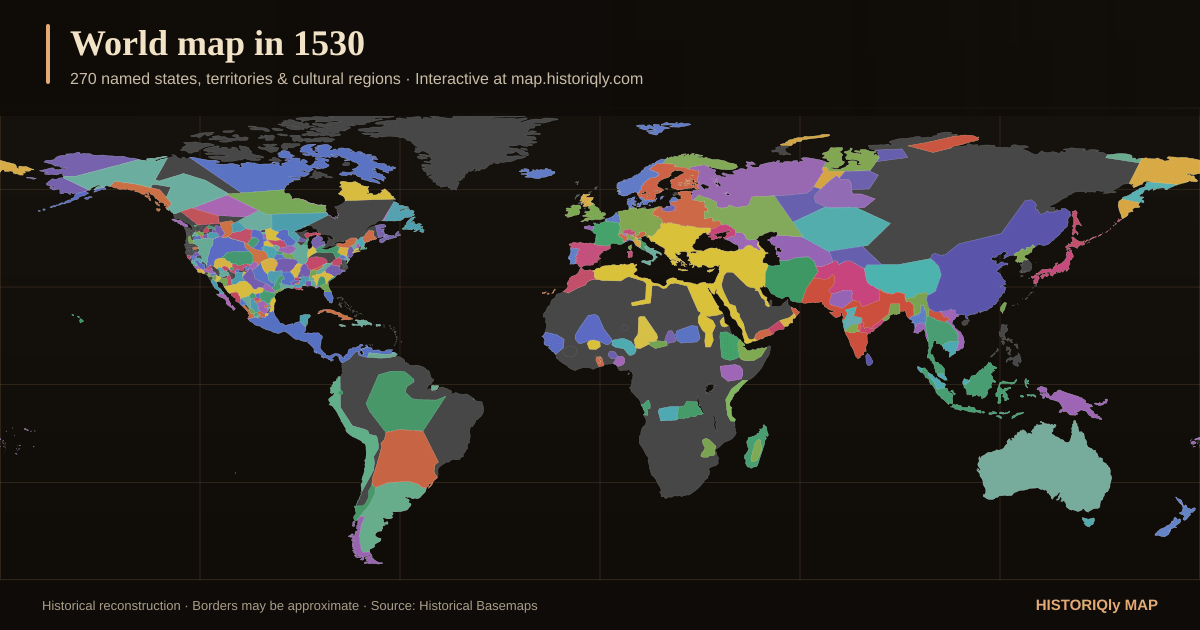
Explore a reconstruction of the world around 1530. See the late medieval and early modern transition as maritime powers, gunpowder states, and new empires emerge. Figures near this year include Catherine de' Medici, Henry VIII, John Calvin.
Snapshot at a glance
Counts come directly from this snapshot and the historical layers available in HistorIQly Map.
These names are encoded in the boundary dataset. Inclusion does not settle disputed borders, sovereignty, spelling, or historical interpretation.
What this snapshot shows
The interactive map lets you inspect named territories in 1530 and compare them to earlier or later snapshots on the timeline.
Meet figures alive in, or close to, 1530 and move from political geography to the people connected to the period.
The related chronicles below provide long-form reading tied closely to the renaissance period.
Conflicts connected to 1530
These editorial date ranges include 1530. Some records group intermittent campaigns or long-running conflict series, so inclusion does not mean continuous fighting in that exact year.
1529 – 1543
Ethiopian Empire & Portugal vs Adal Sultanate & Ottoman Empire
Imam Ahmad ibn Ibrahim al-Ghazi ('Grañ') of the Adal Sultanate nearly conquered the Ethiopian Empire with Ottoman support. Portuguese intervention helped Ethiopia survive, but both empires were devastated by the conflict.
Key battles and events: Battle of Shimbra Kure (1529); Battle of Wayna Daga (1543)
1529 – 1532
Atahualpa (Quito faction) vs Huáscar (Cuzco faction)
Devastating succession war between the half-brothers Atahualpa and Huáscar that fatally weakened the Inca Empire on the eve of the Spanish conquest.
Key battles and events: Battle of Chimborazo (1530); Battle of Quipaipan (1532)
1526 – 1707
Mughal Empire vs Delhi Sultanate, Rajputs, Deccan Sultanates & Marathas
Babur's victory at Panipat in 1526 founded the Mughal Empire, which expanded over two centuries to control nearly all of the Indian subcontinent — one of the most populous and wealthiest empires in history.
Key battles and events: First Battle of Panipat (1526); Battle of Khanwa (1527)
1514 – 1639
Ottoman Empire vs Safavid Persia
Over a century of intermittent warfare between the Sunni Ottoman Empire and Shia Safavid Persia for control of Iraq, the Caucasus, and eastern Anatolia — shaping the Sunni-Shia divide that persists today.
Key battles and events: Battle of Chaldiran (1514); Capture of Baghdad (1534)
1510 – 1599
Toungoo Dynasty (Tabinshwehti, Bayinnaung) vs Shan states, Ayutthaya, Lan Xang
The Toungoo Dynasty unified Burma and created the largest empire in Southeast Asian history under Bayinnaung, who conquered Siam, Lan Xang, and Manipur. His empire collapsed after his death, but set the template for modern Myanmar's borders.
Key battles and events: Fall of Pegu (1539); Conquest of Ayutthaya (1569)
1494 – 1559
France vs Spain vs Holy Roman Empire vs Italian city-states
Sixty-five years of conflict that turned Renaissance Italy into a battleground for European great powers — ending Italian independence for centuries.
Key battles and events: Fornovo (1495); Ravenna (1512)
1468 – 1769
Crimean Khanate, Ottoman Empire vs Poland-Lithuania, Muscovy/Russia, Cossack Hetmanate
Three centuries of devastating slave raids by the Crimean Tatars into Eastern Europe, capturing an estimated 2–3 million people for Ottoman slave markets.
Key battles and events: Sack of Moscow (1571); Battle of Molodi (1572)
1467 – 1615
Rival daimyō clans (Oda, Toyotomi, Tokugawa, Takeda, Uesugi, etc.) vs Various feudal lords & Ashikaga Shogunate
Nearly 150 years of civil war as feudal warlords fought for supremacy across Japan. Three great unifiers — Oda Nobunaga, Toyotomi Hideyoshi, and Tokugawa Ieyasu — progressively reunified the country, culminating in the Tokugawa Shogunate that would rule for 250 years.
Key battles and events: Ōnin War / Fall of Kyoto (1467–1477); Battle of Okehazama (1560)
Historical figures near 1530
France
1519 – 1589
Queen Mother of France, regent during the Wars of Religion, political survivor, patron of the arts
England
1491 – 1547
Break with Rome, English Reformation, six marriages, founding the Church of England
Geneva
1509 – 1564
Protestant reformer, theologian, author of the Institutes of the Christian Religion, builder of Geneva's reformed church
Germany
1483 – 1546
Protestant Reformation, 95 Theses, Bible translation, theology of grace
Florence & Rome
1475 – 1564
Sculptor, painter, architect, poet — creator of the David, the Sistine Chapel ceiling, and the dome of St. Peter's
Poland / Prussia
1473 – 1543
Formulating the heliocentric model of the universe, placing the Sun at the centre
Landmarks standing in 1530
Sites already standing (or still being used) in 1530, drawn from the map's landmark layers.
Built 1521 · North America
One of the oldest churches in the Americas, in Old San Juan, Puerto Rico
Built 1519 · North America
Key assembly point for the Spanish treasure fleet, the Caribbean's most important colonial trading port linking the Americas to Spain
Built 1519 · North America
First Spanish settlement on the Pacific Americas, serving as the staging point for the conquest of Peru and the transit of Andean silver across the isthmus.
Built 1519 · North America
First Spanish colonial port in the Americas, gateway for the Manila Galleon trade and primary link between New Spain and Europe
Built 1514 · Asia
Grand congregational mosque in Bukhara beneath the iconic 12th-century Kalyan Minaret, a centerpiece of the Po-i-Kalyan complex
Built 1512 · North America
Oldest cathedral in the Americas, in Santo Domingo's Colonial Zone
Related chronicles
England · Leader
The King Who Broke with Rome
The Tudor king who shattered a thousand years of papal authority, married six wives, dissolved the monasteries, and forged the Church of England — transforming his kingdom and reshaping the course of Western civilisation forever.
Read Henry VIIIFrance · Leader
The Black Queen
The Florentine orphan who became the most powerful woman in Europe — queen, regent, and the force behind three kings of France through thirty years of civil war.
Read Catherine de' MediciGeneva · Philosopher
The Architect of Reform
The life of the man who turned a small Swiss city into the capital of Protestant Christianity — theologian, exile, and architect of a movement that reshaped the Western world.
Read John CalvinFlorence & Rome · Artist
The Divine Sculptor
The Renaissance genius who carved the David, painted the Sistine Chapel ceiling, and designed the dome of St. Peter’s — told in his own words in a first-person ePub.
Read MichelangeloBoundary source and context layers
Boundary geometry is adapted from Historical Basemaps, a GPL-3.0 project built for world- and continent-scale historical mapping. The source is a work in progress: pre-modern territories can overlap, borders are often disputed, and a snapshot should be read as a reconstruction around 1530, not as survey-level fact.
The source marks 494 of 494 geometries in this snapshot as approximate.
Conflicts, landmarks, trade routes, and biographies come from separate HistorIQly editorial datasets. They provide discovery context but do not yet expose a citation for every individual record; verify a specific claim with specialist sources before citing it.
Frequently asked questions
The 1530 source snapshot reconstructs political borders, territories, and named states for around 1530. You can inspect individual territories, view linked historical figures, and compare this snapshot with nearby years like 1492 and 1500.
HistorIQly records whose date ranges include 1530 include Ethiopian–Adal War, Inca Civil War, Mughal Conquests of India, Ottoman–Safavid Wars, Toungoo Dynasty Wars. Long-running entries may represent intermittent campaigns rather than continuous warfare.
Figures linked near 1530 include Catherine de' Medici, Henry VIII, John Calvin, Martin Luther. Some were alive in this year; others are included because their lives fall within the surrounding historical period.
HistorIQly Map includes 49 historical snapshots spanning from 3000 BC through the modern era, covering the renaissance era and every other major period of world history.
Example labels encoded in the 1530 source snapshot include Ming Chinese Empire, Ottoman Empire, Tsardom of Muscovy, Quazaq Khanate, Tibet, Islamic and Hindu states. These labels and reconstructed boundaries can be approximate or disputed; inspect the map methodology before using them for research.
Nearby years
Related map topics
Historical maps by year
Choose from 49 historical world maps by year. Explore borders, empires, wars, landmarks, trade routes, and people from 3000 BC to the modern era.
Historical borders
Compare historical borders on an interactive map. Explore territories, empires, wars, and political change from 3000 BC through a modern comparison view.
World history atlas
Browse an interactive world history atlas with maps of empires, wars, trade routes, landmarks, and influential figures from ancient history through the modern era.