
Border history
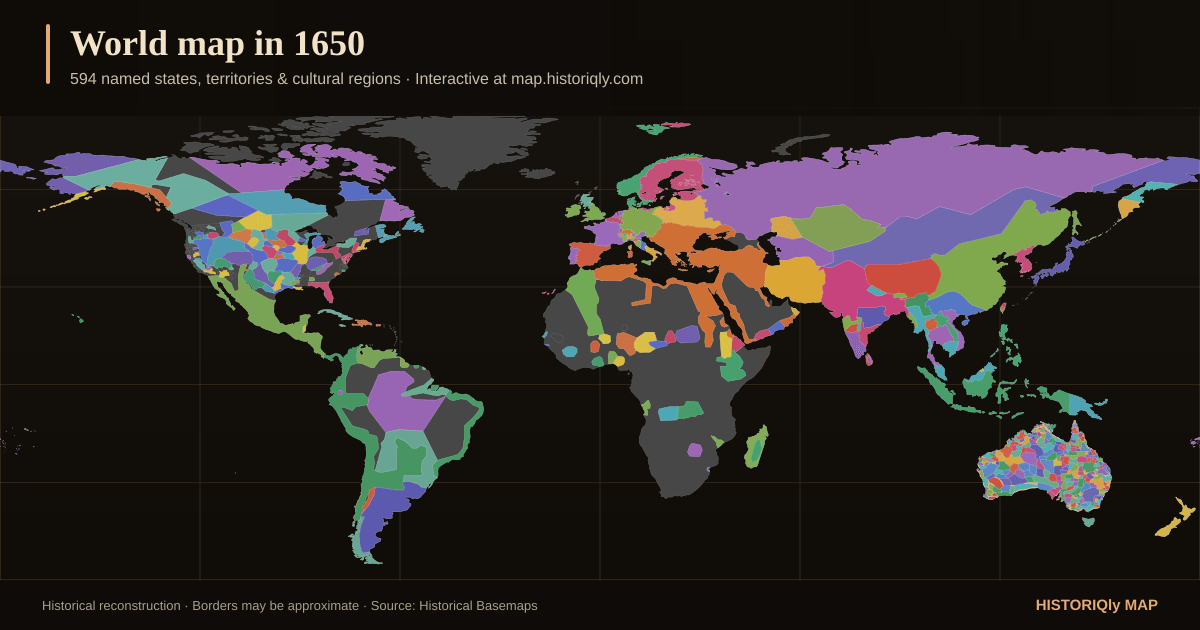
The interactive map lets you inspect named territories in 1650 and compare them to earlier or later snapshots on the timeline.
Renaissance historical map
Explore a reconstruction of the world around 1650. See the late medieval and early modern transition as maritime powers, gunpowder states, and new empires emerge. Figures near this year include Galileo Galilei, William Shakespeare, Elizabeth I.
Snapshot at a glance
Counts come directly from this snapshot and the historical layers available in HistorIQly Map.
These names are encoded in the boundary dataset. Inclusion does not settle disputed borders, sovereignty, spelling, or historical interpretation.
What this snapshot shows
The interactive map lets you inspect named territories in 1650 and compare them to earlier or later snapshots on the timeline.
Meet figures alive in, or close to, 1650 and move from political geography to the people connected to the period.
The related chronicles below provide long-form reading tied closely to the renaissance period.
Conflicts connected to 1650
These editorial date ranges include 1650. Some records group intermittent campaigns or long-running conflict series, so inclusion does not mean continuous fighting in that exact year.
1649 – 1653
English Commonwealth (Oliver Cromwell) vs Irish Confederates & Royalists
Cromwell's brutal reconquest of Ireland included the massacres at Drogheda and Wexford and massive land confiscations. The campaign killed an estimated 15-20% of Ireland's population through war, famine, and plague — a trauma that shaped Anglo-Irish relations for centuries.
Key battles and events: Siege of Drogheda (1649); Siege of Wexford (1649)
1648 – 1657
Zaporozhian Cossacks (Bohdan Khmelnytsky) vs Polish-Lithuanian Commonwealth
Cossack hetman Bohdan Khmelnytsky led a massive uprising against Polish-Lithuanian rule in Ukraine, establishing the Cossack Hetmanate. The uprising triggered devastating pogroms against Jews and ultimately led to Ukraine's union with Russia under the Treaty of Pereyaslav (1654).
Key battles and events: Battle of Zhovti Vody (1648); Battle of Korsun (1648)
1648 – 1653
French Crown (Mazarin, Louis XIV) vs Parlementaires, Princes (Condé, Conti)
French civil war triggered by opposition to Cardinal Mazarin's taxation during the young Louis XIV's minority, shaping the king's later absolutism.
Key battles and events: Battle of Faubourg Saint-Antoine (1652); Siege of Paris (1649)
1645 – 1669
Ottoman Empire vs Republic of Venice, Knights of Malta
One of the longest wars in history, a 24-year siege of Crete's capital Candia (Heraklion) that ended Ottoman conquest of the island from Venice.
Key battles and events: Siege of Candia (1648–1669); Battle of the Dardanelles (1654–1657)
1642 – 1651
Parliamentarians (Roundheads) vs Royalists (Cavaliers)
The war that killed a king and birthed modern democracy — Parliament's army, led by Oliver Cromwell, defeated Charles I and briefly turned England into a republic.
Key battles and events: Edgehill (1642); Marston Moor (1644)
1640 – 1659
Catalonia & France vs Spanish Crown
Catalonia revolted against Spain during the Thirty Years' War, briefly placing itself under French protection. The revolt ended with the Treaty of the Pyrenees, which ceded Roussillon to France but returned Catalonia to Spain.
Key battles and events: Corpus de Sang uprising (1640); Battle of Montjuïc (1641)
1640 – 1668
Portugal vs Spain
Portugal's revolt against Habsburg Spain ended the Iberian Union and restored an independent Portuguese monarchy under the House of Braganza.
Key battles and events: Battle of Montijo (1644); Battle of Ameixial (1663)
1635 – 1659
Kingdom of France vs Spanish Empire
France entered the Thirty Years' War against Spain, and fighting continued for a decade after the Peace of Westphalia. The Treaty of the Pyrenees marked Spain's decline and France's emergence as Europe's dominant power.
Key battles and events: Battle of Rocroi (1643); Battle of the Dunes (1658)
Historical figures near 1650
Italy
1564 – 1642
Father of modern observational astronomy, physics, and the scientific method
England
1564 – 1616
Playwright, poet, actor, shareholder in the Globe Theatre, author of Hamlet, Macbeth, King Lear, and the Sonnets
England
1533 – 1603
Defeated the Spanish Armada, established the Elizabethan Religious Settlement, presided over England's golden age of literature and exploration
England
1643 – 1727
Laws of motion, universal gravitation, calculus, optics, Principia Mathematica
England
1632 – 1704
Empiricist philosophy, natural rights theory, founding modern liberalism
France
1638 – 1715
Absolute monarch, builder of Versailles, longest reign in European history
Landmarks standing in 1650
Sites already standing (or still being used) in 1650, drawn from the map's landmark layers.
Built 1650 · South America
Capital of Dutch Guiana and hub of the Suriname plantation economy, exporting sugar, coffee, and cacao across the Atlantic.
Built 1642 · North America
Founded by the French on the St. Lawrence River, it became the dominant hub of the North American fur trade under the Hudson's Bay and North West Companies.
Built 1632 · South America
Best-preserved Jesuit mission ruins in South America, a UNESCO World Heritage Site
Built 1632 · South America
Ruins of a Jesuit-Guaraní mission in southern Brazil, the best-preserved of the South American Jesuit Reductions
Built 1632 · Asia
Mughal ivory-white marble mausoleum on the bank of the Yamuna
Built 1630 · North America
A leading colonial Atlantic port for cod, rum, and the triangular trade, later pivotal to the American Revolution via the 1773 Tea Party.
Related chronicles
Italy · Scientist
The Man Who Moved the Earth
The astronomer who turned a spyglass toward the heavens, saw what no one had seen before, and paid for the truth with his freedom — told in his own words.
Read Galileo GalileiEngland · Artist
The Upstart Crow Who Named the World
The glover’s son from Stratford who became the greatest writer in the English language — from the lost years to the Globe Theatre, told in his own voice in a first-person ePub.
Read William ShakespeareEngland · Leader
The Virgin Queen
The princess who survived the Tower, outwitted Europe’s mightiest kings, and ruled for forty-four years without ever sharing her throne — told in her own voice.
Read Elizabeth IEngland · Scientist
The Last Magician
The life of the man who unlocked the laws of the universe — from a fatherless childhood in Lincolnshire to the presidency of the Royal Society. A first-person ePub told in Newton’s own voice.
Read Isaac NewtonBoundary source and context layers
Boundary geometry is adapted from Historical Basemaps, a GPL-3.0 project built for world- and continent-scale historical mapping. The source is a work in progress: pre-modern territories can overlap, borders are often disputed, and a snapshot should be read as a reconstruction around 1650, not as survey-level fact.
The source marks 12 of 778 geometries in this snapshot as approximate.
Conflicts, landmarks, trade routes, and biographies come from separate HistorIQly editorial datasets. They provide discovery context but do not yet expose a citation for every individual record; verify a specific claim with specialist sources before citing it.
Frequently asked questions
The 1650 source snapshot reconstructs political borders, territories, and named states for around 1650. You can inspect individual territories, view linked historical figures, and compare this snapshot with nearby years like 1530 and 1600.
HistorIQly records whose date ranges include 1650 include Cromwellian Conquest of Ireland, Khmelnytsky Uprising, The Fronde, Ottoman-Venetian War of Candia, English Civil War. Long-running entries may represent intermittent campaigns rather than continuous warfare.
Figures linked near 1650 include Galileo Galilei, William Shakespeare, Elizabeth I, Isaac Newton. Some were alive in this year; others are included because their lives fall within the surrounding historical period.
HistorIQly Map includes 49 historical snapshots spanning from 3000 BC through the modern era, covering the renaissance era and every other major period of world history.
Example labels encoded in the 1650 source snapshot include Tsardom of Muscovy, central Asian khanates, Manchu Empire, Ottoman Empire, Vice-Royalty of Peru, Mughal Empire. These labels and reconstructed boundaries can be approximate or disputed; inspect the map methodology before using them for research.
Nearby years
Related map topics
Historical maps by year
Choose from 49 historical world maps by year. Explore borders, empires, wars, landmarks, trade routes, and people from 3000 BC to the modern era.
Historical borders
Compare historical borders on an interactive map. Explore territories, empires, wars, and political change from 3000 BC through a modern comparison view.
World history atlas
Browse an interactive world history atlas with maps of empires, wars, trade routes, landmarks, and influential figures from ancient history through the modern era.