
Border history
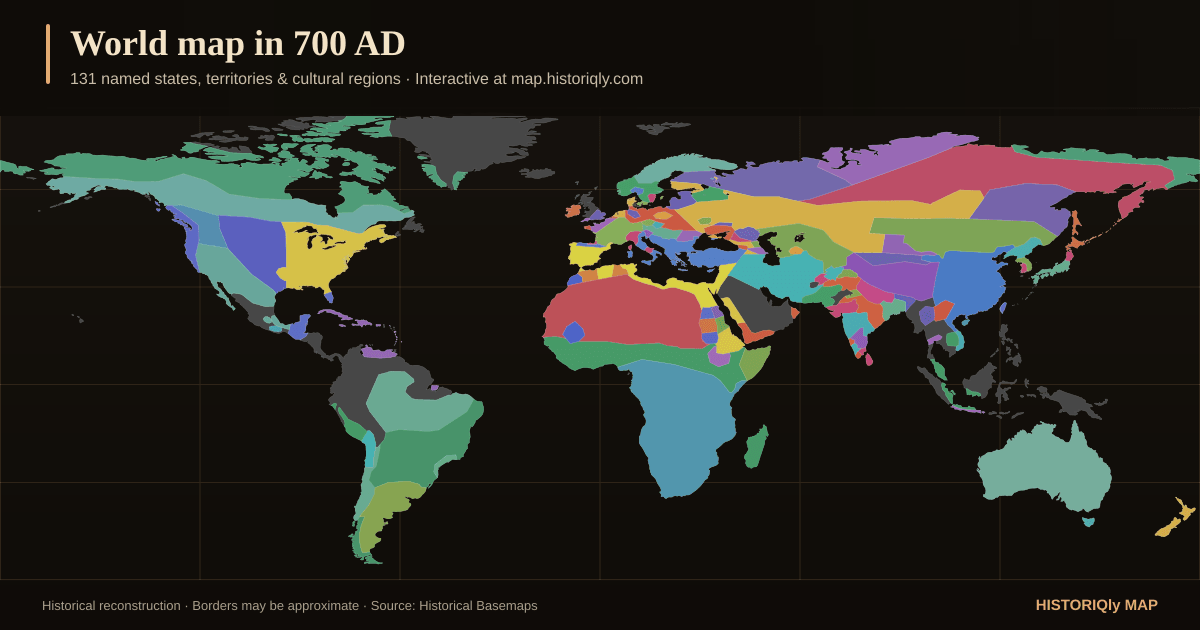
The interactive map lets you inspect named territories in 700 AD and compare them to earlier or later snapshots on the timeline.
Medieval historical map
Explore a reconstruction of the world around 700 AD. Explore caliphates, dynasties, kingdoms, and trade networks across Afro-Eurasia. Figures near this year include Charlemagne, Muhammad, Al-Khwarizmi.
Snapshot at a glance
Counts come directly from this snapshot and the historical layers available in HistorIQly Map.
These names are encoded in the boundary dataset. Inclusion does not settle disputed borders, sovereignty, spelling, or historical interpretation.
What this snapshot shows
The interactive map lets you inspect named territories in 700 AD and compare them to earlier or later snapshots on the timeline.
Meet figures alive in, or close to, 700 AD and move from political geography to the people connected to the period.
The related chronicles below provide long-form reading tied closely to the medieval period.
Conflicts connected to 700 AD
These editorial date ranges include 700 AD. Some records group intermittent campaigns or long-running conflict series, so inclusion does not mean continuous fighting in that exact year.
629 AD – 1180
Byzantine Empire vs Umayyad Caliphate, Abbasid Caliphate
Centuries of warfare between Byzantium and successive Arab caliphates. The Arabs besieged Constantinople twice (674–678, 717–718) but failed both times, with Greek fire proving decisive. The frontier stabilized along the Taurus Mountains for centuries.
Key battles and events: Battle of Yarmouk (636); First Arab Siege of Constantinople (674–678)
700 AD – 1846
Kanem-Bornu Empire (Mai Idris Alooma and successors) vs Bulala vs Hausa states vs Sokoto Caliphate / Fulani jihadists
One of Africa's longest-lived empires, spanning over a millennium around Lake Chad, defending against Bulala invasions, Hausa rivals, and the Fulani jihad before falling to the Sokoto Caliphate.
Key battles and events: Bulala overthrow of Kanem at Njimi (c. 1380); Mai Idris Alooma's campaigns (1564–1596)
681 AD – 1018
Byzantine Empire vs Bulgarian Empire
Over three centuries of intermittent warfare between Byzantium and Bulgaria for control of the Balkans. The conflict included Emperor Basil II's final conquest of Bulgaria in 1018, after which he reportedly blinded 99 out of every 100 Bulgarian prisoners, earning the title 'Bulgar-Slayer'.
Key battles and events: Battle of Pliska (811); Battle of Anchialus (917)
642 AD – 799 AD
Khazar Khaganate vs Umayyad and Abbasid Caliphates
The Khazars blocked Arab expansion into the Caucasus and Eastern Europe for over a century, acting as a crucial buffer that may have changed the course of European history.
Key battles and events: Battle of Balanjar (642 AD); Battle of Marj Ardabil (730 AD)
632 AD – 750 AD
Rashidun & Umayyad Caliphates vs Byzantine Empire vs Sassanid Empire
One of the most rapid expansions in history — Arab armies conquered from Spain to Central Asia within a single century, reshaping the religious and political map of the world.
Key battles and events: Yarmouk (636); Qadisiyyah (636)
626 AD – 800 AD
Caracol (K'an II, K'inich Joy K'awiil) vs Naranjo (Wak Chanil Ajaw dynasty) vs Calakmul (shifting allegiance)
A century and a half of Classic Maya warfare between Caracol and Naranjo, documented on hieroglyphic stairways, with Caracol sacking Naranjo in 631 CE before Naranjo's revival under Lady Six Sky and her son K'ahk' Tiliw Chan Chaak.
Key battles and events: Caracol star-war defeat of Naranjo (626 CE); Caracol sack of Naranjo (631 CE)
600 AD – 800 AD
Southern Moche polity (Huacas de Moche) vs Northern Moche polities (Pampa Grande, San José de Moro) vs Jequetepeque valley lords
During Moche Phase V, the southern Moche capital at Huacas de Moche was abandoned while northern centers such as Pampa Grande rose and then burned amid environmental stress from El Niño events and regional warfare on Peru's north coast.
Key battles and events: Abandonment of Huacas de Moche (c. 600 CE); Burning of Pampa Grande (c. 750 CE)
600 AD – 1288
Srivijaya Empire vs Chola Dynasty, Majapahit, Javanese kingdoms
Maritime thalassocracy based in Sumatra that controlled the Strait of Malacca trade for centuries before falling to Chola naval raids and Javanese rivals.
Key battles and events: Chola invasion of Srivijaya (1025); Conquest of Malay Peninsula ports
Historical figures near 700 AD
Frankish Empire
c. 742 AD – 814 AD
Emperor of the Romans, King of the Franks, father of Europe, Carolingian Renaissance
Arabian Peninsula
c. 570 CE – 632 CE
Founder of Islam, Prophet of God, statesman and military commander who unified the Arabian Peninsula and revealed the Quran — the sacred text that shaped the lives of over 1.8 billion people
Baghdad
c. 780 CE – c. 850 CE
Father of algebra, originator of the word 'algorithm', pioneer of Hindu-Arabic numerals in the Islamic world
India (Kerala to the Himalayas)
c. 788 CE – c. 820 CE
Founder of Advaita Vedanta, philosopher of non-dualism, unifier of Hindu thought across India
Landmarks standing in 700 AD
Sites already standing (or still being used) in 700 AD, drawn from the map's landmark layers.
Built 700 AD · Asia
Medieval China's greatest port, gateway to the maritime Silk Road
Built 700 AD · Europe
Maritime republic rivaling Venice, key Adriatic trade hub connecting the Balkans with Mediterranean commerce
Built 692 AD · Asia
One of the oldest mosques in the Gulf region, its twin minarets in Bahrain mark over 1,300 years of continuous Islamic worship
Built 691 AD · Asia
Islamic shrine on Jerusalem's Temple Mount
Built 670 AD · Africa
Oldest mosque in North Africa, founded by Uqba ibn Nafi during the Muslim conquest of the Maghreb
Built 650 AD · North America
Hilltop Mesoamerican ceremonial city in Morelos dominated by the Pyramid of the Feathered Serpent, where astronomer-priests gathered to reform the calendar.
Related chronicles
Frankish Empire · Conqueror
The King Who United Europe
The Frankish king who conquered half of Europe, was crowned Emperor of the Romans on Christmas Day 800, and launched a cultural renaissance that preserved learning through the Dark Ages — the man historians call the Father of Europe.
Read CharlemagneArabian Peninsula · Philosopher
The Prophet Who United Arabia
From an orphaned merchant in Mecca to the founder of a civilization — the life of Muhammad ibn Abdullah, told in his own words: the first revelation, the Hijra, the battles of Badr and Uhud, the conquest of Mecca, and the Farewell Sermon that completed a faith for 1.8 billion people.
Read MuhammadBaghdad · Thinker
The Man Who Invented Algebra
The Baghdad scholar who gave the world algebra and the word algorithm — how a ninth-century polymath at the House of Wisdom synthesised Greek, Indian, and Persian mathematics into a system that would power every equation ever written.
Read Al-KhwarizmiIndia (Kerala to the Himalayas) · Philosopher
The Man Who Reclaimed the Infinite
In thirty-two years, Adi Shankaracharya walked the length of India barefoot, defeated every rival philosophical school in open debate, founded four monasteries that still stand today, and delivered one message that reshaped a civilization: you are Brahman. You always were.
Read ShankaraBoundary source and context layers
Boundary geometry is adapted from Historical Basemaps, a GPL-3.0 project built for world- and continent-scale historical mapping. The source is a work in progress: pre-modern territories can overlap, borders are often disputed, and a snapshot should be read as a reconstruction around 700 AD, not as survey-level fact.
The source marks 253 of 253 geometries in this snapshot as approximate.
Conflicts, landmarks, trade routes, and biographies come from separate HistorIQly editorial datasets. They provide discovery context but do not yet expose a citation for every individual record; verify a specific claim with specialist sources before citing it.
Frequently asked questions
The 700 AD source snapshot reconstructs political borders, territories, and named states for around 700 AD. You can inspect individual territories, view linked historical figures, and compare this snapshot with nearby years like 500 AD and 600 AD.
HistorIQly records whose date ranges include 700 AD include Byzantine–Arab Wars, Kanem–Bornu Wars, Byzantine–Bulgarian Wars, Khazar-Arab Wars, Early Muslim Conquests. Long-running entries may represent intermittent campaigns rather than continuous warfare.
Figures linked near 700 AD include Charlemagne, Muhammad, Al-Khwarizmi, Shankara. Some were alive in this year; others are included because their lives fall within the surrounding historical period.
HistorIQly Map includes 49 historical snapshots spanning from 3000 BC through the modern era, covering the medieval era and every other major period of world history.
Example labels encoded in the 700 AD source snapshot include Sui Empire, Sasanian Empire, Tufan Empire, Umayyad Caliphate, Eastern Roman Empire, Hindu kingdoms. These labels and reconstructed boundaries can be approximate or disputed; inspect the map methodology before using them for research.
Nearby years
Related map topics
Historical maps by year
Choose from 49 historical world maps by year. Explore borders, empires, wars, landmarks, trade routes, and people from 3000 BC to the modern era.
Medieval history map
Explore medieval world maps with kingdoms, caliphates, dynasties, trade routes, landmarks, wars, and border changes across Afro-Eurasia.
World history atlas
Browse an interactive world history atlas with maps of empires, wars, trade routes, landmarks, and influential figures from ancient history through the modern era.