
Border history
The interactive map lets you inspect named territories in 600 AD and compare them to earlier or later snapshots on the timeline.
Medieval historical map
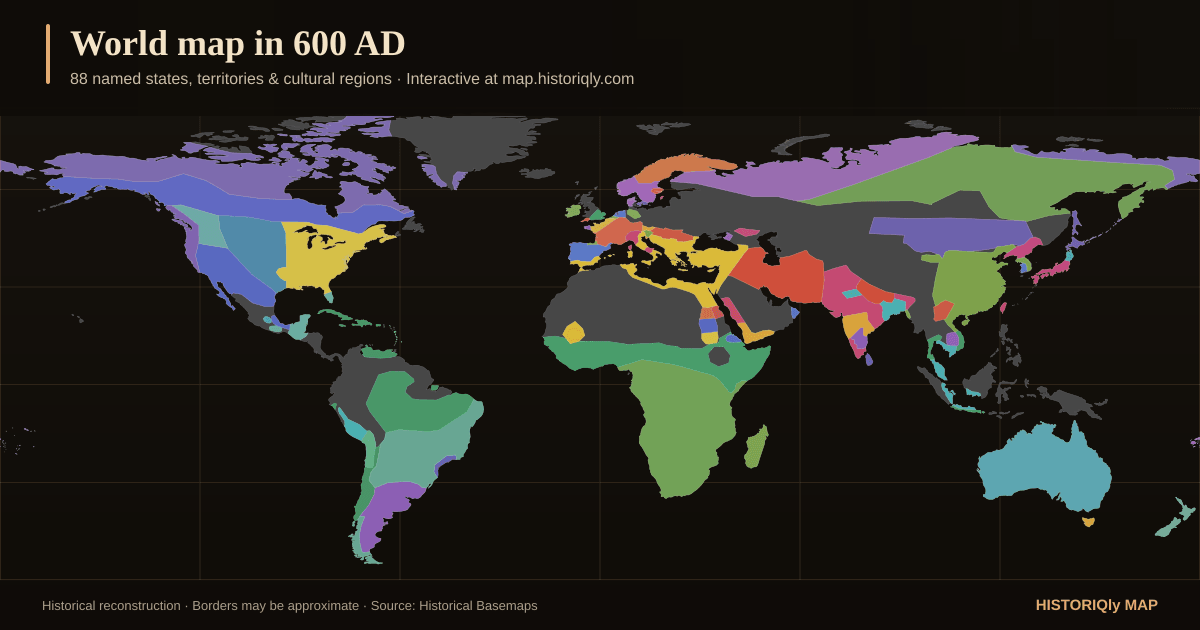
Explore a reconstruction of the world around 600 AD. Explore caliphates, dynasties, kingdoms, and trade networks across Afro-Eurasia. Figures near this year include Muhammad.
Snapshot at a glance
Counts come directly from this snapshot and the historical layers available in HistorIQly Map.
These names are encoded in the boundary dataset. Inclusion does not settle disputed borders, sovereignty, spelling, or historical interpretation.
What this snapshot shows
The interactive map lets you inspect named territories in 600 AD and compare them to earlier or later snapshots on the timeline.
Meet figures alive in, or close to, 600 AD and move from political geography to the people connected to the period.
The related chronicles below provide long-form reading tied closely to the medieval period.
Conflicts connected to 600 AD
These editorial date ranges include 600 AD. Some records group intermittent campaigns or long-running conflict series, so inclusion does not mean continuous fighting in that exact year.
600 AD – 800 AD
Southern Moche polity (Huacas de Moche) vs Northern Moche polities (Pampa Grande, San José de Moro) vs Jequetepeque valley lords
During Moche Phase V, the southern Moche capital at Huacas de Moche was abandoned while northern centers such as Pampa Grande rose and then burned amid environmental stress from El Niño events and regional warfare on Peru's north coast.
Key battles and events: Abandonment of Huacas de Moche (c. 600 CE); Burning of Pampa Grande (c. 750 CE)
600 AD – 1288
Srivijaya Empire vs Chola Dynasty, Majapahit, Javanese kingdoms
Maritime thalassocracy based in Sumatra that controlled the Strait of Malacca trade for centuries before falling to Chola naval raids and Javanese rivals.
Key battles and events: Chola invasion of Srivijaya (1025); Conquest of Malay Peninsula ports
600 AD – 1000
Tiwanaku polity (Lake Titicaca basin) vs Wari Empire (Ayacucho)
Two Middle Horizon Andean powers — highland Tiwanaku centered on Lake Titicaca and Wari in the central highlands — coexisted and competed over the Moquegua valley and southern Peru, evidenced by fortified frontier sites such as Cerro Baúl.
Key battles and events: Wari foundation of Cerro Baúl (c. 600 CE); Cerro Baúl ritual abandonment (c. 1000 CE)
600 AD – 1000
Wari Empire vs Nazca polities vs Moche successor states vs Local highland groups
The Wari state expanded from Ayacucho across the central Andes, building administrative centers such as Pikillaqta and Viracochapampa and projecting military power over coastal and highland Peru during the Middle Horizon.
Key battles and events: Conquest of the Nazca region (c. 650 CE); Establishment of Pikillaqta garrison (c. 650 CE)
598 AD – 614 AD
Kingdom of Goguryeo (Korea) vs Sui Dynasty (China)
The Sui Dynasty launched four massive invasions of the Korean kingdom of Goguryeo, mobilising over a million troops. The catastrophic defeats — especially the annihilation of 300,000 soldiers at the Salsu River — triggered rebellions that toppled the Sui Dynasty itself.
Key battles and events: First Sui Invasion (598); Battle of Salsu / Chongchon River (612)
552 AD – 744 AD
Göktürk Khaganate vs Rouran, Sassanid Persia, Tang China, Uyghur
The Göktürks built the first great Turkic empire, stretching from Manchuria to the Byzantine frontier, before splitting into eastern and western khaganates and eventually falling to Tang China and the Uyghurs.
Key battles and events: Destruction of Rouran Khaganate (552); Istemi's western conquests (560s)
537 AD – 743 AD
Tikal (Mutal dynasty) vs Calakmul (Kaan/Snake dynasty) vs Caracol (Calakmul ally) vs Dos Pilas (Calakmul ally)
A multi-generational rivalry between the two Classic Maya superpowers, fought through proxy kingdoms across the central lowlands until Tikal's resurgent victories in the 8th century.
Key battles and events: Caracol defeats Tikal (562 CE); Dos Pilas defeats Tikal (679 CE)
400 BC – 900 AD
Tikal vs Calakmul vs Caracol vs Dos Pilas vs Palenque vs Copán vs other Maya polities
Over a millennium of warfare among rival Classic Maya polities, dominated by the Tikal–Calakmul superpower rivalry and a web of proxy conflicts that shaped Classic Maya civilization.
Key battles and events: Caracol sack of Tikal (562 CE); Dos Pilas campaigns against Tikal (648–761 CE)
Historical figures near 600 AD
Arabian Peninsula
c. 570 CE – 632 CE
Founder of Islam, Prophet of God, statesman and military commander who unified the Arabian Peninsula and revealed the Quran — the sacred text that shaped the lives of over 1.8 billion people
Landmarks standing in 600 AD
Sites already standing (or still being used) in 600 AD, drawn from the map's landmark layers.
Built 600 AD · Asia
One of the largest stupas in the world, centre of Tibetan Buddhism in Kathmandu
Built 600 AD · North America
Pre-Columbian Mississippian city in Illinois, the largest archaeological site north of Mexico with massive earthen mounds
Built 600 AD · North America
Major Maya city with the iconic Kukulcán pyramid
Built 600 AD · Asia
Rock-cut Hindu, Buddhist, and Jain cave temples in Maharashtra
Built 600 AD · North America
Pre-Columbian farming village in El Salvador buried by volcanic ash around 660 AD, the 'Pompeii of the Americas' preserving daily Maya life
Built 600 AD · North America
Ancestral Puebloan cliff dwellings in the American Southwest
Related chronicles
Arabian Peninsula · Philosopher
The Prophet Who United Arabia
From an orphaned merchant in Mecca to the founder of a civilization — the life of Muhammad ibn Abdullah, told in his own words: the first revelation, the Hijra, the battles of Badr and Uhud, the conquest of Mecca, and the Farewell Sermon that completed a faith for 1.8 billion people.
Read MuhammadBoundary source and context layers
Boundary geometry is adapted from Historical Basemaps, a GPL-3.0 project built for world- and continent-scale historical mapping. The source is a work in progress: pre-modern territories can overlap, borders are often disputed, and a snapshot should be read as a reconstruction around 600 AD, not as survey-level fact.
The source marks 204 of 204 geometries in this snapshot as approximate.
Conflicts, landmarks, trade routes, and biographies come from separate HistorIQly editorial datasets. They provide discovery context but do not yet expose a citation for every individual record; verify a specific claim with specialist sources before citing it.
Frequently asked questions
The 600 AD source snapshot reconstructs political borders, territories, and named states for around 600 AD. You can inspect individual territories, view linked historical figures, and compare this snapshot with nearby years like 400 AD and 500 AD.
HistorIQly records whose date ranges include 600 AD include Late Moche Internecine Conflicts, Srivijaya Maritime Wars, Tiwanaku–Wari Rivalry, Wari Imperial Expansion, Goguryeo–Sui Wars. Long-running entries may represent intermittent campaigns rather than continuous warfare.
Figures linked near 600 AD include Muhammad. Some were alive in this year; others are included because their lives fall within the surrounding historical period.
HistorIQly Map includes 49 historical snapshots spanning from 3000 BC through the modern era, covering the medieval era and every other major period of world history.
Example labels encoded in the 600 AD source snapshot include Sui Empire, Sasanian Empire, Eastern Roman Empire, Hindu kingdoms, Frankish Kingdom, Visigothic Kingdom. These labels and reconstructed boundaries can be approximate or disputed; inspect the map methodology before using them for research.
Nearby years
Related map topics
Historical maps by year
Choose from 49 historical world maps by year. Explore borders, empires, wars, landmarks, trade routes, and people from 3000 BC to the modern era.
Medieval history map
Explore medieval world maps with kingdoms, caliphates, dynasties, trade routes, landmarks, wars, and border changes across Afro-Eurasia.
World history atlas
Browse an interactive world history atlas with maps of empires, wars, trade routes, landmarks, and influential figures from ancient history through the modern era.