
Border history
The interactive map lets you inspect named territories in 500 AD and compare them to earlier or later snapshots on the timeline.
Medieval historical map
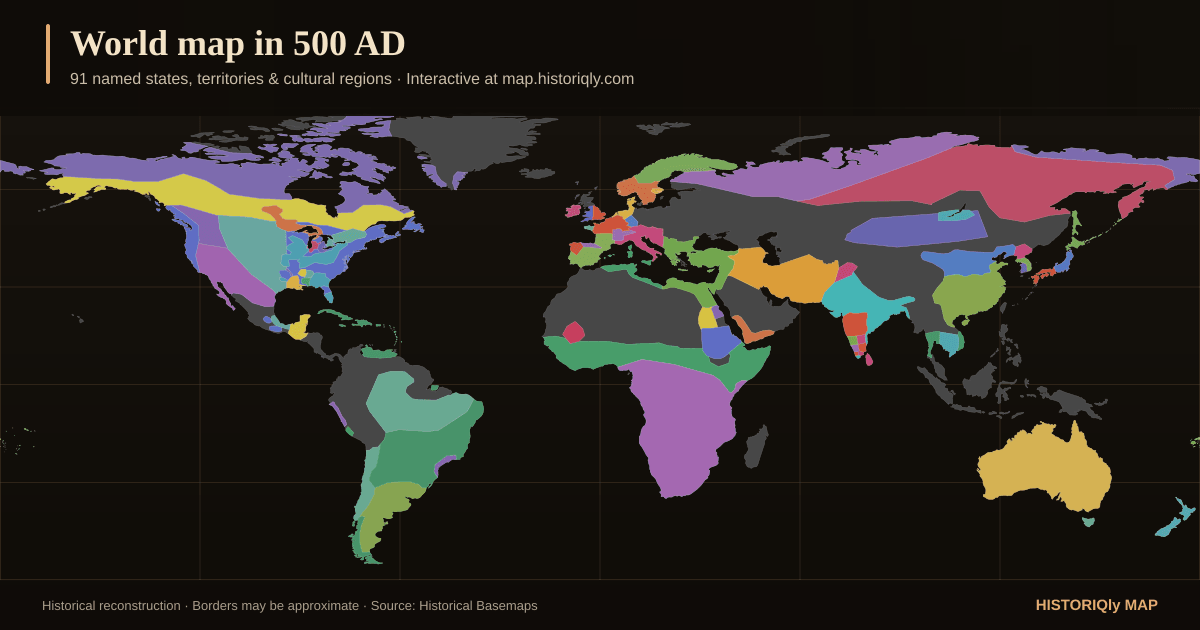
Explore a reconstruction of the world around 500 AD. Explore caliphates, dynasties, kingdoms, and trade networks across Afro-Eurasia. Figures near this year include Muhammad.
Snapshot at a glance
Counts come directly from this snapshot and the historical layers available in HistorIQly Map.
These names are encoded in the boundary dataset. Inclusion does not settle disputed borders, sovereignty, spelling, or historical interpretation.
What this snapshot shows
The interactive map lets you inspect named territories in 500 AD and compare them to earlier or later snapshots on the timeline.
Meet figures alive in, or close to, 500 AD and move from political geography to the people connected to the period.
The related chronicles below provide long-form reading tied closely to the medieval period.
Conflicts connected to 500 AD
These editorial date ranges include 500 AD. Some records group intermittent campaigns or long-running conflict series, so inclusion does not mean continuous fighting in that exact year.
486 AD – 507 AD
Frankish Kingdom (Clovis I) vs Syagrius, Alamanni & Visigoths
Clovis I united the Frankish tribes and conquered Roman Gaul, defeating the last Roman governor Syagrius at Soissons, the Alamanni, and the Visigoths at Vouillé. His conversion to Christianity and the kingdom he built laid the foundations of medieval France.
Key battles and events: Battle of Soissons (486); Battle of Tolbiac (496)
420 AD – 560 AD
Hephthalite (White Hun) Empire vs Sassanid Persia, Gupta India, Göktürks
The Hephthalites carved out a vast Central Asian empire, defeating the Sassanids and destroying the Gupta dynasty before being crushed by a Sassanid-Göktürk alliance.
Key battles and events: Defeat of Sassanid Peroz I (484); Destruction of Gupta India (c. 500)
270 AD – 525 AD
Kingdom of Aksum vs Kingdom of Himyar
The powerful East African kingdom of Aksum fought the Himyarite kingdom across the Red Sea for control of trade routes. The wars culminated in Aksum's 525 AD invasion of Himyar after the Jewish Himyarite king Dhu Nuwas persecuted Christians.
Key battles and events: Aksumite invasion of Yemen (c. 270 AD); Final invasion under Kaleb (525 AD)
200 BC – 500 AD
Monte Albán (Zapotec state) vs Cuicatlán Cañada polities vs Mixtec highland groups vs Valley of Oaxaca rivals
From its hilltop capital above the Valley of Oaxaca, the Zapotec state at Monte Albán expanded by military conquest, commemorating subjugated places on the Building J 'conquest slabs' and extending control into the Cuicatlán Cañada.
Key battles and events: Conquest of the Cuicatlán Cañada (c. 200 BCE); Construction of Building J conquest slabs (c. 100 BCE)
400 BC – 900 AD
Tikal vs Calakmul vs Caracol vs Dos Pilas vs Palenque vs Copán vs other Maya polities
Over a millennium of warfare among rival Classic Maya polities, dominated by the Tikal–Calakmul superpower rivalry and a web of proxy conflicts that shaped Classic Maya civilization.
Key battles and events: Caracol sack of Tikal (562 CE); Dos Pilas campaigns against Tikal (648–761 CE)
Historical figures near 500 AD
Arabian Peninsula
c. 570 CE – 632 CE
Founder of Islam, Prophet of God, statesman and military commander who unified the Arabian Peninsula and revealed the Quran — the sacred text that shaped the lives of over 1.8 billion people
Landmarks standing in 500 AD
Sites already standing (or still being used) in 500 AD, drawn from the map's landmark layers.
Built 500 AD · Africa
Sacred Yoruba city in Nigeria renowned for its naturalistic bronze and terracotta portrait heads from the 12th–15th centuries
Built 500 AD · South America
Mountaintop fortress of the Chachapoyas 'Warriors of the Clouds' in northern Peru, with 20-meter walls enclosing over 400 stone buildings
Built 500 AD · North America
Puuc-style Maya city in the Yucatán with the rounded Pyramid of the Magician and elaborately carved stone facades
Built 495 AD · Asia
Legendary Chan Buddhist monastery in Henan province, birthplace of Shaolin kung fu and a major center of Chinese Buddhist tradition
Built 493 AD · Asia
Over 2,300 limestone caves with 110,000 Buddhist statues near Luoyang, a masterwork of Chinese stone carving spanning four centuries
Built 490 AD · Asia
One of the holiest Hindu temples, dedicated to Shiva in Varanasi
Related chronicles
Arabian Peninsula · Philosopher
The Prophet Who United Arabia
From an orphaned merchant in Mecca to the founder of a civilization — the life of Muhammad ibn Abdullah, told in his own words: the first revelation, the Hijra, the battles of Badr and Uhud, the conquest of Mecca, and the Farewell Sermon that completed a faith for 1.8 billion people.
Read MuhammadBoundary source and context layers
Boundary geometry is adapted from Historical Basemaps, a GPL-3.0 project built for world- and continent-scale historical mapping. The source is a work in progress: pre-modern territories can overlap, borders are often disputed, and a snapshot should be read as a reconstruction around 500 AD, not as survey-level fact.
The source marks 205 of 205 geometries in this snapshot as approximate.
Conflicts, landmarks, trade routes, and biographies come from separate HistorIQly editorial datasets. They provide discovery context but do not yet expose a citation for every individual record; verify a specific claim with specialist sources before citing it.
Frequently asked questions
The 500 AD source snapshot reconstructs political borders, territories, and named states for around 500 AD. You can inspect individual territories, view linked historical figures, and compare this snapshot with nearby years like 300 AD and 400 AD.
HistorIQly records whose date ranges include 500 AD include Frankish Conquest of Gaul, Hephthalite Wars, Aksumite–Himyarite Wars, Monte Albán Zapotec Conquest State, Maya City-State Wars. Long-running entries may represent intermittent campaigns rather than continuous warfare.
Figures linked near 500 AD include Muhammad. Some were alive in this year; others are included because their lives fall within the surrounding historical period.
HistorIQly Map includes 49 historical snapshots spanning from 3000 BC through the modern era, covering the medieval era and every other major period of world history.
Example labels encoded in the 500 AD source snapshot include Sasanian Empire, Jin Empire, Gupta Empire, Eastern Roman Empire, Franks, Himyarite Kingdom. These labels and reconstructed boundaries can be approximate or disputed; inspect the map methodology before using them for research.
Nearby years
Related map topics
Historical maps by year
Choose from 49 historical world maps by year. Explore borders, empires, wars, landmarks, trade routes, and people from 3000 BC to the modern era.
Medieval history map
Explore medieval world maps with kingdoms, caliphates, dynasties, trade routes, landmarks, wars, and border changes across Afro-Eurasia.
World history atlas
Browse an interactive world history atlas with maps of empires, wars, trade routes, landmarks, and influential figures from ancient history through the modern era.