
Border history
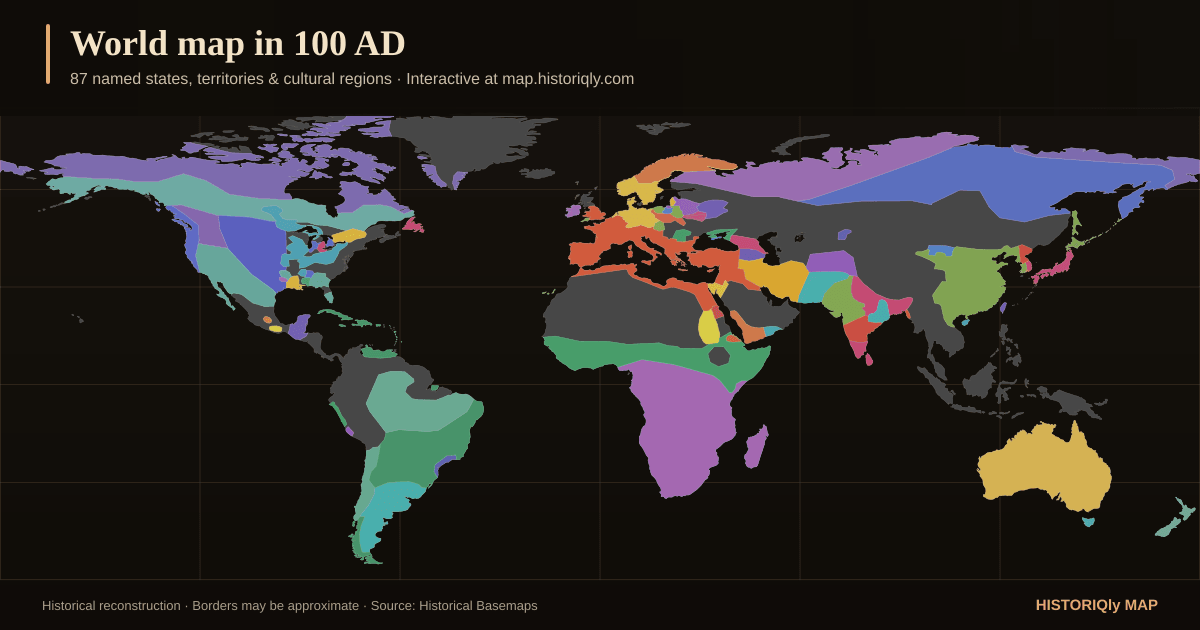
The interactive map lets you inspect named territories in 100 AD and compare them to earlier or later snapshots on the timeline.
Classical historical map
Explore a reconstruction of the world around 100 AD. Follow Mediterranean, Persian, Indian, and East Asian powers as the classical world expands and collides. Figures near this year include Rabban Gamliel, Yochanan ben Zakkai, Marcus Aurelius.
Snapshot at a glance
Counts come directly from this snapshot and the historical layers available in HistorIQly Map.
These names are encoded in the boundary dataset. Inclusion does not settle disputed borders, sovereignty, spelling, or historical interpretation.
What this snapshot shows
The interactive map lets you inspect named territories in 100 AD and compare them to earlier or later snapshots on the timeline.
Meet figures alive in, or close to, 100 AD and move from political geography to the people connected to the period.
The related chronicles below provide long-form reading tied closely to the classical period.
Conflicts connected to 100 AD
These editorial date ranges include 100 AD. Some records group intermittent campaigns or long-running conflict series, so inclusion does not mean continuous fighting in that exact year.
66 AD – 135 AD
Roman Empire vs Jewish rebels
Three major revolts against Roman rule in Judea — culminating in the destruction of the Second Temple in 70 AD and the Jewish diaspora.
Key battles and events: Siege of Jerusalem (70 AD); Masada (73 AD)
30 AD – 375 AD
Kushan Empire (Kujula Kadphises, Kanishka) vs Indo-Parthians, Indo-Scythians
The Kushans built a vast empire spanning Central Asia to the Ganges, becoming a crucial link on the Silk Road and one of the great patrons of Gandharan Buddhist art.
Key battles and events: Conquest of Gandhara (c. 75 AD); Kanishka's campaigns in the Gangetic plain
53 BC – 217 AD
Roman Republic / Empire vs Parthian Empire
Centuries of conflict over Mesopotamia and the Euphrates frontier, beginning with Crassus's catastrophic defeat at Carrhae where seven Roman legions were destroyed.
Key battles and events: Battle of Carrhae (53 BC); Mark Antony's failed invasion (36 BC)
200 BC – 500 AD
Monte Albán (Zapotec state) vs Cuicatlán Cañada polities vs Mixtec highland groups vs Valley of Oaxaca rivals
From its hilltop capital above the Valley of Oaxaca, the Zapotec state at Monte Albán expanded by military conquest, commemorating subjugated places on the Building J 'conquest slabs' and extending control into the Cuicatlán Cañada.
Key battles and events: Conquest of the Cuicatlán Cañada (c. 200 BCE); Construction of Building J conquest slabs (c. 100 BCE)
400 BC – 900 AD
Tikal vs Calakmul vs Caracol vs Dos Pilas vs Palenque vs Copán vs other Maya polities
Over a millennium of warfare among rival Classic Maya polities, dominated by the Tikal–Calakmul superpower rivalry and a web of proxy conflicts that shaped Classic Maya civilization.
Key battles and events: Caracol sack of Tikal (562 CE); Dos Pilas campaigns against Tikal (648–761 CE)
Historical figures near 100 AD
Yavneh / Rome
c. 50 AD – c. 118 AD
First Nasi of the Sanhedrin after the destruction of the Second Temple, leader of the Yavneh academy, architect of the Passover Haggadah, the Birkat HaMinim, and the standardisation of Jewish prayer
Jerusalem / Yavne
c. 30 BC – c. 90 AD
Escaping besieged Jerusalem in a coffin, negotiating with Vespasian, founding the academy at Yavne, transforming Judaism from a Temple-based religion into a portable faith that could survive two thousand years of exile
Rome
121 AD – 180 AD
Roman Emperor, Stoic philosopher, author of the Meditations, last of the Five Good Emperors
South India
c. 150 CE – c. 250 CE
Founder of Madhyamaka Buddhism, philosopher of emptiness and dependent arising
Roman Judea
c. 4 BC – c. 30 AD
Founder of Christianity, itinerant preacher, teacher of radical love and forgiveness whose life and death reshaped the moral foundations of Western civilisation
Rome
63 BC – 14 AD
First Roman Emperor, founder of the Principate, Pax Romana, transformation of Rome from republic to empire
Landmarks standing in 100 AD
Sites already standing (or still being used) in 100 AD, drawn from the map's landmark layers.
Built 100 AD · South America
Moche adobe pyramid near Trujillo, Peru, covered in polychrome friezes of the fanged god Ai Apaec and site of ritual sacrifices.
Built 100 AD · North America
Zapotec and Mixtec religious center in Oaxaca famed for its intricate geometric stone mosaics and tombs of high priests.
Built 100 AD · Africa
Remarkably preserved Roman colonial town in Algeria, founded by Trajan with a perfect grid layout, triumphal arch, and public library
Built 80 AD · Europe
Iconic Roman amphitheater that hosted gladiatorial contests
Built 68 AD · Asia
The first Buddhist temple established in China, founded during the Eastern Han dynasty in Luoyang after Indian monks brought sutras on white horses
Built 4 BC · Asia
Most sacred Shinto shrine, ritually rebuilt every 20 years since antiquity
Related chronicles
Yavneh / Rome · Leader
The Man Who Rebuilt Judaism from the Ashes
The Nasi who inherited a shattered nation after the destruction of the Second Temple and rebuilt Judaism from a coastal village — standardising prayer, codifying the Haggadah, and holding together a fractured people through sheer force of authority.
Read Rabban GamlielJerusalem / Yavne · Philosopher
The Sage Who Saved a Civilisation
The Pharisee sage who escaped besieged Jerusalem in a coffin, predicted Vespasian would become emperor, and founded the academy at Yavne that preserved Judaism after the Temple’s destruction — told in his own words.
Read Yochanan ben ZakkaiRome · Philosopher
The Philosopher on the Throne
The emperor who never wanted the throne — Stoic philosopher, frontier warrior, and the last ruler of Rome's golden age. A first-person ePub told in Marcus Aurelius's own voice.
Read Marcus AureliusSouth India · Philosopher
The Philosopher of Emptiness
The Buddhist philosopher who proved that emptiness is not void but the very condition of all existence — founder of the Madhyamaka school, dialectician of dependent arising, and the most influential Buddhist thinker after the Buddha himself.
Read NāgārjunaBoundary source and context layers
Boundary geometry is adapted from Historical Basemaps, a GPL-3.0 project built for world- and continent-scale historical mapping. The source is a work in progress: pre-modern territories can overlap, borders are often disputed, and a snapshot should be read as a reconstruction around 100 AD, not as survey-level fact.
The source marks 440 of 440 geometries in this snapshot as approximate.
Conflicts, landmarks, trade routes, and biographies come from separate HistorIQly editorial datasets. They provide discovery context but do not yet expose a citation for every individual record; verify a specific claim with specialist sources before citing it.
Frequently asked questions
The 100 AD source snapshot reconstructs political borders, territories, and named states for around 100 AD. You can inspect individual territories, view linked historical figures, and compare this snapshot with nearby years like 100 BC and 1 BC.
HistorIQly records whose date ranges include 100 AD include Jewish–Roman Wars, Kushan Empire Conquests, Roman–Parthian Wars, Monte Albán Zapotec Conquest State, Maya City-State Wars. Long-running entries may represent intermittent campaigns rather than continuous warfare.
Figures linked near 100 AD include Rabban Gamliel, Yochanan ben Zakkai, Marcus Aurelius, Nagarjuna. Some were alive in this year; others are included because their lives fall within the surrounding historical period.
HistorIQly Map includes 49 historical snapshots spanning from 3000 BC through the modern era, covering the classical era and every other major period of world history.
Example labels encoded in the 100 AD source snapshot include Roman Empire, Parthian Empire, Saka Kingdom, Hindu kingdoms, Suren Kingdom, Kushan Empire. These labels and reconstructed boundaries can be approximate or disputed; inspect the map methodology before using them for research.
Nearby years
Related map topics
Historical maps by year
Choose from 49 historical world maps by year. Explore borders, empires, wars, landmarks, trade routes, and people from 3000 BC to the modern era.
Ancient history map
Explore ancient world maps from 3000 BC through the classical era. Follow early civilizations, empires, trade routes, landmarks, and borders.
World history atlas
Browse an interactive world history atlas with maps of empires, wars, trade routes, landmarks, and influential figures from ancient history through the modern era.