
Border history
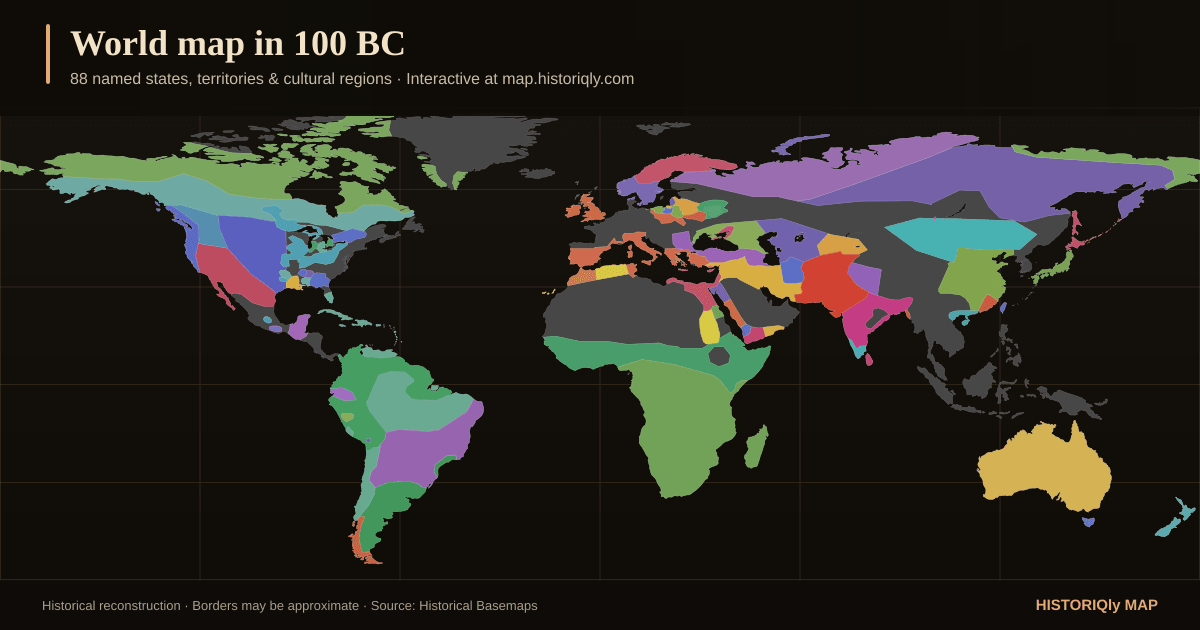
The interactive map lets you inspect named territories in 100 BC and compare them to earlier or later snapshots on the timeline.
Classical historical map
Explore a reconstruction of the world around 100 BC. Follow Mediterranean, Persian, Indian, and East Asian powers as the classical world expands and collides. Figures near this year include Cicero, Joshua ben Perachiah, Julius Caesar.
Snapshot at a glance
Counts come directly from this snapshot and the historical layers available in HistorIQly Map.
These names are encoded in the boundary dataset. Inclusion does not settle disputed borders, sovereignty, spelling, or historical interpretation.
What this snapshot shows
The interactive map lets you inspect named territories in 100 BC and compare them to earlier or later snapshots on the timeline.
Meet figures alive in, or close to, 100 BC and move from political geography to the people connected to the period.
The related chronicles below provide long-form reading tied closely to the classical period.
Conflicts connected to 100 BC
These editorial date ranges include 100 BC. Some records group intermittent campaigns or long-running conflict series, so inclusion does not mean continuous fighting in that exact year.
104 BC – 100 BC
Roman Republic vs Slave rebels under Salvius & Athenion
A second massive slave revolt erupted in Sicily, led by Salvius and then Athenion. The rebels briefly established their own state before being defeated by consul Manius Aquillius.
Key battles and events: Battle of Morgantina (104 BC); Battle of Scirthaea (101 BC)
200 BC – 89 AD
Han Dynasty vs Xiongnu Confederacy
Centuries of conflict between the Chinese Han Dynasty and the nomadic Xiongnu confederation along the northern frontier. Emperor Wu's massive campaigns eventually split the Xiongnu, with the southern branch submitting to China. The wars drove construction of the Great Wall and opened the Silk Road.
Key battles and events: Battle of Baideng (200 BC); Battle of Mobei (119 BC)
200 BC – 500 AD
Monte Albán (Zapotec state) vs Cuicatlán Cañada polities vs Mixtec highland groups vs Valley of Oaxaca rivals
From its hilltop capital above the Valley of Oaxaca, the Zapotec state at Monte Albán expanded by military conquest, commemorating subjugated places on the Building J 'conquest slabs' and extending control into the Cuicatlán Cañada.
Key battles and events: Conquest of the Cuicatlán Cañada (c. 200 BCE); Construction of Building J conquest slabs (c. 100 BCE)
206 BC – 46 BC
Roman Republic vs Numidia
Rome's complex relationship with Numidia spanned from alliance against Carthage to eventual annexation. Masinissa's Numidia was a key Roman ally, but later kings like Jugurtha and Juba I challenged Rome, leading to full conquest under Caesar.
Key battles and events: Jugurthine War campaigns (112–105 BC); Battle of Thapsus (46 BC)
400 BC – 900 AD
Tikal vs Calakmul vs Caracol vs Dos Pilas vs Palenque vs Copán vs other Maya polities
Over a millennium of warfare among rival Classic Maya polities, dominated by the Tikal–Calakmul superpower rivalry and a web of proxy conflicts that shaped Classic Maya civilization.
Key battles and events: Caracol sack of Tikal (562 CE); Dos Pilas campaigns against Tikal (648–761 CE)
Historical figures near 100 BC
Rome
106 BC – 43 BC
Roman orator, statesman, philosopher, defender of the Republic
Jerusalem / Alexandria
c. 140 BC – c. 76 BC
Nasi of the Sanhedrin, second of the Zugot, author of one of the most famous ethical maxims in Jewish tradition, survivor of Alexander Jannaeus's persecution
Rome
100 BC – 44 BC
Roman dictator, military genius, political reformer, conqueror of Gaul
Egypt
69 BC – 30 BC
Last pharaoh of Egypt, polyglot, political strategist, lover of Caesar and Antony
Rome
63 BC – 14 AD
First Roman Emperor, founder of the Principate, Pax Romana, transformation of Rome from republic to empire
Judea
c. 200 BC – c. 161 BC
First Nasi of the Sanhedrin, founder of the Zugot era, martyr of the Maccabean persecution, called the most pious of the priesthood
Landmarks standing in 100 BC
Sites already standing (or still being used) in 100 BC, drawn from the map's landmark layers.
Built 100 BC · Asia
Nabataean rock-cut tombs in the Arabian desert, the southern sister city of Petra in Saudi Arabia
Built 100 BC · North America
Largest earthen enclosures in the world, built by the Hopewell culture in Ohio, including a giant octagon aligned to track the moon's 18.6-year cycle.
Built 200 BC · Asia
Buddhist cave paintings and sculptures, a UNESCO masterpiece
Built 200 BC · North America
Major Maya city known for its elaborate stelae and hieroglyphic stairway
Built 200 BC · Asia
Oasis town and Silk Road waypoint near the Mogao Caves
Built 200 BC · Asia
Major Chinese port on the Maritime Silk Road
Related chronicles
Rome · Conqueror
He Crossed a River and Ended a Republic. Six Years Later His Own Senate Stabbed Him 23 Times.
The definitive biography of Rome's most ambitious son — from the streets of the Subura to the banks of the Rubicon. Plus a first-person ePub told in Caesar's own voice.
Read Julius CaesarRome · Thinker
The Voice of the Republic
The greatest orator Rome ever produced — lawyer, consul, philosopher, and the last voice of the dying Republic. A first-person ePub told in Cicero's own words.
Read CiceroJerusalem / Alexandria · Philosopher
The Teacher Who Judged All Men Charitably
The Pharisee sage who led the Sanhedrin, survived a tyrant king's persecution, and carried the oral tradition through exile to ensure its survival — told in his own words.
Read Joshua ben PerachiahEgypt · Leader
A Greek by Blood. A Pharaoh by Choice. Dead by Her Own Hand at 39.
The true story of history's most misunderstood queen — polyglot, strategist, and the last ruler of a three-thousand-year civilization.
Read CleopatraBoundary source and context layers
Boundary geometry is adapted from Historical Basemaps, a GPL-3.0 project built for world- and continent-scale historical mapping. The source is a work in progress: pre-modern territories can overlap, borders are often disputed, and a snapshot should be read as a reconstruction around 100 BC, not as survey-level fact.
The source marks 233 of 233 geometries in this snapshot as approximate.
Conflicts, landmarks, trade routes, and biographies come from separate HistorIQly editorial datasets. They provide discovery context but do not yet expose a citation for every individual record; verify a specific claim with specialist sources before citing it.
Frequently asked questions
The 100 BC source snapshot reconstructs political borders, territories, and named states for around 100 BC. You can inspect individual territories, view linked historical figures, and compare this snapshot with nearby years like 300 BC and 200 BC.
HistorIQly records whose date ranges include 100 BC include Second Servile War, Han–Xiongnu Wars, Monte Albán Zapotec Conquest State, Roman–Numidian Wars, Maya City-State Wars. Long-running entries may represent intermittent campaigns rather than continuous warfare.
Figures linked near 100 BC include Cicero, Joshua ben Perachiah, Julius Caesar, Cleopatra. Some were alive in this year; others are included because their lives fall within the surrounding historical period.
HistorIQly Map includes 49 historical snapshots spanning from 3000 BC through the modern era, covering the classical era and every other major period of world history.
Example labels encoded in the 100 BC source snapshot include Xiongnu, Kushan Empire, Han Empire, Scythians, Seleucid Kingdom, Mauryan Empire. These labels and reconstructed boundaries can be approximate or disputed; inspect the map methodology before using them for research.
Nearby years
Related map topics
Historical maps by year
Choose from 49 historical world maps by year. Explore borders, empires, wars, landmarks, trade routes, and people from 3000 BC to the modern era.
Ancient history map
Explore ancient world maps from 3000 BC through the classical era. Follow early civilizations, empires, trade routes, landmarks, and borders.
World history atlas
Browse an interactive world history atlas with maps of empires, wars, trade routes, landmarks, and influential figures from ancient history through the modern era.