
Border history
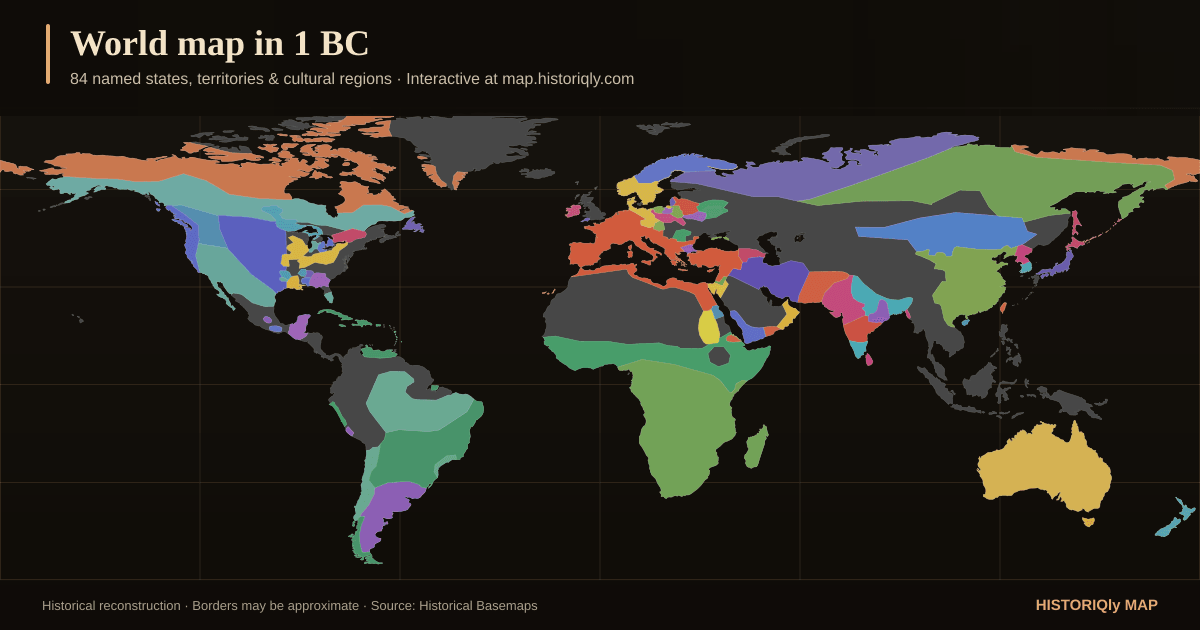
The interactive map lets you inspect named territories in 1 BC and compare them to earlier or later snapshots on the timeline.
Classical historical map
Explore a reconstruction of the world around 1 BC. Follow Mediterranean, Persian, Indian, and East Asian powers as the classical world expands and collides. Figures near this year include Augustus Caesar, Jesus Christ, Yochanan ben Zakkai.
Snapshot at a glance
Counts come directly from this snapshot and the historical layers available in HistorIQly Map.
These names are encoded in the boundary dataset. Inclusion does not settle disputed borders, sovereignty, spelling, or historical interpretation.
What this snapshot shows
The interactive map lets you inspect named territories in 1 BC and compare them to earlier or later snapshots on the timeline.
Meet figures alive in, or close to, 1 BC and move from political geography to the people connected to the period.
The related chronicles below provide long-form reading tied closely to the classical period.
Conflicts connected to 1 BC
These editorial date ranges include 1 BC. Some records group intermittent campaigns or long-running conflict series, so inclusion does not mean continuous fighting in that exact year.
12 BC – 16 AD
Roman Empire vs Germanic tribal alliance (Arminius)
Augustus sought to conquer Germania east of the Rhine. Arminius ambushed and destroyed three Roman legions at the Teutoburg Forest in 9 AD — one of Rome's worst defeats, ending expansion into Germania permanently.
Key battles and events: Battle of Teutoburg Forest (9 AD); Germanicus's campaigns (14–16 AD)
53 BC – 217 AD
Roman Republic / Empire vs Parthian Empire
Centuries of conflict over Mesopotamia and the Euphrates frontier, beginning with Crassus's catastrophic defeat at Carrhae where seven Roman legions were destroyed.
Key battles and events: Battle of Carrhae (53 BC); Mark Antony's failed invasion (36 BC)
200 BC – 89 AD
Han Dynasty vs Xiongnu Confederacy
Centuries of conflict between the Chinese Han Dynasty and the nomadic Xiongnu confederation along the northern frontier. Emperor Wu's massive campaigns eventually split the Xiongnu, with the southern branch submitting to China. The wars drove construction of the Great Wall and opened the Silk Road.
Key battles and events: Battle of Baideng (200 BC); Battle of Mobei (119 BC)
200 BC – 500 AD
Monte Albán (Zapotec state) vs Cuicatlán Cañada polities vs Mixtec highland groups vs Valley of Oaxaca rivals
From its hilltop capital above the Valley of Oaxaca, the Zapotec state at Monte Albán expanded by military conquest, commemorating subjugated places on the Building J 'conquest slabs' and extending control into the Cuicatlán Cañada.
Key battles and events: Conquest of the Cuicatlán Cañada (c. 200 BCE); Construction of Building J conquest slabs (c. 100 BCE)
400 BC – 900 AD
Tikal vs Calakmul vs Caracol vs Dos Pilas vs Palenque vs Copán vs other Maya polities
Over a millennium of warfare among rival Classic Maya polities, dominated by the Tikal–Calakmul superpower rivalry and a web of proxy conflicts that shaped Classic Maya civilization.
Key battles and events: Caracol sack of Tikal (562 CE); Dos Pilas campaigns against Tikal (648–761 CE)
Historical figures near 1 BC
Rome
63 BC – 14 AD
First Roman Emperor, founder of the Principate, Pax Romana, transformation of Rome from republic to empire
Roman Judea
c. 4 BC – c. 30 AD
Founder of Christianity, itinerant preacher, teacher of radical love and forgiveness whose life and death reshaped the moral foundations of Western civilisation
Jerusalem / Yavne
c. 30 BC – c. 90 AD
Escaping besieged Jerusalem in a coffin, negotiating with Vespasian, founding the academy at Yavne, transforming Judaism from a Temple-based religion into a portable faith that could survive two thousand years of exile
Egypt
69 BC – 30 BC
Last pharaoh of Egypt, polyglot, political strategist, lover of Caesar and Antony
Rome
106 BC – 43 BC
Roman orator, statesman, philosopher, defender of the Republic
Rome
100 BC – 44 BC
Roman dictator, military genius, political reformer, conqueror of Gaul
Landmarks standing in 1 BC
Sites already standing (or still being used) in 1 BC, drawn from the map's landmark layers.
Built 4 BC · Asia
Most sacred Shinto shrine, ritually rebuilt every 20 years since antiquity
Built 19 BC · Asia
Last remnant of Herod's Second Temple, Judaism's holiest prayer site
Built 25 BC · Europe
Best-preserved Roman provincial capital in Iberia, with a theater, amphitheater, aqueducts, and bridge still in use in Spain
Built 57 BC · Asia
Thousand-year capital of the Silla Kingdom in Korea, with royal tombs, Buddhist ruins, and the Cheomseongdae observatory
Built 100 BC · Asia
Nabataean rock-cut tombs in the Arabian desert, the southern sister city of Petra in Saudi Arabia
Built 100 BC · North America
Largest earthen enclosures in the world, built by the Hopewell culture in Ohio, including a giant octagon aligned to track the moon's 18.6-year cycle.
Related chronicles
Roman Judea · Philosopher
The Man Who Changed Everything
The life of Jesus of Nazareth — a carpenter's son from Galilee who gathered twelve followers, preached for three years, was executed by Rome, and became the most influential figure in human history.
Read Jesus ChristRome · Leader
The First Emperor
The sickly teenager who inherited Caesar's name and outmanoeuvred every rival to become the most powerful man on earth — then ruled for forty-one years and built the world Rome would inhabit for centuries.
Read Augustus CaesarJerusalem / Yavne · Philosopher
The Sage Who Saved a Civilisation
The Pharisee sage who escaped besieged Jerusalem in a coffin, predicted Vespasian would become emperor, and founded the academy at Yavne that preserved Judaism after the Temple’s destruction — told in his own words.
Read Yochanan ben ZakkaiEgypt · Leader
A Greek by Blood. A Pharaoh by Choice. Dead by Her Own Hand at 39.
The true story of history's most misunderstood queen — polyglot, strategist, and the last ruler of a three-thousand-year civilization.
Read CleopatraBoundary source and context layers
Boundary geometry is adapted from Historical Basemaps, a GPL-3.0 project built for world- and continent-scale historical mapping. The source is a work in progress: pre-modern territories can overlap, borders are often disputed, and a snapshot should be read as a reconstruction around 1 BC, not as survey-level fact.
The source marks 442 of 442 geometries in this snapshot as approximate.
Conflicts, landmarks, trade routes, and biographies come from separate HistorIQly editorial datasets. They provide discovery context but do not yet expose a citation for every individual record; verify a specific claim with specialist sources before citing it.
Frequently asked questions
The 1 BC source snapshot reconstructs political borders, territories, and named states for around 1 BC. You can inspect individual territories, view linked historical figures, and compare this snapshot with nearby years like 200 BC and 100 BC.
HistorIQly records whose date ranges include 1 BC include Roman–Germanic Wars, Roman–Parthian Wars, Han–Xiongnu Wars, Monte Albán Zapotec Conquest State, Maya City-State Wars. Long-running entries may represent intermittent campaigns rather than continuous warfare.
Figures linked near 1 BC include Augustus Caesar, Jesus Christ, Yochanan ben Zakkai, Cleopatra. Some were alive in this year; others are included because their lives fall within the surrounding historical period.
HistorIQly Map includes 49 historical snapshots spanning from 3000 BC through the modern era, covering the classical era and every other major period of world history.
Example labels encoded in the 1 BC source snapshot include Roman Empire, Xiongnu, Parthian Empire, Saka Kingdom, Hindu kingdoms, Suren Kingdom. These labels and reconstructed boundaries can be approximate or disputed; inspect the map methodology before using them for research.
Nearby years
Related map topics
Historical maps by year
Choose from 49 historical world maps by year. Explore borders, empires, wars, landmarks, trade routes, and people from 3000 BC to the modern era.
Ancient history map
Explore ancient world maps from 3000 BC through the classical era. Follow early civilizations, empires, trade routes, landmarks, and borders.
World history atlas
Browse an interactive world history atlas with maps of empires, wars, trade routes, landmarks, and influential figures from ancient history through the modern era.