
Border history
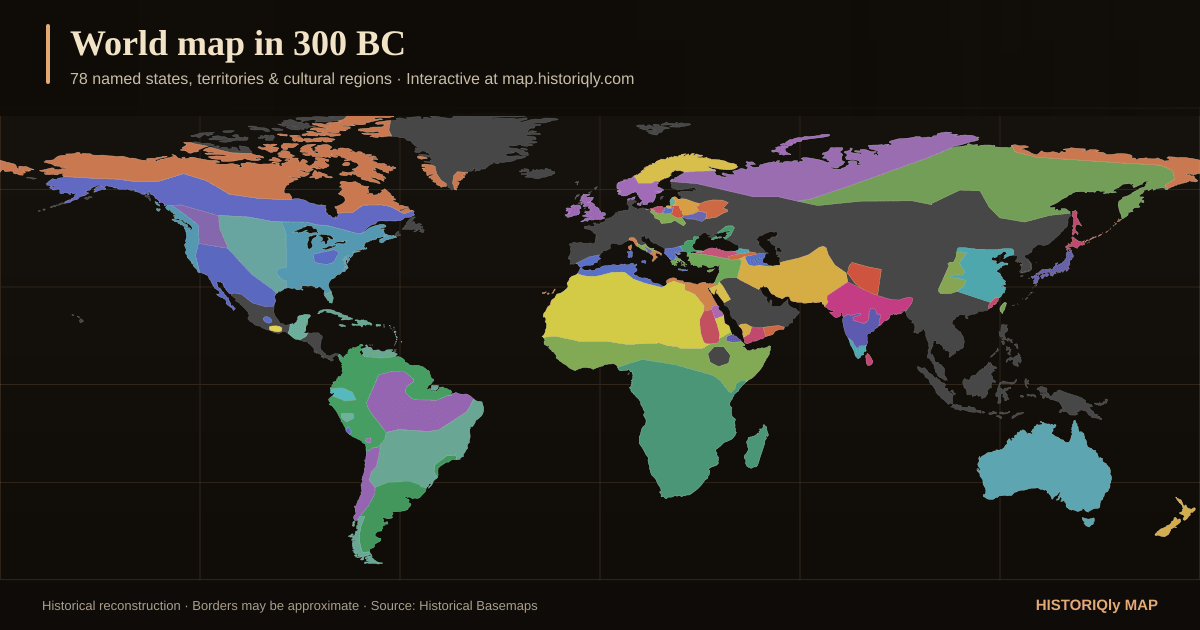
The interactive map lets you inspect named territories in 300 BC and compare them to earlier or later snapshots on the timeline.
Classical historical map
Explore a reconstruction of the world around 300 BC. Follow Mediterranean, Persian, Indian, and East Asian powers as the classical world expands and collides. Figures near this year include Aristotle, Alexander the Great, Plato.
Snapshot at a glance
Counts come directly from this snapshot and the historical layers available in HistorIQly Map.
These names are encoded in the boundary dataset. Inclusion does not settle disputed borders, sovereignty, spelling, or historical interpretation.
What this snapshot shows
The interactive map lets you inspect named territories in 300 BC and compare them to earlier or later snapshots on the timeline.
Meet figures alive in, or close to, 300 BC and move from political geography to the people connected to the period.
The related chronicles below provide long-form reading tied closely to the classical period.
Conflicts connected to 300 BC
These editorial date ranges include 300 BC. Some records group intermittent campaigns or long-running conflict series, so inclusion does not mean continuous fighting in that exact year.
322 BC – 281 BC
Successor generals of Alexander
The brutal 40-year power struggle between Alexander's generals that shattered his empire into rival kingdoms — Ptolemaic Egypt, Seleucid Persia, and Antigonid Macedon.
Key battles and events: Ipsus (301 BC); Corupedium (281 BC)
343 BC – 290 BC
Roman Republic vs Samnite Confederation
Three wars between Rome and the Samnites for control of central and southern Italy. Rome's eventual victory secured dominance over the Italian peninsula and laid the foundation for its Mediterranean empire.
Key battles and events: Battle of the Caudine Forks (321 BC); Battle of Sentinum (295 BC)
400 BC – 900 AD
Tikal vs Calakmul vs Caracol vs Dos Pilas vs Palenque vs Copán vs other Maya polities
Over a millennium of warfare among rival Classic Maya polities, dominated by the Tikal–Calakmul superpower rivalry and a web of proxy conflicts that shaped Classic Maya civilization.
Key battles and events: Caracol sack of Tikal (562 CE); Dos Pilas campaigns against Tikal (648–761 CE)
475 BC – 221 BC
State of Qin vs States of Qi, Chu, Yan, Zhao, Wei & Han
Seven major Chinese states fought for supremacy over 250 years of escalating warfare, ending when the State of Qin conquered all rivals and unified China under the first imperial dynasty in 221 BC.
Key battles and events: Battle of Guiling (354 BC); Battle of Maling (342 BC)
509 BC – 264 BC
Roman Republic vs Etruscan city-states
Centuries of intermittent conflict between Rome and the Etruscan civilization. Rome's conquest of Veii in 396 BC was a turning point, and by 264 BC all Etruscan cities had been absorbed into the Roman state.
Key battles and events: Battle of the Cremera (477 BC); Siege of Veii (406–396 BC)
Historical figures near 300 BC
Greece
384 BC – 322 BC
Philosopher, scientist, tutor of Alexander the Great, founder of the Lyceum
Macedon
356 BC – 323 BC
Undefeated military commander, conqueror of the Persian Empire, founder of over twenty cities
Greece
c. 428 BC – c. 348 BC
Philosopher, founder of the Academy, author of the Republic and the Dialogues
India
c. 340 BC – c. 297 BC
Founding the Maurya Empire, unifying India, defeating Seleucus Nicator, Arthashastra statecraft
Landmarks standing in 300 BC
Sites already standing (or still being used) in 300 BC, drawn from the map's landmark layers.
Built 300 BC · Asia
Hellenistic city in northern Afghanistan — the easternmost Greek city known, with a gymnasium, theater, and temple of Zeus
Built 300 BC · Asia
Great city at the crossroads of East-West trade in ancient Syria
Built 300 BC · North America
The largest pyramid by volume ever built, a Mesoamerican temple-mountain in Puebla topped today by a colonial Catholic church.
Built 300 BC · North America
Largest serpent effigy mound in the world in Ohio, a 411-meter earthwork aligned to solstice sunsets and lunar cycles
Built 300 BC · Asia
Hellenistic hilltop city in western Turkey with a dramatic acropolis, the steepest theater of antiquity, and the famous Altar of Zeus
Built 300 BC · Asia
Ancient Nabataean city carved into rose-red cliffs
Related chronicles
Greece · Philosopher
The Man Who Catalogued the World
The philosopher who catalogued the world — from logic to biology, politics to poetry. Plato's greatest student, Alexander's tutor, and the mind that shaped Western thought for two thousand years.
Read AristotleMacedon · Conqueror
Heir at 20. Pharaoh at 24. Master of Asia at 30. Dead at 32.
The king who conquered the known world before the age of thirty — from Macedonia to Egypt to the borders of India.
Read Alexander the GreatGreece · Philosopher
The Philosopher Who Invented the West
The philosopher who founded the Academy, wrote the Republic, and shaped every branch of Western thought for two and a half thousand years — from the streets of wartime Athens to the courts of Sicilian tyrants.
Read PlatoIndia · Conqueror
The Exile Who Built an Empire
The exile who overthrew an empire and built one of his own — how Chandragupta Maurya and Chanakya unified the Indian subcontinent for the first time in history.
Read Chandragupta MauryaBoundary source and context layers
Boundary geometry is adapted from Historical Basemaps, a GPL-3.0 project built for world- and continent-scale historical mapping. The source is a work in progress: pre-modern territories can overlap, borders are often disputed, and a snapshot should be read as a reconstruction around 300 BC, not as survey-level fact.
The source marks 155 of 155 geometries in this snapshot as approximate.
Conflicts, landmarks, trade routes, and biographies come from separate HistorIQly editorial datasets. They provide discovery context but do not yet expose a citation for every individual record; verify a specific claim with specialist sources before citing it.
Frequently asked questions
The 300 BC source snapshot reconstructs political borders, territories, and named states for around 300 BC. You can inspect individual territories, view linked historical figures, and compare this snapshot with nearby years like 400 BC and 323 BC.
HistorIQly records whose date ranges include 300 BC include Wars of the Diadochi, Samnite Wars, Maya City-State Wars, Warring States Period, Roman–Etruscan Wars. Long-running entries may represent intermittent campaigns rather than continuous warfare.
Figures linked near 300 BC include Aristotle, Alexander the Great, Plato, Chandragupta Maurya. Some were alive in this year; others are included because their lives fall within the surrounding historical period.
HistorIQly Map includes 49 historical snapshots spanning from 3000 BC through the modern era, covering the classical era and every other major period of world history.
Example labels encoded in the 300 BC source snapshot include Seleucid Kingdom, Zhow states, Mauryan Empire, Kingdom of Antigonus, Hindu kingdoms and republics, Carthaginian Empire. These labels and reconstructed boundaries can be approximate or disputed; inspect the map methodology before using them for research.
Nearby years
Related map topics
Historical maps by year
Choose from 49 historical world maps by year. Explore borders, empires, wars, landmarks, trade routes, and people from 3000 BC to the modern era.
Ancient history map
Explore ancient world maps from 3000 BC through the classical era. Follow early civilizations, empires, trade routes, landmarks, and borders.
World history atlas
Browse an interactive world history atlas with maps of empires, wars, trade routes, landmarks, and influential figures from ancient history through the modern era.