
Border history
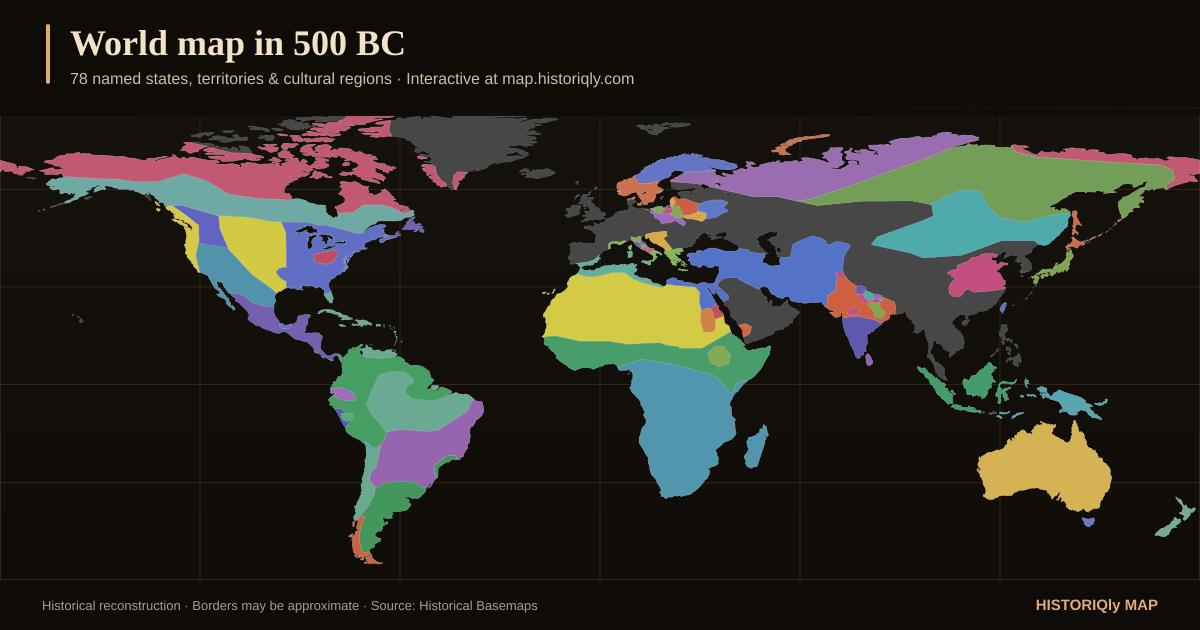
The interactive map lets you inspect named territories in 500 BC and compare them to earlier or later snapshots on the timeline.
Classical historical map
Explore a reconstruction of the world around 500 BC. Follow Mediterranean, Persian, Indian, and East Asian powers as the classical world expands and collides. Figures near this year include Pericles, Socrates, Plato.
Snapshot at a glance
Counts come directly from this snapshot and the historical layers available in HistorIQly Map.
These names are encoded in the boundary dataset. Inclusion does not settle disputed borders, sovereignty, spelling, or historical interpretation.
What this snapshot shows
The interactive map lets you inspect named territories in 500 BC and compare them to earlier or later snapshots on the timeline.
Meet figures alive in, or close to, 500 BC and move from political geography to the people connected to the period.
The related chronicles below provide long-form reading tied closely to the classical period.
Conflicts connected to 500 BC
These editorial date ranges include 500 BC. Some records group intermittent campaigns or long-running conflict series, so inclusion does not mean continuous fighting in that exact year.
509 BC – 264 BC
Roman Republic vs Etruscan city-states
Centuries of intermittent conflict between Rome and the Etruscan civilization. Rome's conquest of Veii in 396 BC was a turning point, and by 264 BC all Etruscan cities had been absorbed into the Roman state.
Key battles and events: Battle of the Cremera (477 BC); Siege of Veii (406–396 BC)
771 BC – 476 BC
Various Chinese states (Qi, Chu, Jin, Qin, Wu, Yue)
Nearly three centuries of interstate warfare among the fragmented Zhou feudal states. Powerful lords known as the 'Five Hegemons' rose to dominate weaker states, setting the stage for the even bloodier Warring States Period.
Key battles and events: Battle of Chengpu (632 BC); Battle of Boju (506 BC)
Historical figures near 500 BC
Athens
c. 495 BC – 429 BC
Athenian statesman, orator, patron of the arts, architect of the Golden Age of Athens
Greece
c. 470 BC – 399 BC
Philosopher, founder of Western ethics, inventor of the Socratic method
Greece
c. 428 BC – c. 348 BC
Philosopher, founder of the Academy, author of the Republic and the Dialogues
Northern India / Nepal
c. 563 BC – c. 483 BC
Founder of Buddhism, philosopher, teacher of the Middle Way and the Four Noble Truths
State of Lu, China
551 BC – 479 BC
Founder of Confucianism, the Analects, ritual and moral philosophy, teacher of three thousand
Zhou Kingdom, China
c. 6th century BC – Unknown
Founder of Daoism, author of the Dao De Jing, keeper of the Zhou royal archives
Landmarks standing in 500 BC
Sites already standing (or still being used) in 500 BC, drawn from the map's landmark layers.
Built 500 BC · Asia
Strategic port at the entrance to the Red Sea, key entrepôt for Indian Ocean trade connecting East Africa, Arabia, and India
Built 500 BC · Asia
Ruins of pre-Mongol Samarkand in Uzbekistan, a major Silk Road hub with 7th-century palace murals depicting ambassadors
Built 500 BC · Asia
Ancient capital of Sri Lanka for over 1,400 years, with massive brick dagobas, sacred Bo tree cuttings, and elaborate irrigation reservoirs
Built 500 BC · Asia
Ancient Silk Road oasis and center of Islamic scholarship
Built 500 BC · North America
A six-mound Native American ceremonial complex in Florida occupied continuously for over 1,600 years, from around 500 BC through the early colonial period.
Built 500 BC · North America
Zapotec hilltop capital overlooking the Oaxaca Valley in Mexico, with pyramids, ball courts, and carved stone slabs
Related chronicles
Athens · Leader
The First Citizen of Athens
The statesman who built the Parthenon, perfected Athenian democracy, and delivered the most famous speech in Western history — then watched plague destroy everything he had created.
Read PericlesGreece · Philosopher
The Man Who Knew Nothing
The stonemason’s son who never wrote a word, yet became the most influential philosopher in Western history — condemned to death by the democracy he loved for the crime of asking questions.
Read SocratesGreece · Philosopher
The Philosopher Who Invented the West
The philosopher who founded the Academy, wrote the Republic, and shaped every branch of Western thought for two and a half thousand years — from the streets of wartime Athens to the courts of Sicilian tyrants.
Read PlatoNorthern India / Nepal · Philosopher
The Awakened One
The life of Siddhartha Gautama — a prince who abandoned a palace for a forest, starved himself to the edge of death, and emerged with a diagnosis of human suffering that has shaped the lives of half a billion people.
Read BuddhaBoundary source and context layers
Boundary geometry is adapted from Historical Basemaps, a GPL-3.0 project built for world- and continent-scale historical mapping. The source is a work in progress: pre-modern territories can overlap, borders are often disputed, and a snapshot should be read as a reconstruction around 500 BC, not as survey-level fact.
The source marks 189 of 189 geometries in this snapshot as approximate.
Conflicts, landmarks, trade routes, and biographies come from separate HistorIQly editorial datasets. They provide discovery context but do not yet expose a citation for every individual record; verify a specific claim with specialist sources before citing it.
Frequently asked questions
The 500 BC source snapshot reconstructs political borders, territories, and named states for around 500 BC. You can inspect individual territories, view linked historical figures, and compare this snapshot with nearby years like 1000 BC and 700 BC.
HistorIQly records whose date ranges include 500 BC include Roman–Etruscan Wars, Spring and Autumn Period Wars. Long-running entries may represent intermittent campaigns rather than continuous warfare.
Figures linked near 500 BC include Pericles, Socrates, Plato, Buddha. Some were alive in this year; others are included because their lives fall within the surrounding historical period.
HistorIQly Map includes 49 historical snapshots spanning from 3000 BC through the modern era, covering the classical era and every other major period of world history.
Example labels encoded in the 500 BC source snapshot include Achaemenid Empire, Zhou states, Hindu kingdoms, Carthaginian Empire, Meroe, Greek city-states. These labels and reconstructed boundaries can be approximate or disputed; inspect the map methodology before using them for research.
Nearby years
Related map topics
Historical maps by year
Choose from 49 historical world maps by year. Explore borders, empires, wars, landmarks, trade routes, and people from 3000 BC to the modern era.
Ancient history map
Explore ancient world maps from 3000 BC through the classical era. Follow early civilizations, empires, trade routes, landmarks, and borders.
World history atlas
Browse an interactive world history atlas with maps of empires, wars, trade routes, landmarks, and influential figures from ancient history through the modern era.