
Border history
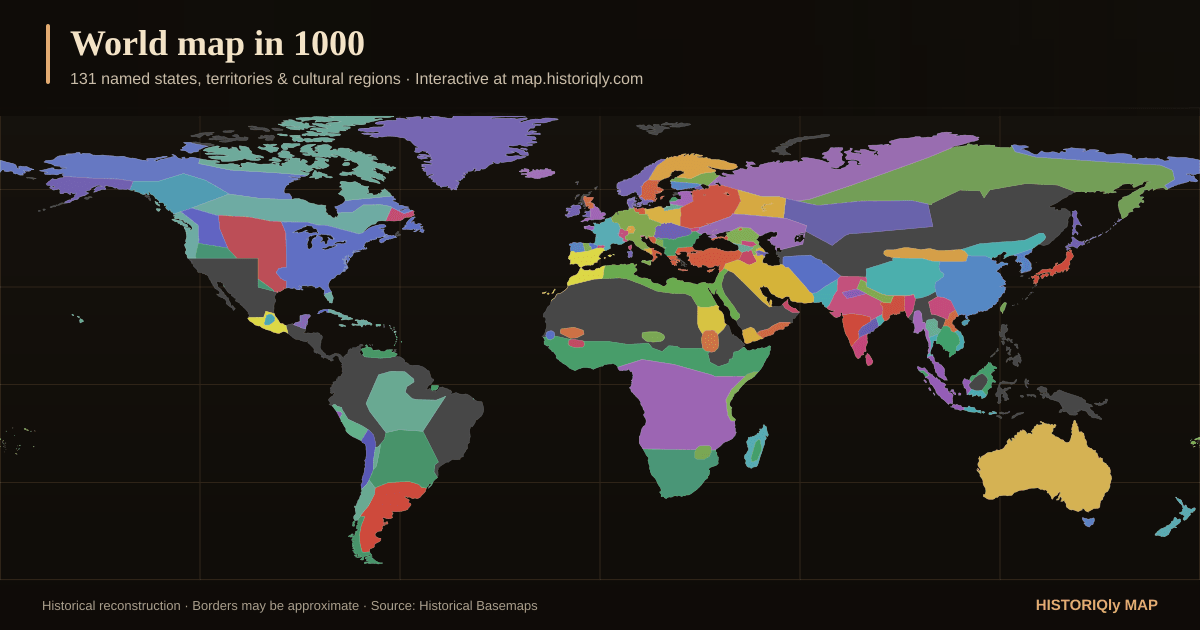
The interactive map lets you inspect named territories in 1000 and compare them to earlier or later snapshots on the timeline.
Medieval historical map
Explore a reconstruction of the world around 1000. Explore caliphates, dynasties, kingdoms, and trade networks across Afro-Eurasia. Figures near this year include Hai Gaon, Ibn Sina, William the Conqueror.
Snapshot at a glance
Counts come directly from this snapshot and the historical layers available in HistorIQly Map.
These names are encoded in the boundary dataset. Inclusion does not settle disputed borders, sovereignty, spelling, or historical interpretation.
What this snapshot shows
The interactive map lets you inspect named territories in 1000 and compare them to earlier or later snapshots on the timeline.
Meet figures alive in, or close to, 1000 and move from political geography to the people connected to the period.
The related chronicles below provide long-form reading tied closely to the medieval period.
Conflicts connected to 1000
These editorial date ranges include 1000. Some records group intermittent campaigns or long-running conflict series, so inclusion does not mean continuous fighting in that exact year.
629 AD – 1180
Byzantine Empire vs Umayyad Caliphate, Abbasid Caliphate
Centuries of warfare between Byzantium and successive Arab caliphates. The Arabs besieged Constantinople twice (674–678, 717–718) but failed both times, with Greek fire proving decisive. The frontier stabilized along the Taurus Mountains for centuries.
Key battles and events: Battle of Yarmouk (636); First Arab Siege of Constantinople (674–678)
982 AD – 1471
Đại Việt (Vietnam) vs Kingdom of Champa
Centuries of warfare between Vietnamese and Cham kingdoms as Đại Việt expanded southward, culminating in the destruction of the Cham capital and the effective end of Champa as a major power.
Key battles and events: Lê Hoàn's invasion of Champa (982); Cham sack of Thăng Long (1371)
979 AD – 1005
Song Dynasty China vs Khitan Liao Dynasty
Series of conflicts between Song China and the Khitan Liao over the strategic Sixteen Prefectures, ending with the Treaty of Shanyuan and annual Song tribute payments.
Key battles and events: Battle of Gaoliang River (979); Liao invasion of 986
907 AD – 1125
Khitan Liao Dynasty vs Song China, Balhae, Jurchen Jin
The Khitan built a powerful dual-administration empire controlling northern China and the steppe, forcing the Song dynasty to pay annual tribute before being overthrown by the Jurchen.
Key battles and events: Conquest of Balhae (926); Treaty of Shanyuan (1005)
900 AD – 1168
Toltec Empire vs Chichimec invaders, rival Mesoamerican states
The Toltec Empire, centered at Tula, dominated central Mexico through military conquest before being overthrown by Chichimec invaders — their warrior legacy deeply influenced the later Aztec civilization.
Key battles and events: Toltec conquest of central Mexico (c. 950); Fall of Tula (c. 1168)
860 AD – 1240
Kievan Rus' princes vs Byzantine Empire, Pechenegs, Cumans, Mongols
The Rus' state expanded from Viking origins into a major European power, warring with Byzantium and steppe nomads before fracturing into rival principalities conquered by the Mongols.
Key battles and events: Siege of Constantinople (860); Sviatoslav's Balkan campaign (968–971)
802 AD – 1431
Khmer Empire vs Champa, Dai Viet, Ayutthaya
The Khmer Empire dominated Southeast Asia from Angkor for six centuries, waging wars against Champa, Dai Viet, and eventually Ayutthaya. The Thai sack of Angkor in 1431 ended the empire and forced the capital's relocation to Phnom Penh.
Key battles and events: Cham sack of Angkor (1177); Jayavarman VII's counter-offensive (1181)
800 AD – 1000
Chichén Itzá vs Cobá vs Yaxuná vs Uxmal and the Puuc cities
During the Terminal Classic, Chichén Itzá rose to dominance in the northern Yucatán, defeating rivals such as Cobá and absorbing Puuc polities while the southern Maya lowland cities collapsed.
Key battles and events: Abandonment of Uxmal and the Puuc sites (c. 950 CE); Chichén Itzá conflict with Yaxuná (c. 900 CE)
Historical figures near 1000
Babylonia (modern Iraq)
939 CE – 1038 CE
Gaon of Pumbedita, master of Talmudic law, author of nearly one thousand responsa, last and greatest of the Geonim
Persia / Central Asia
c. 980 CE – 1037 CE
Author of the Canon of Medicine, philosopher of the Islamic Golden Age, synthesiser of Greek and Islamic medical tradition
Normandy & England
c. 1028 – 1087
Conquering England at the Battle of Hastings, ordering the Domesday Book, and transforming English society, language, and law
Khorasan / Seljuk Empire
1058 – 1111
Critique of Aristotelian philosophy, synthesis of Sufism with orthodox Islam, Revival of the Religious Sciences
Egypt & Babylonia
882 CE – 942 CE
First systematic Jewish philosopher, translator of the Torah into Arabic, Gaon of Sura
Rayy / Baghdad / Persia
c. 854 – 925
First clinical distinction of smallpox from measles, empirical medicine, alchemy, critique of Galen's humoral theory
Landmarks standing in 1000
Sites already standing (or still being used) in 1000, drawn from the map's landmark layers.
Built 1000 · Africa
Tellem cliff settlements developed from around the eleventh century; later Dogon communities added dwellings, granaries, and shrines.
Built 1000 · Asia
Major spice trading port on India's Malabar Coast
Built 1000 · North America
A 54-acre Mississippian ceremonial center in Georgia featuring three large platform mounds, considered the most intact site of its kind in the southeastern United States.
Built 1000 · Europe
Maritime republic rivaling Venice for control of Mediterranean trade
Built 1000 · North America
Only confirmed Norse settlement in North America, proving Viking exploration of the New World five centuries before Columbus
Built 1000 · Oceania
Most sacred marae in Polynesia on Raiatea, spiritual centre of the Eastern Pacific
Related chronicles
Babylonia (modern Iraq) · Philosopher
The Last Light of Babylon
The last and greatest of the Geonim — the scholar who answered questions from Jews across four continents, shaped the foundations of Jewish law for a millennium, and whose death in 1038 ended five centuries of Babylonian Jewish supremacy.
Read Hai GaonPersia / Central Asia · Scientist
The Prince of Physicians
The Persian polymath who wrote the Canon of Medicine — a million-word medical encyclopedia that remained the standard textbook across two continents for six centuries — while fleeing political persecution, serving as vizier, surviving imprisonment, and writing one of the most ambitious works of philosophy since Aristotle.
Read Ibn SinaNormandy & England · Conqueror
The Bastard Who Took a Kingdom
The illegitimate son of a Norman duke who survived childhood assassination attempts, crossed the Channel with six hundred ships, and won England in a single day of battle — then changed its language, law, and landscape forever.
Read William the ConquerorKhorasan / Seljuk Empire · Philosopher
The Proof of Islam
The scholar who silenced the philosophers, survived a spiritual collapse, and wrote the most influential Islamic text after the Quran — told in his own words.
Read Al-GhazaliBoundary source and context layers
Boundary geometry is adapted from Historical Basemaps, a GPL-3.0 project built for world- and continent-scale historical mapping. The source is a work in progress: pre-modern territories can overlap, borders are often disputed, and a snapshot should be read as a reconstruction around 1000, not as survey-level fact.
The source marks 264 of 264 geometries in this snapshot as approximate.
Conflicts, landmarks, trade routes, and biographies come from separate HistorIQly editorial datasets. They provide discovery context but do not yet expose a citation for every individual record; verify a specific claim with specialist sources before citing it.
Frequently asked questions
The 1000 source snapshot reconstructs political borders, territories, and named states for around 1000. You can inspect individual territories, view linked historical figures, and compare this snapshot with nearby years like 800 AD and 900 AD.
HistorIQly records whose date ranges include 1000 include Byzantine–Arab Wars, Champa–Đại Việt Wars, Song–Liao Wars, Khitan Liao Wars, Toltec Wars. Long-running entries may represent intermittent campaigns rather than continuous warfare.
Figures linked near 1000 include Hai Gaon, Ibn Sina, William the Conqueror, Al-Ghazali. Some were alive in this year; others are included because their lives fall within the surrounding historical period.
HistorIQly Map includes 49 historical snapshots spanning from 3000 BC through the modern era, covering the medieval era and every other major period of world history.
Example labels encoded in the 1000 source snapshot include Denmark-Norway, Song Empire, Tibet, Buwayhid Emirates, Fatimid Caliphate, Rajput Kingdoms. These labels and reconstructed boundaries can be approximate or disputed; inspect the map methodology before using them for research.
Nearby years
Related map topics
Historical maps by year
Choose from 49 historical world maps by year. Explore borders, empires, wars, landmarks, trade routes, and people from 3000 BC to the modern era.
Medieval history map
Explore medieval world maps with kingdoms, caliphates, dynasties, trade routes, landmarks, wars, and border changes across Afro-Eurasia.
World history atlas
Browse an interactive world history atlas with maps of empires, wars, trade routes, landmarks, and influential figures from ancient history through the modern era.